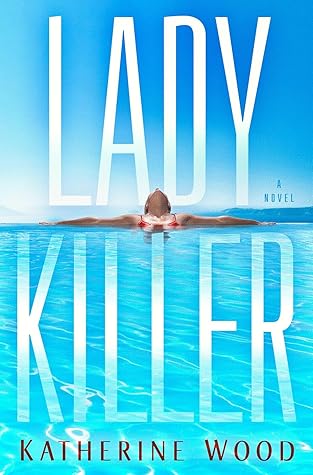
Lady Killer, by Katherine Woods***-****

Lady Killer marks the debut of novelist Katherine Wood. The suspense begins when Abby flies to Greece at the invitation of her best friend, an heiress named Gia, who is planning a birthday party there. Gia has disappeared, and it is her journal that provides clues as to what may have happened. Suspicion falls on her husband because of things that are indicated in the journal, but he’s gone, too.

My thanks go to NetGalley and Random House for the invitation to read and review. This book is for sale now.

It is clear from the get-go that Wood can write. Her word smithery is smooth and original. However, there is so much sexual content that I can’t enjoy the story or bond with the main characters. Partner swapping; threesomes. I finally gave myself permission to skim the rest. Unlike some other reviewers, I have no difficulty with the ending; it’s getting there that makes me queasy.

For some readers, the steamy segments of this novel will make it more pleasurable, but the only perspective from which I can write is my own.

Recommended to those that like a sexy novel of suspense.

The Book of Fire, by Christy Lefteri****

My thanks go to NetGalley and Random House Ballantine for the invitation to read and review. I found myself drawn to this novel because it’s different from everything else I have read. I’m fairly sure that I have never read a book set entirely in Greece; then there’s the fire, and the way that the forest interacts with the rural community living in and around it; many people have relied upon it, in one way or another, to make a living.  The Book of Fire is an interesting read, and it’s available to the public now.

Having said this, my first 25% or so of the story finds me with buyer’s remorse (or, reader’s remorse?) The thing is sorrow, grief, and more sorrow. I begin to think maybe I’ll abandon it, because eventually one disengages when there’s no hope of any kind for a brighter outcome. But just as these thoughts begin to crystalize, there is a subtle shift, and then the whole thing becomes more toothsome.

The story is told in alternating timeframes, with the current day being told to us in the first person, while the past is told as if it is a fairytale, and so in it, our protagonist, Irini, is referred to most of the time as “the mother,” her spouse is “the husband,” and their child is “the girl.” It took me a long time to figure out the protagonist’s name, but then there is dialogue, and that helps.

Initially, the protagonist confides to us what she has done. She found the arsonist in the burnt forest; he was on the ground beneath a tree with a rope around his neck. The branch above him is broken, so it’s either a botched lynching or a botched suicide, but not entirely botched, because he’s in bad shape. She begins to try to help him, but then she remembers what he has done, and she walks away from him. When she returns the next day, full of remorse, he’s dead. And so already we have this fact thrown in there along with the man’s own crime. We don’t know whether he did this or it was done to him until nearly the end.

In time more details emerge to muddy the waters of responsibility, so then she has a hundred little ethical questions to examine, and these are joined with a powerful environmental message. Because of this, I think this novel would be terrific for book clubs, and also for the high school classroom. There’s no sex in it, and the vocabulary is accessible. And despite my early fears, the entire book is not a portrait of grief and misery.

Recommended to those that enjoy literary fiction.

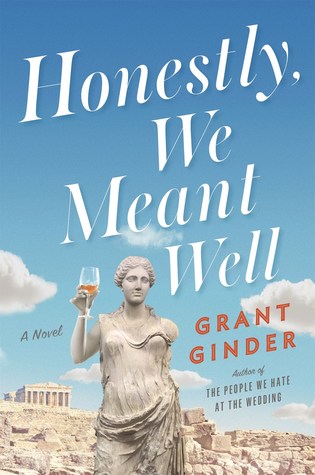
Honestly, We Meant Well, by Grant Ginder****

“All art is appropriation.”

Sue Ellen Wright is a professor of Greek classics; she’s headed for Greece to deliver lectures and reminisce about the experiences of her youth. At the last minute, her philandering husband Dean and the couple’s lovesick son Will decide to tag along. Grant Ginder has made a career of writing hilarious prose about disastrous families, and Honestly, We Meant Well made me laugh out loud more than once.  Thanks go to Net Galley and Flatiron Books for the review copy. This book is for sale now.

The book opens as Sue Ellen is conferring with a freshman who’s come to her office to challenge his midterm exam score:

“’I’m pretty sure I got this one right.’

“Connor points to a picture on his midterm…it’s an artifact that he was meant to identify.

“’That’s not a bong, Connor. That’s a Corinthian urn from the fifth century B.C.E…’

“But can’t you see how it could have been a bong?’

“’No,’ Sue Ellen says, ‘Actually, I can’t.’”

Teachers, are you experiencing flashbacks here? And those of you that aren’t teachers can appreciate that Sue Ellen needs a break, one that takes her as far away as possible. Her bags are packed.

Dean is a professor as well, and he’s a celebrated one. As the writer of a bestselling novel, The Light of Our Shadows, he is permitted to cherry-pick which students may enroll in his seminars. He knows he ought not to have sex with any of them, but they’re so insistent; and why shouldn’t they be? He’s a genius. At the moment, though, he’s a genius with writer’s block, and he thinks a Grecian holiday might just be what he needs; it will strengthen his marriage and get his creative juices flowing as well.

Will is a student, but who can chart a course, academic or otherwise, when his heart has been shattered? His boyfriend broke up with him and has instantly turned up on Instagram with kissy-face photos of himself with his new squeeze. It’s humiliating. It’s horrifying. Worse: everyone is liking those photos. Meanwhile, he has committed an unforgivable academic sin, one he’s desperate to keep his parents from learning.

Ginny Polonsky works at the university, and she knows where the bodies are buried. Readers know what Ginny knows—well, most of it anyway—and as the family unknits itself and copes with one unforeseen event after another, we are waiting for Ginny’s other shoe to drop on them. It’s immensely satisfying when it does.

There’s not a lot of character development here, but not much is needed. I believe each of these characters, which are written with admirable consistency. The prose is tight and the resolution surprises me. I would read this author again in a heartbeat.

The Wrights are Caucasian and middle class, and this is the demographic most likely to enjoy this book. It’s just the thing to toss into your suitcase or carry on when you’re headed on a trip of your own.