Fever Beach, by Carl Hiaasen**-***

What happened? I used to absolutely love novels by Carl Hiaasen. In his most recent release, Fever Beach, we see a conflict between good—in the person of our main character, Viva Morales—and evil, played by a variety of Proud Boys wannabees and other undesirables. The good person is always good; the bad guys have no redeeming qualities. Only Viva’s ex-husband is a dynamic character.

Still, my thanks go to Doubleday and NetGalley for the review copy. This book is for sale now.

As I read, I keep reminding myself that this is not a book I’m supposed to take too seriously, to lighten up and just roll with it. I certainly used to do so when reading Hiaasen’s work. But perhaps because of the stereotyping and complete lack of nuance, what might otherwise have seemed droll and satirical, instead comes across like a whole lot of cheap shots fired off the bow.

Mind you, I am certainly not a fan of ultraright organizations, and the rising tide of bigotry, fascist ideology and anti-Semitism concerns me greatly. But in an already highly polarized nation and world, all I can think as I read is that this story isn’t helping. It is the snobbery and elitism of the highly educated that has driven a large number of folks into the arms of extreme right; some intelligently reject the elitism and cancel culture consciously, but they aren’t in this book. In real life, those that are poorly educated and/or intellectually handicapped, as the bad guys in this book are, would in most cases give their right arms to wake up “clever” like Viva.  It strikes me as counterproductive to write a book that makes fun of right-wing intolerance, while practicing intolerance from a different angle.

Back in the day, before anyone judged anyone else by the color of their hat, I used to roar with laughter at this author’s work. Did it change, or did I? I would like to think it is the former.

I rated this book 2.5 stars and have rounded it upward, more from a fondness of his early novels than anything else. I do recall reading another of his more recent books—not for review, but just because I felt like it—and saw some of the same problems, so I will tell you that this book will probably work for you if you enjoyed his last one. Apart from that, I cannot recommend it.

Overkill, by J.A. Jance*****

Overkill is the 18th book in the Ali Reynolds series. Ali and her husband, B. Simpson, run a cybersecurity firm. This mystery features two parallel problems. The first is when B’s first wife, Clarice, is accused of a murder that she didn’t commit. B. wants nothing to do with the problem—or Clarice—but Ali is convinced that she should look into it. The second problem is that Cami, the young woman that works for Ali and B., is being stalked while on a business trip. Both problems create a tremendous amount of suspense for the reader, and Jance is an expert at juggling many threads and details without dropping anything, while making the story clear enough that the reader can keep track. I enjoyed this book a great deal, and it’s for sale now.

My thanks go to NetGalley and Gallery Books for the review copy.

One of the things I love most about reading a J.A. Jance mystery is the feminist mojo she brings to every book. It’s subtle and built into the plot, rather than reading like a manifesto, but her sympathies toward working women, both professionals like Ali, and humble housekeepers such as the woman accused here, is manifest. It’s not an unusual mindset to encounter in a novel these days, but Jance has been doing it since long before it was common. In addition, her pacing never flags, and I don’t get confused by her plot lines, even when there are a good number of characters to track.

This is the first time I’ve used an audio version to read any of Jance’s books; I had fallen behind a bit, so I checked out the audio to keep me company on a road trip. Karen Ziemba does a fine job with the narration. I highly recommend this book to those that love the genre; you can read it as a stand alone if desired.

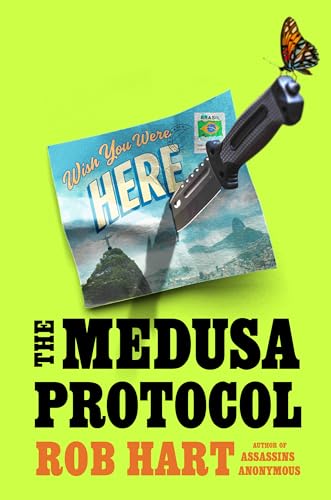
The Medusa Protocol, by Rob Hart****

“’I’m Mark, and I haven’t killed anyone in two and a half years,’ I say.    ‘Hi, Mark.’”


The Medusa Protocol is author Rob Hart’s second book in his Assassins Anonymous series. Happily for me, I didn’t notice that I was reading the second in a series; I didn’t read the first, and I might have sidestepped it had I realized I was entering mid-series. As it was, I had fun and enjoyed this satirical romp through a sea of professional murderers, sharks, and poisonous vipers.

My thanks go to NetGalley and Putnam Penguin for the invitation to read and review. This book is for sale now.

Our story commences with a group of recovering assassins meeting in a church basement. Then things start to go sideways; a member who’s expected isn’t there, but sends her personal choice of pizza to let them know she’s in trouble just as enemy assassins crash the meeting.

Huh? What?

From there, we dive down the rabbit hole, seeing the past and present alternately through the eyes of Mark, who is Astrid’s mentor in the program, and Astrid, a recovering killer who has been kidnapped and is being held in a Brazilian prison on an island in shark-infested waters, and which is home to a great many large, venomous vipers. How can her friends rescue her without having to kill anybody?

Just keep whispering the Serenity Prayer to yourselves, guys.

This is a fun read. Although the point of view shifts with every chapter, either between characters or time periods, these are clearly delineated, and I have no trouble keeping them straight. I only had the digital galley, not the audio, but I suspect that, assuming the reader provides the headings at chapter beginnings, it will be fine. The humorous moments when the rescuers worry about the mission threatening their sobriety are meted out exactly as they should be, not so many that it stops being funny, but frequent enough to keep me chuckling. There isn’t a lot of character development, but I don’t expect it from a satirical, action-packed novel like this one; there is some dialogue toward the middle that is overly wordy and should be edited down, but apart from that, it’s smooth as glass.

Some reviewers suggest not reading this one unless one has read the first; I am glad I didn’t see that advice till after I had read this one. I don’t care that this book provides spoilers for the first, because I am not going to read that one anyway. I will, however, cheerfully read the next in the series, whenever it becomes available. Meanwhile, I recommend this nifty little book to you.

What Kind of Paradise, by Janelle Brown*****

What if the Unabomber had had a daughter? Thriller writer Janelle Brown spins a fascinating, credible, and memorable story based on this idea. My thanks go to NetGalley and Random House for the invitation to read and review. This book is for sale now.

Jane Williams grows up in a remote mountain cabin with her father; her mother died many years ago, so it is just the two of them. Once in a rare while she is allowed to accompany him into town to visit the bookstore, maybe even get an ice cream cone, but otherwise, she is cut off from society. She has no friends, apart from a casual friendship with the bookstore owner’s daughter; she has no play dates, no television, no computer. She is homeschooled. 

But every now and then, her father will wake her from a sound sleep in the middle of the night. They have to go! She grabs her bugout bag and goes through their established routine, escaping via the tunnels he has built beneath their cabin. Her heart pounds, her chest heaves…but hey, it turns out to be only a drill, after all.

Her father is a writer, composing political tracts that he sells in small, independent bookstores that carry zines. And so, for most of each day, he writes, she reads, and when the weather permits, she watches ants build hills, picks wildflowers, and leads the sort of bucolic life he has planned for her. But then, things change.

The story is told from Jane’s point of view; when Jane longs for even a photograph of her dead mother, anything at all to tell her about the other half of her beginnings, I feel it viscerally. Poor kid. But things are not necessarily as they appear, and as she grows to adulthood, Jane finds clues, small tidbits she’s not meant to find, and each morsel leaves her ravenous for more.

The story unfolds in the 1990s with occasional flashes of Jane’s childhood the decade before, so while it’s not historical fiction, it does have a retro vibe, one that Brown provides with absolute accuracy. We see small snatches of the events that took place in the U.S. during that time, but Brown is too good to rely on pop culture, so these are meted out sparingly, only when needed, never as a crutch.

This is a fun read, and it’s unlike anything I have seen written recently. I highly recommend it to fans of the genre.

May the Wolf Die, by Elizabeth Heider***-****

“Sometimes, killing is necessary.”

Elizabeth Heider is a scientist with a long, impressive track record. Now she has published her first mystery, May the Wolf Die, as well, proving that some of us can wear multiple hats very well indeed. My thanks go to Penguin Random House and NetGalley for the invitation to read and review. This book is for sale now.

Our protagonist is Nikki Serafino, an investigator living in Italy. She’s out in her boat one day when she finds a man’s corpse, and from there we venture into local organized crime.

The mystery itself wasn’t as engaging as I had anticipated, given the buzz, but there are a few laudatory aspects nonetheless. First, Heider is a scientist, and often when someone is a specialist in some other field, they info-dump so much data into their novel that it loses its sheen. Heider’s restraint here is admirable. The unusual characteristic of the corpse, which I won’t disclose, appeared to be a gimmick that would take over the story, but it wasn’t and didn’t. The ending was solid. But the best and most important feature, the thing that elevates this mystery from three stars to four, is the punchy yet tasteful manner in which Heider deals with sexism and violence against women in the military. There are a couple of stand up and cheer moments that made me sit up and take notice.

This is a debut novel, and a promising start for Heider. I wish her well in her new career.

Far and Away, by Amy Poeppel****-*****

Amy Poeppel is the queen of intelligent feel-good novels. Her newest work, Far and Away, is about two women that have never met, one in Dallas, one in Berlin, who exchange houses for several months. The deal is done fast, as both of them have a short time to line something up, and soon they will both regret their hasty decisions.

My thanks go to NetGalley and Emily Bestler Books for the invitation to read and review. This book is for sale now.

One of the things I love best about Poeppel’s writing is her ability to create a complex plot with a lot of moving pieces, along with believable, sympathetic characters; yet somehow, the whole thing is easily understood, never confusing. Our story starts with Lucy and her family in Dallas, Texas. Her eldest child, Jack, is about to graduate from a private high school, then attend M.I.T. At the last minute, however, he is expelled unceremoniously. He’s done something dumb, and it’s been interpreted as something more sinister. He isn’t even offered a chance to explain or to defend himself. And though there is a lot of other business involving other characters, I enjoy this part most for the message it sends us at a time it’s desperately needed. Before you judge someone, take a moment to listen. Ask some questions before you hurl accusations and seek vengeance. If the behavior is as deplorable as you think it is, there’s still plenty of time to accuse and avenge afterward.  We in the U.S. and also Europeans can benefit from this one tasty nugget. Plenty of others can, too.

On the other side of the world in Berlin, Greta’s husband Otto has been invited to teach for a term at a college in Texas. He’s accepted without even discussing it with Greta; he has to go right away! Where will they even live? Otto suggests a hotel; Greta is having none of it. In her desperate search for last minute housing, she is connected with someone that knows that Lucy has decided, quite suddenly, to relocate for the summer. The accusations against Jack have turned to harassment and vandalism, and she’s ready to get out of Dodge. Her husband is incommunicado, performing a simulation for NASA, a part of which is to be cut off from everyone else. Mason still thinks that Jack graduated, and that M.I.T. is Jack’s next step.

And so it is that Lucy and her brood relocate to Greta’s apartment in Berlin, and Greta and Otto take up residence in the massive experimental home in Dallas owned by Lucy and Mason. Not a lot of details have been exchanged about either place; there hasn’t been time. So, they get on the plane, and everybody gets what they get, to their sometimes consternation.

There are many hilarious moments here; I especially enjoy the foreign language errors made, both English to German, and German to English.

If there were one thing I could change, I’d rework the epilogue. There’s a considerable jump in time, but the chapter heading doesn’t tell us, and so I am taking in details while doing some mental calculations. That’s not so bad when it’s at the start of a book, but at the end, it’s disorienting and breaks the flow. I also feel as if there were too many things tied up with too many bows. A kindergarten teacher told me once that the key to having a kindergartner paint, was to know when to stop them. It may also apply to adults and their writing.

Nevertheless, I loved this book! Part of the magic is due to Poeppel’s understanding of human nature, which is inherently good, and part of it is her hilariously quirky humor that often drops in, seemingly out of nowhere. Highly recommended.

Lady Killer, by Katherine Woods***-****

Lady Killer marks the debut of novelist Katherine Wood. The suspense begins when Abby flies to Greece at the invitation of her best friend, an heiress named Gia, who is planning a birthday party there. Gia has disappeared, and it is her journal that provides clues as to what may have happened. Suspicion falls on her husband because of things that are indicated in the journal, but he’s gone, too.

My thanks go to NetGalley and Random House for the invitation to read and review. This book is for sale now.

It is clear from the get-go that Wood can write. Her word smithery is smooth and original. However, there is so much sexual content that I can’t enjoy the story or bond with the main characters. Partner swapping; threesomes. I finally gave myself permission to skim the rest. Unlike some other reviewers, I have no difficulty with the ending; it’s getting there that makes me queasy.

For some readers, the steamy segments of this novel will make it more pleasurable, but the only perspective from which I can write is my own.

Recommended to those that like a sexy novel of suspense.

Cat’s People, by Tanya Guerrero****

Cat’s People marks author Tanya Guerrero’s debut in writing a novel for adults, and she does it beautifully. This heartwarming feel-good story tells the story of five people in Brooklyn that are brought together by a stray cat in the neighborhood. My thanks go to NetGalley and Random House Ballantine for the invitation to read and review. This book is for sale now.

When I first received the call to read this book, I was leery. That pink cover with a cat on it; I thought it might be cloyingly sweet. I let the widget sit in my file for a while. However, Goodreads friends—people that are not dimwits—really liked it, and it occurred to me that my own selections were a little on the dark and heavy side, so I went back and retrieved it. It was a good choice. Because I was running a little late with it, I checked out the audio version from Seattle Bibliocommons, and it made a delightful travel companion when I found myself driving across the state line for a semi-emergency within my family. Even Ox, my oversized beagle, seemed to find it soothing. Reader Elena Ray does a wonderful job.

I’m not entirely sure whether the protagonist here is Nuria, the woman that volunteers for a local group that feeds stray cats in the neighborhood, or Cat himself; this would make a nice book club discussion question. Nuria is single and a bit at sea in New York, the city where her mother told her not to move. However, she begins finding post it notes in the area where she feeds Cat; they are from a secret admirer.

The admirer in question is Collin, a successful author who’s also single, lonesome, and very shy. Collin sees Cat outside in the cold, so he builds him a small house with a bed, and he puts it in his courtyard. Others in Cat’s orbit are Omar, the mailman who’s going through a crisis of his own; Bong, the owner of Nuria’s favorite Bodega, who’s grieving the loss of his wife; and Lily, the sprightly newcomer who’s come to the city to find Nuria. All of them are brought together when Cat becomes ill.

I have never said this about a novel for adults before, but this book is adorable! The tone is perfect, balancing the cares and anxieties of the humans with acts of kindness by each that remind us that humankind is inherently good.

Recommended to those that need something a little bit warm, light, and fluffy–even dog people.

Broken Country, by Clare Leslie Hall*****

I am late to the party, but it would be a crime not to review Broken Country, the stirring love story by Clare Leslie Hall that can make even the hardest cynic weepy-eyed. My thanks go to NetGalley and Simon and Schuster for the review copy. This book is for sale now.

The story is set in a small village in Britain during the mid-1900s. The setting bounces back and forth between the present day and the past; it’s easy to keep track of, partly because the author takes care to delineate which chapter is which, and partly because there are few characters to keep track of. Our protagonist is Beth, and she and her husband, Frank, are farmers, have lived in the same community for their whole lives. A farm accident claimed the life of their only child, Bobby, a few years before, but they are both still fragile, ragged in their grief.

Then, oh my my, who comes back to town but Beth’s old flame, Gabriel, a man that came from money and went on to make a name for himself as a novelist. Gabriel has inherited the family house and land, and in the wake of his divorce, has brought his son Leo to live here. Here. Right next door to Beth and Frank.  And to complicate old feelings all the more, his son Leo is about the same age as Bobby was when he died.

Is it possible to be in love with two men at the same time? Beth would tell you that it is. Frank can see what is unfolding, and he tries to reason with Beth, but she assures him that everyone is grown up now, the past is the past, and there’s no reason that they and their new old neighbor cannot be friends.

Well.

I seldom reach for novels like this one, wary as I am of schmalz and schlock, but reader, I see none of either one in this story. The writing is disciplined and restrained, yet oh, so intimate. When a formula or trope comes into view, Hall goes the other way instead. And though I may have thought I knew where we would all end up, I was mistaken; the ending is beautifully planned and executed.

Because I had fallen a bit behind, I checked out the audio version from Seattle Bibliocommons; reader Hattie Morahan does a stellar job with the narration.

Highly recommended.

Everybody Says It’s Everything, by Xhenet Aliu**-***

2.5 stars, rounded upwards.

Xhenet (pronounced similar to “Jeanette”) Aliu is the author of Brass, the award-winning debut novel that was one of my favorites of 2018. When I saw that she had a new book, Everybody Says It’s Everything, I was so excited that I bounced up and down in my desk chair. My thanks go to Random House and NetGalley for the invitation to read and review; sadly, I found this book disappointing. The sophomore slump is real, friends.

Our story centers—to the extent that it has a center—on adopted twins, Drita and Pete, who’ve been leading quintessential American lives. Drita was a star student, and is in the midst of graduate studies when she is called home to care for her mother; Pete—actually Petrit—has been in various sorts of trouble, and now his girlfriend and son have landed with Drita looking for help, since they aren’t getting any from Pete. The story takes us through their native Albanian roots and heritage, through the war in Kosovo, and through Pete’s discouragement, hardship, and addiction.

I have a hard time connecting with any of these characters. The dialogue drags, and the poignant qualities that I found in Brass are nowhere to be found. Both are sad stories, but the protagonist in Brass had my whole heart and my full attention, whereas these characters left me feeling as if I was eavesdropping on one more group of depressed, underserved people, but also edging towards the door. I was just straight up bored, a word I rarely use in reviews. I continued all the way through because I was sure that it would turn brilliant any minute; it never did.

I look forward to seeing what this author writes next, because she has proven that she has the ability to connect with readers in general and me in particular, but I can’t recommend this book to you.