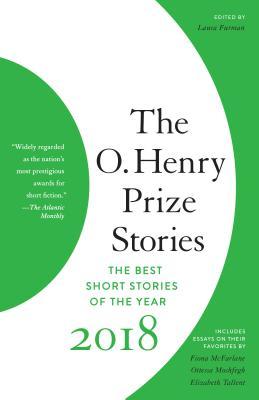
The O Henry Prize Stories 2018, by Laura Furman, editor*****

TheOHenryPrize2018This collection is guaranteed to be good, and I was thrilled when I received a review copy, thanks to Net Galley and Doubleday. Those that enjoy strong fiction should buy it and read it, even if you have to pay full jacket price. This year’s edition holds 20 prize winning stories along with a bit of judging commentary at the end. This book is now for sale.
The first story in any short story collection is bound to be good, and so I knew that Joanne Beard’s Tin House would be strong, and it is, in a dark, surreal way. I wouldn’t read it at bedtime lest it enter my dreams, but it’s memorable, original, and gritty. I also enjoy Brad Felver’s Queen Elizabeth, and Past Perfect Continuous, by Dounia Choukri. My favorite of all of them, the one that made me laugh out loud, is Why Were They Throwing Bricks, by Jenny Zhang, a story that features a cagey, manipulative Chinese grandmother and the grandchildren whose lives she enters, leaves and reenters. Zhang appears to have mostly published poetry up to this point, but I hope she writes more fiction, because I want to read it.

The only aspect of any short story that I don’t enjoy is the open-ended sort that conclude with no real resolution. This screamingly frustrating inclination is minimal here, showing at the ends of a just a couple of the featured stories.

Short stories are terrific to leave, once you’ve finished them, in your guest room, because people that stay with you briefly can read a story or more without the frustration of having to either leave an incomplete novel behind or beg to borrow it, not knowing when they can return it. If you need an excuse to get this excellent collection for yourself, there it is.

Highly recommended.

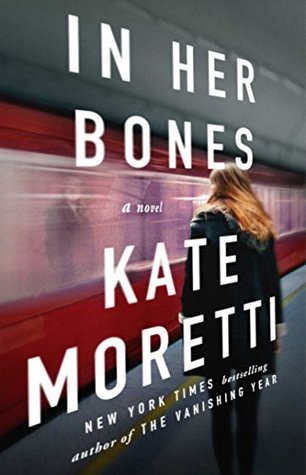
In Her Bones, by Kate Moretti****

InHerBonesMoretti’s mysteries are addictive, and when I found this galley in my email, I jumped it to the front of the queue. Big thanks go to Net Galley and Atria for letting me read it free and early. You can buy it now.

Edie is an outcast, spurned by her friends when her mother Lilith is arrested as a serial killer. Since it is so rare for a serial murderer to be female, the press is everywhere; meanwhile, all Edie has left is her brother Dylan and later, his young family. Otherwise, the people to whom she feels most closely bonded don’t know Edie, don’t realize that she is watching them, obsessing over them in person and in cyberspace; they are the bereaved family members of Lilith’s victims. It gives me chills.

One day Edie takes her voyeuristic tendencies to the next level; when the man she’s been stalking is found dead, police immediately suspect Edie of being his killer. And as we read Edie’s narrative, which tells us some things but not everything, we wonder too: is Edie a lonely, isolated young woman searching for connection to another human being; or is she a chip off the old block, a stone cold killer just like her mama?

The first person narrative alternates with a third person study of Lilith, and so the voice switches from Edie’s very personal story to a clinical, dry report regarding her aberrant mother. (Let me tell you, whatever issues you may have with your own mother—she’s going to seem like the mother of the year once you’ve read this.)

I’ve read a few unhappy reviews by online friends. but I like this book. It helps if you approach it as a mystery rather than a thriller; those in search of a grab-you-by-the-hair page-turner may not get what you’re looking for, but I wanted an interesting story with an original premise and a credible ending, and this is that. In addition, the third person case notes written by social workers and their ilk ring true to me. In fact, I made a wry note to myself, wondering whether Edie or Dylan might have been in one of my classes; I have never taught the children of a serial killer to my knowledge, yet the wanton neglect and lack of nurturance, even a simple effort to provide the basics eludes Lilith in a way that seems familiar. You think I am exaggerating? Not so much. There are terrific parents; there are indifferent parents; and there are, I am sad to say, more than a few Lilith Wades out there in the parent pool.

This is my third galley by this writer. Whereas I liked The Blackbird Season a little more than this one, mostly because of its amazing word smithery, I find this story more original and memorable than The Vanishing Year, which has the sort of denouement that makes me roll my eyes. Here Moretti pulls the ending together in a way that keeps me thinking about the characters rather than the author, and I sigh with appreciation when it’s done.

All told, it’s a solid mystery with a satisfying conclusion. Recommended to all that enjoy the genre.

Across the Great Lake, by Lee Zacharias***

AcrosstheGreatLakeI received this book free from Net Galley and University of Wisconsin Press in exchange for this honest review. It will be available for purchase on September 18, 2018.

Conceptually this story has great promise.  The Great Lakes are where important American naval battles have taken place, and yet very little fiction is set there. This reviewer lived near Lake Erie for most of the 1980s, and I thought this novel would be a sure fire winner.

An elderly woman is looking back at her life, and the story starts with her earliest memories, when her parents separate and her father, a sea captain, takes her from her unstable mother and the girl goes to sea with him. Sailors mutter dark things. There’s a ghost ship that the crew speaks of ominously.

Zacharias nails Fern’s developmental stages, which is critical for anyone writing about a child, particularly if that child is going to voice some of the narrative. Failing to do so breaks the spell entirely, and I am cheered when I see it done correctly. There’s also a great deal of painstaking historical and nautical detail here. As a history teacher I appreciate it, and I learned some things.

Sadly, the character feels weighted down by the setting instead of developed by it. I never feel as if I know the protagonist, but rather as though the author has a great deal of research done and is going to use as much of it as is humanly possible. I pushed my way through it until just before the halfway mark, and then I abandoned ship.

Where the Crawdads Sing, by Delia Owens*****

wherethecrawdadsKya Clark lives with her family in a shack deep in a North Carolina marsh.  The year is 1969. They are miserably poor, but Kya’s mother tells her it will be alright, as long as the women of the family stick together. But then one day, she leaves. Older brother Jodie tells Kya that Ma will be back, because it isn’t in a mother to leave her children, but Kya isn’t so sure. Ma is wearing her alligator heels, and she doesn’t turn midway and wave like she always has. And one by one, everyone in her family leaves, and they don’t return. Kya is not even old enough to enter first grade, and she is alone.

This haunting novel is the best surprise of the summer, and it’s for sale today. Thanks go to Net Galley and Putnam Penguin for the review copy.

Owens is a wildlife scientist of some renown; here she changes lanes with her debut novel. She uses her knowledge base to create an evocative setting that is real and immediate, but she never adds scientific information at the expense of pacing. Instead, the setting is used to reinforce Kya’s character; this is unusual in a researcher turning toward fiction writing. Professors and other specialists tend to shoehorn in every fact that they think the reader ought to know regardless of what it does to the flow of the narrative. Instead, Owens blends setting and character seamlessly, spooling Kya’s life before us with the patience and discipline of the finest master storyteller.

Kya barely survives, digging mussels to eat and selling them at a waterside convenience store owned by an African-American entrepreneur known as Jumpin’.  Little by little, Jumpin’ comes to realize exactly how dire this child’s situation is, and he and his “good sized” wife, Mabel, contrive to provide her with a few of life’s necessities without frightening her or hurting her pride. I would have preferred to see these resonant characters voiced without the written dialect, but there are no stereotypes in this book.

Tate is an older boy that has been a family friend since she was tiny, but she doesn’t remember him, and thinks she is meeting him for the first time after he begins leaving her beautiful bird feathers on a stump in the swamp. It is he that teaches Kya to read, and he becomes her first love.

The narrative shifts between Kya’s life and an investigation of a murder. Chase Andrews, a local football hero and the son of a local bigwig, is found dead at the base of a nearby water tower. Kya, who is poorly groomed, impoverished, and has no family to protect her becomes the focus of the investigation. Townspeople have long considered her to be “swamp trash,” and this discrimination is age old; Kya can remember her mother telling her that she must never run when she goes into town, because if she does someone will say that she stole something.

One of the most appealing aspects of this novel is that the mystery of Chase’s death never eclipses the main story. The book isn’t about Chase or his demise; it’s about Kya in the marsh, and as she becomes an official suspect, we only want what is best for her.

I read several stories at a time, now that I am retired, but this is the one that occupied my thoughts when I was doing other things. I kept thinking about that poor little girl out there. I can almost always put a book down; it’s what I do, after all. This one is exceptional.

Those that love excellent literary fiction; Southern fiction; or romance need to get this book and read it, even If you have to pay full jacket price.


Lake Success, by Gary Shteyngart****

Lakesuccess“’All I know is I never had any advantages,’ Barry said. ‘I wasn’t even lucky enough to be born to immigrant parents.’”

Schteyngart’s wry new novel takes a swift kick at the funny bone of the American ruling class. My thanks go to Net Galley and Random House for the review copy.

Barry grew up as the son of the pool guy, the man that serviced the swimming pools of the wealthy. Now between one trade and another—some of it inside, some of it legal—he has become one of the wealthiest men in Manhattan. His entitlement and vast privilege rubs up against his flimsy social conscience; meanwhile he tries to avoid coming to terms with his two-year-old son’s Autism. (When the children of the very rich are Autistic, it’s referred to as “on the Spectrum.”) His midlife crisis comes to a head when rumblings suggest he may be held accountable for his dubious business practices, and with his marriage teetering on the brink and the law breathing heavily down his collar, Barry flings himself onto a Greyhound bus and rubs elbows with the hoi polloi. Obsessed with becoming a mentor to someone with brown skin, Barry takes his rolling case of impossibly expensive wristwatches and embarks on a series of failed friendships and romances as he hurls himself due south and then west to San Diego. Who knows? Maybe he will even start an urban watch fund so that children that live in poverty can learn to appreciate fine timepieces.

Humor is a hard field for many authors. Some get stuck on a single joke, which is funny at the outset but tired by the end of an entire novel; others simply bomb, and unlike stand-up comics, the bad humor is enshrined forever in published form. So I approach humorous novels cautiously; but Schteyngart is no novice, though he is new to me, he has a good sized body of humorous work before this. The result is smooth and professional, but also original and at times laugh-out-loud funny.

The ending is brilliant.

This book will be available September 5, 2018.

Foundryside, by Robert Jackson Bennett***-****

Foundryside RD4 clean flat3.5 rounded up. This title is the first in a new series. Those that love fantasy, and especially those that already enjoy this writer’s work will want to check it out. My thanks go to Crown and Net Galley for the DRC, which I received free and early in exchange for this honest review. Bennett comes to this project with a list of awards as long as your arm, so I was excited to read him. I probably would have been more impressed by this book if there hadn’t been so much build up. Still, it has a lot going for it. It will be released August 21, 2018.

The fictional city of Tevanne in which this story takes place is even more polarized than the developed world of today; there is a walled city in which the haves get everything and live in tremendous luxury, and then we have The Commons, where not only is there no law enforcement or legally held private property; in fact there are no laws at all. This is where the dispossessed try to stay alive. Our protagonist is Sancia, a thief that has been commissioned to steal a valuable artifact. Buildings speak to Sancia through her hands, so when she doesn’t want to be distracted or drained, she must wear gloves. The technology of the time is scriving, a magical method similar to artificial intelligence on steroids, and this dominates the plot. Sancia discovers Clef, a key that is scrived, and Clef becomes her sidekick.

The story starts out with a lot of noise, but not much of substance takes place; we have scriving, and we have a lot of chasing, running, hiding, climbing, jumping, running, fighting, running some more and…well, you get the idea. I generally prefer a more complex plot along the lines of Stephen Donaldson or Tolkien, but I was glad I stayed with it when I saw where it ended up.

I am pumped to have a series that has a strong female protagonist, and here we also have a female villain. I would be even more pumped if rape were never even mentioned. I read an interview years ago with movie director Jodie Foster, who said that working with male writers, directors and producers was frustrating, because so few of them were able to imagine motivation for a female character without landing there. Why would this character do [whatever]? Why, she must have been raped. It was rape. She’s afraid of rape.

Still, after all of the scriving, running, chasing, hiding, fighting and fleeing, we come to an ethical quandary that makes it worth the wait. And of course, the series is still in its infancy, so it’s fun to get in on the ground floor.

Bennett’s fans will be delighted, and those that love fantasy should consider adding this book to their queue.

The Lido, by Libby Page***-****

thelido3.5 stars rounded up. My thanks go to Simon and Schuster and Net Galley for inviting me to read and review this charming debut. This book is for sale now.

Kate is a journalist, painfully shy, anxious, and lonely. Rosemary is an elderly widow. When the Lido—which I learned is an open air swimming pool—in Brixton is slated to close, Rosemary is up in arms. She isn’t usually an activist, but she has swum in this pool her entire life, and many of the most memorable events she has experienced took place there. She loves it still, and she cannot abide the fact that the lido is being sold to private developers who want to put up “swish new high rises.” Rumor has it that it won’t even remain a swimming pool; they may pave it over and put in tennis courts. Rich folks love tennis.

Kate smells a story, and she wants to interview Rosemary. Rosemary makes a counteroffer: she’ll do the interview only after Kate has swum at the Lido.

For Kate, this is traumatic. She isn’t crazy about her own body, and the thought of disrobing in front of others in a locker room nearly undoes her. But she swims, and she gets her interview. Over the course of the fight to save the lido, which Kate joins, she and Rosemary become good friends, and Kate’s own life blossoms. At the same time, there’s a bit of history here as we wander back in time with Rosemary to the war years when she met her husband, George.

The text has a soothing quality that you don’t see much of anymore. It’s not a page turner, and gets a bit slow in places, but sometimes a more sedate pace is what’s needed. I found it good bedtime reading, because it helped me unwind. My feminist heart is cheered by a story in which both main characters are female, and neither of them fits the tiny-but-fierce model that so many writers seem to favor. Kate is awkward. Rosemary is a fat old granny. Oh hell yes. Both are white women; there is a side character named Ahmed, but those looking for a truly diverse bit of fiction will have to look elsewhere.

Some readers are disturbed by blue language and sex scenes. Though the story isn’t entirely devoid of these, there’s very little of it.  The text is accessible to anyone with a high school education.

There are moments where the sweetness goes over the top. I gagged when the Brownie troop joined the protest to save the pool, and I wondered how Rosemary could have dozens of sweet memories of George and not even a single resentful or ambiguous one. But these are relatively small concerns.

For those looking for a feel good story, this book is recommended.

The Line That Held Us, by David Joy****

thelinethatheldusDarl Moody and Calvin Hooper have been best friends forever, and so when Darl has the worst kind of accident, he knows who to turn to. You know what they say real friends will help you bury. The body in question is Carol Brewer; Darl was hunting out of season, and when he glimpsed something moving through the woods he thought it was a wild pig. Turned out he was wrong; turned out to be Carol, poaching ginseng on Coon Coward’s land. But you can’t bring the dead back to life, and you sure can’t call the cops for something like this. Carol is Dwayne’s brother, after all. Dwayne is a huge man, half- crazy and rattlesnake mean. There are no bygones in Dwayne Brewer’s world. There is only revenge.

My thanks go to G.P. Putnam and Net Galley for the galley, which I received free in exchange for this honest review.

“I’d be lucky if all he did was come after me,” Darl said, “But knowing him, knowing everything he’s done, you and me both know it wouldn’t end there. I bet he’d come after my mama and my little sister and my niece and nephews and anybody else he could get his hands on. That son of a bitch is crazy enough to dig up my daddy’s bones just to set him on fire.”

“[Calvin tells him] “You’re talking crazy, Darl.

“Am I?”

So Carol disappears…for awhile. But Dwayne won’t be satisfied till he knows what has happened to his brother, who is all the family he has left. Once he finds out, of course all hell breaks loose.
Joy is a champion at building visceral characters and using setting to develop them further. I know of no living writer better at describing hard core rural poverty to rival anything the Third World can offer:

“The house had been built a room at a time from scrap wood salvaged and stolen. Nothing here was permanent and as each addition rotted away, a new one was hammered together from plywood and bent nails off another side so that slowly through the decades, the five-room shanty shifted around the property like a droplet of water following the path of least resistance. Red Brewer was no carpenter. Chicken coops were built better. So were doghouses. But this place had been the roof over their heads and had kept the rain off the Brewer clan’s backs all Dwayne’s miserable life.”

The murderous rage of Dwayne Brewer contrasts with the tender, poignant love that exists between Calvin and his girlfriend Angie, who has just learned she is pregnant. Calvin understands throughout all of this that he has a lot to lose, and this makes the conflict between Dwayne and Calvin a more unequal one.

I would have liked to see Angie better developed, and I blanched a bit at the line where she thinks that the only important thing is what’s growing in her uterus. But the story isn’t really about Angie, and I have seen Joy develop a strong female character in one of his earlier books. I hope to see more of that in his future work.

Meanwhile, the passage where Dwayne visits Coon Coward—some four or five pages long—just about knocks me over. This is what great writing looks like.

I struggled a bit with the ending, and this is where the fifth star comes off. The first 96 percent of this tale is flat-out brilliant, but I feel as if Joy pulls the ending a bit, and I can’t see why. None of the rest of the book points us toward this conclusion.

Last, the reader should know that there is a great deal of truly grisly material here. We have a torture scene; we have numerous encounters with a decaying corpse. If you are a person that does most of your reading during mealtime, this might not be the best choice.

For those that love excellent literary fiction or Southern fiction, this story is recommended. It will be released August 14, 2018, but you can pre-order it now.

Paper Ghosts, by Julia Heaberlin***

PaperGhostsGrace is convinced that Carl Feldman killed her sister Rachel. The once celebrated photographer was tried for the murder of a young woman and acquitted; now he is very elderly, and residing in assisted living due to dementia. Grace poses as his daughter, and she wants to take him on a road trip.

My thanks go to Ballantine Books and Net Galley for the invitation to read and review. This book is now for sale.

The outset feels delightfully creepy, as in small bits and pieces Grace tells us what she knows and what she wonders about. We don’t know where she plans to take him, or what she intends to do with him, only that she isn’t who she claims to be and her intentions aren’t what she says they are.

The story is uneven in its quality. The first half is superior to the second half; at first I can buy the premise, which is full of holes—why would they release him to her? How could someone her age have enough money to do this, even with saving every penny she’s earned? How is she so careless with his meds, and how can he suddenly behave as if he is much younger and more vigorous than he has been for years? –but as the story continues, I find myself stopping now and then and rolling my eyes. I put it down, then come back to it, and the same thing happens. By the time I reach the ending, which feels cobbled together and not authentic at all, I am ready to be done.

Fans of Heaberlin’s may enjoy this book, but my advice is to wait till you can get it free or cheaply.

Soul Survivor, by G.M. Ford*****

SoulSurvivorLeo Waterman is one of my favorite fictional detectives. Lucky me, I scored this eleventh in the series free courtesy of Net Galley and Thomas and Mercer in exchange for this honest review.

Leo has changed, and yet he hasn’t. He came into his old man’s ill-gotten fortune awhile back, so he doesn’t have to work anymore, and since his knees are going, it’s just as well. But an old family friend comes calling on behalf of a grieving parent who wants to know how her boy, Matthew, turned into a mass shooter. Matthew died too, so nobody can ask him. Waterman goes to the funeral, where hysterical gun law advocates start a ruckus, and somehow Leo finds himself in the middle of it. From there, it’s all downhill.

Waterman runs afoul of some serious thugs, and they nearly kill him. He wakes up in the hospital and learns that his assailants have carved a symbol into his chest, one associated with white supremacy.

At first the plot seemed, once we were past the hospital portion, a little too familiar. Waterman always seems to find himself opposing right-wing nut jobs, and in chasing a resolution, he always ends up leaving Seattle in pursuit of reactionary criminals in some hinterland headquarters or bunker. But upon reflection, I decided I’m good with that, since it matches my own worldview. There are some bad apples in every city, every town, but the most progressive parts of society gravitate toward major population centers. Even an elitist place like Seattle contains more laudable elements than the teeny rightwing enclaves that are established in various rural outposts.

It doesn’t hurt that the Waterman series makes me laugh out loud at least once every single time.

I have read too many mysteries in which the sleuth is shot, stabbed, or whatevered, and when they wake up in the hospital, the first thing they do is rip out their IV, hobble into their clothes, and scoot out the door against doctor’s orders, material reality be damned. This inclination is inching its way onto my hot-button list of stupid plot points I never want to see again, and so I am greatly cheered by the way Ford writes this portion of the book. Leo’s in the hospital for a good long while, because he’s hurt. He’s really hurt. At the outset, he’s in a wheelchair, and then he needs additional surgeries and physical therapy. He leaves when he’s discharged. I’m pretty sure I hollered my thanks at least once here.

Ford’s corrupt cop characters are among the best written anywhere. I also love the intrepid desk clerk named Dylan who uses what little power he possesses for the forces of good.

This story is a page turner, and it’s hilarious in places. Last I looked, the Kindle version was only six bucks. If you love the genre and lean left, you should get it and read it. Your weekend will thank you for it.