
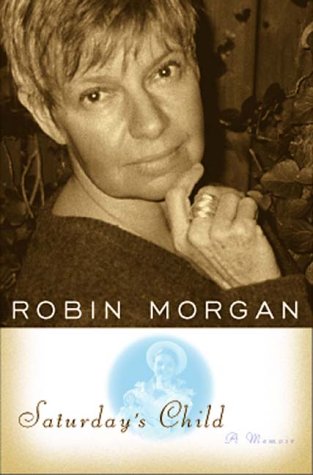
 Robin Morgan is one of the mothers of contemporary feminism. She has charted history, together with other women and those who support them, in more ways than I can even keep track of. Although she was once famous for her performances as a child actor, it is for her feminism that I know her, and for that reason I was eager to read her memoir. Huge thanks to Net Galley and Open Road Integrated Media for the ARC.
Now a social warrior of advanced age, she is still undoubtedly one of the most articulate individuals alive. However the heat that came from her discussion of her childhood all but singed my eyebrows. Some of us grow mellower with age and learn to let go of things that happened when we were small, but I suppose for some, outrage and sorrow compound faster than interest on a credit card.
You see, Morgan was raised as a child celebrity. From the age of two years her life was a constant swirl of organdy dresses, auditions, and performances. She rode in parades and promoted a doll that resembled her, though she was not permitted to play with one. She wasn’t allowed to nurture friendships, and would not have had time for them in any case. Work, education, and rehearsal took up all of her time, and special arrangements had to be made in order for her education to be completed because of her exhausting schedule. She was a highly capable student and is clearly extremely literate, but her formal education ended with high school; her mother, who lived off of Morgan’s pay from Morgan’s toddlerhood until her death (including investments that lived on after Morgan retired from show business), told her that college was out of the question. She deals articulately and extensively with issues surrounding the exploitation of child actors by adults during this period, as well as the surprise revelation that came about when she tracked down the father she had never known.
I found my long dead and slightly famous great-uncle buried in her text; Sherman Billingsley, owner of The Stork Club, named a drink for her, similar to a Shirley Temple, but with a chunk of pineapple. Funny stuff, though Morgan’s childhood experiences were mostly grim.
The rest of the book gave me what I came for. Morgan came of age during the antiwar era of the late 1960’s and early 1970’s. The era of protest surrounding the US war against the people of Vietnam radicalized the youth who participated in it; the women who had been side-lined during this time period by their male counterparts began to realize that they should be taking part in the decision-making process instead of rustling up sandwiches and coffee while the men talked politics.
“Free love” really meant group sex, and Morgan learned quickly that it was not liberating for her, but rather it was traumatic. From Eldridge Cleaver to Abbie Hoffman, one radical male after another showed himself to be a member of the old boys’ club where women were concerned. It gave her and several other women pause, and soon led to a number of publications, including Sisterhood is Powerful, an anthology I treasure to this day. Morgan’s energy and achievements appear to have been boundless.
The urban myth in which feminists all burn their bras appears to have originated with Morgan and other feminists’ boycott and picket of the Miss America Pageant in 1968. At this event a certain amount of street theater took place to draw attention to the objectification and trivialization of women in US society. One of these involved whirling bras, symbol of the restriction and shaming of women, in the air and then dramatically dropping them in trash cans. (No fire.)
Morgan’s achievements are too many to enumerate here, but her history, and that of other feminists, from Betty Friedan, bell hooks and Bella Abzug to Gloria Steinem, founder of Ms. Magazine, should be part of every general course in American history, and here the author weighs in once more. She is absolutely correct in reminding us all that the history of women does not belong isolated in a women’s studies department, but is a part of history in general. Pick up a textbook and list the names; how many are male, and how many are female, even for the relatively recent period since World War II? Nor is this problem limited to the USA; in fact, it appears to extend all over the world. There can be no post-feminist era until women enjoy social, political, and economic equality. It hasn’t happened yet.
In fact, Morgan’s internationalism, which has been a large part of her career since the first publication of Sisterhood is Global, is where she shines brightest.
After reading Saturday’s Child, I have found myself once more becoming conscious of the imbalance in the world around me. I have noted that if I mention in one instance or another that women are under-represented, even my own children give me a look that says I am bringing up trivial, petty matters that I should have let pass. And then I hear Morgan, reminding me that trivializing women is part of the problem.
If you are a woman, or if you love one, reading Saturday’s Child may leave you feeling dissatisfied and in need of social change. And until the world becomes equal for everyone, that is as it should be. If Morgan’s legacy is that more women raise hell for their reproductive freedom and economic equality until both are gained, then what better thing could she have done for the world?

 Seattle Book Mama