
On the Line, a labor memoir by Daisy Pitkin, tells the true story of a grassroots struggle to organize a nonunion laundry in Arizona as part of an industry-wide unionizing campaign. My thanks go to NetGalley and Algonquin for the invitation to read and review. This book is for sale now.
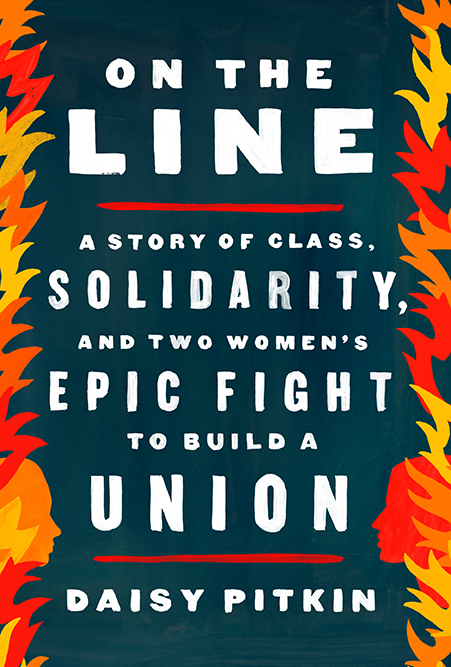
Daisy is an organizer for UNITE, a labor union that organizes textiles, laundries, transportation, service workers, and some others, created by the merger of ILGWU (International Ladies Garment Workers Union) and ACTWU, the American Clothing and Textile Workers Union (of which this reviewer was once a member and union activist.) She is working at the ground level, approaching workers in the parking lot, partnering with a woman named Alma that worked there and could talk to other workers inside the factory.
The memoir is written in the second person to Alma, and at first this seems odd, but as I read, I realize this is an effective and intelligent choice. By addressing Alma and the things that Alma has said and done during this fight, as well as the things the author did, along with what they did together, and the occasional differences of opinion they had and how they resolved them, she avoids making herself sound like a martyr to the cause. It would not read nearly so well in the first person, with the reader as audience.
The tasks of the workers all revolve around the commercial laundering process. Immense bags of dirty linens weighing up to 300 pounds are pushed off of the delivery trucks in rolling carts.
“The linen moves down the belt, you said, and then you flicked your arms back and forth to demonstrate how you and the other sorters toss sheets into one bin, towels to another, gowns to a third, and so on. You said, Sometimes they speed up the conveyor, and we don’t have time to be careful. There is a lot of blood and puke and feces. You said, We don’t get shoe covers, so some of us take off our shoes and drive home in our socks. You said, Our gloves are too big—they slip off our hands. Sometimes when they tear open, we have to handle the soiled linen with exposed skin…you were demanding a seemingly simple thing: to work your eight-or-ten-hour shift and come home unharmed. You wanted gloves that hospital needles cannot puncture. You wanted face masks to keep the blood and fluids from other bodies from entering your bodies. You wanted safety guards put back on machines where they had been removed. You wanted linen dust cleaned from the rafters to prevent fires.”
Safety rules are routinely flouted. Dirty linens land on the belt, and the belt feeds them into the mouth of a tunnel washer. When the washer jams, workers sometimes have to crawl through hot, bleachy, contaminated water to clear it and get it working. The supervisors are supposed to cut power when someone is in there, but they don’t. Ultimately it’s a choice for the owners to risk a possible, but unlikely fine from the government, or frequent decreases in production, which cut into profits. The workers are expendable; they can always find more. The wash and dry departments of industrial laundries are the most fatal of all industries, according to U.S. government statistics.
Daisy and Alma are working on a shoestring. When they have to be away from home overnight in order to meet workers as they go in or come out, they sleep in the car. Their signs are made by hand with posterboard and Sharpies. Initially, all of the workers sign cards, but then management begins a campaign of threats and intimidation. Not all of the workers are in the States legally, and most of them don’t know their legal rights. Most of them rescind their votes, and then it’s an uphill climb to get them to sign again.
This is a topic that is of great interest to me, and I was supposed to have read and reviewed this book in April of 2023, but my stomach twisted as I read of the horrific obstacles encountered by workers and by Daisy, and halfway through I had to put it down. Only recently did I slap myself upside the head and resume reading.
In any labor union, there are two sets of obstacles. The first, the one that is obvious, is the company, the bosses. Unions cut into profits, so the owners or boards of directors nearly always fight unionization. The second, and lesser known, is the union officialdom at the top. These people spend more time around the bosses and other highly paid union officers than they do around the workers, and they become jaded, sometimes contemptuous of those that they are supposed to represent, whose dues pay their salaries. When Daisy is eventually promoted, she discovers it’s harder to do anything that is in the interests of the clientele.
The book also includes a fair amount of union history, and it’s clearly explained, well woven throughout the narrative.
For those that are interested in unions and labor history, this is an excellent resource. But don’t read it at bedtime; it will do things to your dreams.

 Seattle Book Mama