
Somewhere Toward Freedom, by Bennett Parten*****

Bennett Parten is a fine historical writer, and here he examines General William Sherman’s renowned march through Georgia during the American Civil War through the lens of the formerly enslaved people that followed him. It’s a job that needed doing, and I’m glad that Parten was the one to do it. My thanks go to Simon and Schuster and NetGalley for the review copy. This book is for sale now.

The Union’s approach to formerly enslaved people evolved considerably over the course of the war. (This is your reviewer talking, not Parten.) In the beginning, when both North and South thought the conflict would be a brief one—ending, of course, in their own victories—anyone that left a plantation without permission to follow the Union army was promptly returned to their owner. But this was problematic from the start, if only logistically, as such practices slowed the army’s pace and drained resources from it, all in service to the enemy. For a while, then, everything was unofficial, as gradually, the formerly enslaved were sometimes folded into the army as support staff, helping cook, set up camps, pave roads, and whatever other noncombat roles needed to be filled. Eventually the practice was codified, not because slaves were declared free—not yet—but as “contrabands” of war. The idea was that by taking the enemy’s property that one runs across, be it livestock, crops, or (wince!) human beings, one’s own forces were strengthened, the enemy’s weakened. And after the Emancipation Proclamation, the formerly enslaved could theoretically go wherever they chose, but since guns and dogs can render such a proclamation from a far away and often unrecognized authority, it seemed like a wise plan for the formerly enslaved to follow the Union army.

Prior to reading this book, I was unaware of the relative size of the crowd of followers as opposed to the army itself. As Sherman’s forces made their way through Georgia waging total war, razing fields and burning cities, the crowd behind it grew from hundreds, to thousands, to tens of thousands!

Sherman’s first obligation, as he saw it, was to win this war. The army had to be his focus. Yet, as enthusiastic followers swarmed, they needed food, shelter, and sometimes other assistance. Initially, the troops were instructed not to give food to anyone other than those followers tapped to serve the army, but it proved difficult to enforce. There were children there, and they might well starve if not fed. The army had, as an intentional strategy, denuded the farms and villages of food and other necessary resources, so telling the followers to go find their own food was disingenuous. The army had nearly all the food there was; unfortunately, it wasn’t enough for thousands of extra mouths. And at times, Sherman and his generals made an effort to prevent, or to at least not help, the followers from remaining with them.

The greatest scandal was the one at Ebenezer Creek. (Sherman himself was not physically present for this, but what happened was consistent with his policies.) Georgia was full of rivers, swamps, creeks, and bogs, and in order to cross them, sometimes the engineers constructed bridges, and then either burned them behind themselves to prevent the enemy from following, or retrieved them for later use. In this instance, the enemy was close at the rear, and the order was given to pull up the bridges just as soon as the last soldier was across. The result was horrifying: with the hounds baying behind them, the desperate followers used every possible means to try to stay with the army. Some drowned; others were captured and either returned to slavery or killed. Women and children perished in those muddy waters, and later, the Federals launched an investigation.

There were other less dramatic, yet still tragic, incidents of the same sort.

In order to solve this conundrum, Sherman ordered a series of abandoned plantations in Port Royal, an island in South Carolina, to be turned over for the use of the freedmen and women. The book goes into a fair amount of detail about how these were run, with a fierce competition between two sides for control. Despite an overly colonial administration, formerly enslaved people were able to farm for themselves, and in some cases were able to buy land with the money they earned. It was a sound, if flawed program that was ultimately destroyed when Lincoln was murdered and Andrew Johnson, a sympathizer of the South, became president and gave the plantations back to their original owners, making no provision whatsoever for the farmers that now worked them.

It is this aspect of which I knew nearly nothing. Part of this is because I am a coward; I have a dozen or more books about Reconstruction that I say I will read, but then I don’t, and that is because I know the ending will be heartbreaking. But there’s also this: conventional histories of the Civil War tend to follow one or another army, general, and so forth, and very few tell the story of what happens after the army marches onward. And so I learned a good deal from this portion of the book; and yes, my heart broke, but not as much as those of the people that were first assisted, and then abandoned by the U.S. government.

Finally, I want to comment on the notes and sources used here. They are beyond reproach, with many primary sources used, multiple sources per endnote in most cases, and well-integrated. I particularly appreciated the quotations of the followers themselves.

I highly recommend this book to all that are interested in the American Civil War, Reconstruction, and the many social and racial problems that have continued to weigh on American society ever since.
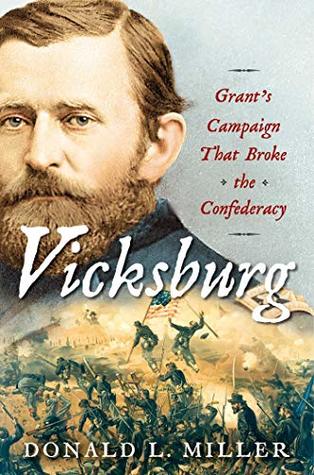
Vicksburg, by Donald L. Miller****

4 stars plus. Donald Miller’s treatment of Vicksburg is one of the best I’ve seen to date; it’s clear, easy to read, well documented, and in parts, vastly entertaining. Thanks go to Net Galley and Simon and Schuster for the review copy. This book is for sale now.

The siege and battle of Vicksburg was the single most significant event in the American Civil War. When the Union emerged victorious, it seized control of key arteries of commerce, food, and military supplies by capturing access and use of the Mississippi River as well as an important railroad that ran east to west. It liberated vast numbers of slaves, and it dealt a savage blow to the morale of diehard Southerners who believed the city and its fort unassailable. The fall of Vicksburg cut the Confederacy in two, and it made communication between the two halves slow and difficult. It also sealed President Lincoln’s election and provided him with a second term he might otherwise not have gained. I knew all of these things before I began reading Miller’s work, but I found a tremendous number of details I didn’t know about, and more importantly, I gained a much solider sense of context.

Many prominent works on Vicksburg are also Grant biographies, and that usually suits me fine, because Grant is one of my greatest heroes. However, those that read about Vicksburg solely within that framework lose out on the progress made—and sometimes lost again—by the Union Navy and others. Though I had read James McPherson’s work on the Union Navy, there is a lot more detail provided here by Miller. The rivers that surrounded Vicksburg are confusing as heck, and this played a big role in lengthening the fight, but at the same time, it can also confuse readers. It certainly did me. For example, when those traveling on rivers go “above” a certain point, what does that mean? I always assumed it meant north, but sometimes it doesn’t. I had never heard or read the term “Brown water navy,” (or if I did, I had thoroughly forgotten it), and this is a key aspect of the story. For the first time I have a solid grasp of the route used by the Union navy and army.

Readers should know that Miller is fond of including gore. I don’t know whether this is because college students are easily bored, and the consideration of Grant calmly conveying orders while spattered in brain matter is just more attention-getting than the same information without the gore, or whether Miller feels compelled to use these details to drive home the horror that heroes were forced to look beyond in order to be effective, but there it is, and so if you are inclined to take a book with you on your lunch break, you may want a different one then.

One of the aspects I appreciate most is the emphasis Miller places on the role of slaves during this critical time. If the waters were inscrutable, the land was little better in places, with thick, tropical foliage, snakes, leaches and other hazards. Those that lived nearby had an incalculable advantage, but local whites used this knowledge to confuse and obfuscate troops they considered to be enemies. Slaves, on the other hand, understood how important a Union victory would be, and they provided information that would have taken a lot longer to obtain without them. This is material that other writers often mention briefly but treat as a side issue. Miller goes into specifics, gives concrete examples, and shares the respect that Grant gained for his newly emancipated spies, guides, and soldiers.

The chapter titled “The Entering Wedge” is where good prose and information become solid gold. During this section of the book and the chapter after it, I did a lot of rereading for pleasure. There are excellent quotes throughout the book, and the author wisely focuses on those that are little seen in other books, providing a freshness and you-are-there quality at times that I haven’t seen for a long time.

At one point, during a passage discussing the caves that housed soldiers as well as local families affected by shelling, I realized that these must surely be part of the national park dedicated to this event, and I searched the web for images of them; sadly, because of the very soft earth in and around Vicksburg, (most likely the same soft earth that enabled the river to continuously change course,) those caves are all gone, washed away by hard rain. There’s a photo of a modern version based on the information available, but that’s not the same thing. Rats.

I nearly gave this book five stars, but there’s a surprisingly disturbing part toward the end that left me deflated and scratching my head. There are pages and more pages devoted to ugly rumors that seem to begin and end with Cadwallader. Although the author repeatedly reminds us that these statements are “unsubstantiated” and “controversial,” he nevertheless devotes a whole lot of time and space to them, and what’s more they are near the end, where the reader is most likely to recall them. Overall, he seems harder on Grant than most are, but up to this point he was fair, weighing his weaknesses while acknowledging his strengths. Why he would do a hatchet job on this iconic hero in closing is a mystery to me. Then the very end of the book is given to a Confederate.

Nevertheless, this is a strong work for those that know the basics and want the details. I don’t recommend it to those new to the American Civil War; if you are just getting your feet wet, read McPherson’s Battle Cry of Freedom, or explore the excellent historical fiction of Michael and Jeff Shaara, Shelby Foote, and E.L. Doctorow. But for those that are well-versed and in search of new information, I highly recommend this book.

I Freed Myself: African-American Self-Emancipation in the Civil War Era, by David Williams *****

IfreedmyselfWilliams is smoking hot when it comes to the role of African-Americans in the American Civil War. The overstatement that Lincoln freed the slaves rubs many of us, and his thesis that not only did the slaves largely set themselves free, but were pivotal to the Union’s ultimate victory, is a strong one.

In Marxist organizations, there is an expression for a political over-correction. It’s called “bending the stick too far back”. The idea is that you want the stick to be straight up, but sometimes when something has been done wrong, and once the evidence piles up until the reader cannot believe that anyone was dumb enough to think otherwise, it can cause other mitigating facts to be obscured; thus, the stick is bent too far the other way. And although I really like the work Williams has done here, and am making my 4.5 rating round up to 5 lest anyone not read this scholarly, well documented work, I do think he has made an error or two by disregarding the dynamics of the war and the decision-making process. It’s easy to do.

Actually, when I taught about this subject, I treated Lincoln and his role in it largely the way Williams does here, and that was a mistake. I used the same quotes Williams uses, and said that every American president basically does whatever he is pressured to do by those who hold the economy in their grip.

I was mistaken, and Williams is too, in this one way. Lincoln was such a friend to the Black man, in fact, that his name did not even appear on Southern presidential ballots (according to Catton, who notes it in the first volume of his trilogy). It was exactly because of this known fact that South Carolina gave notice of its secession even before Lincoln was inaugurated. And when Lincoln was being smuggled from his home to Washington, DC, plans for what to do once in office were prefaced by the qualifier, “If you live…” Because, despite the things Lincoln had to do to set the wheels in motion and set the stage for Emancipation, he was going to see the slaves freed.

The first thing Lincoln had to do, though, was protect the integrity of the Union. This was not a racist error; it’s hard to read about the things he said and did, but if the South were allowed to secede, or succeeded in its mission, it would become entirely dependent upon Britain for its manufactured goods, and largely so for its cotton market, and the slaves might well have remained in bondage much longer than they did.

The most graphic way to see it is this way: take a very basic political map of North America. Draw a line where the states end and territory begins as of 1861. Color all of Canada, which was a protectorate of Britain, red. Now color all of the Confederate States red. Mark the Border States with red stripes. Draw red arrows toward the eastern coast of North America pointing toward the USA. And once you have done all of this, put some red question marks on all of the western territory, and color the remaining Union states blue.

The result will be a very small piece of blue in the middle of all that red. If Britain were able to dominate North America so overwhelmingly, it would only be a matter of time before she began arming the borders, to the north, to the south, occupying harbors, and proceeding to take her “colonies” back. (Remember this had been attempted just 50 years before the Civil War during the War of 1812, when Britain burned the US Capitol to the ground.) So in many ways, this war started out being about maintaining national sovereignty, and could only be about freeing the slaves—which HAD to be done in order for Feudalism to die and capitalism to move forward, as history demands—once it was clear that the Union was safe. And the starting point there was keeping Maryland and Kentucky in the Union. (Color Maryland red and you will note that the entire Capitol city is now surrounded by the enemy; with the president and Congress on hostile soil, the war ends pretty quickly, and the slaves are still slaves, at least for the time being.) So I think that Williams is too harsh in his judgment of Lincoln at the outset of the war. It was like a chess game, in which everything had to be done in order. Had the South remained in the Union, slavery would still have had to end, and perhaps with less bloodshed. Most of Europe had ended slavery through government buy-out programs, and Lincoln quietly probed for this alternative several times, even after South Carolina had announced its secession. But the southern power brokers were having none of it.

But this does not diminish (as US history texts do) the role of the slave, the role of the free Black man, the role of the former slave, in the victory of the Union. And I learned a lot from Williams, because written US history has largely suppressed slave revolts, noting only the Nat Turner rebellion, and of course, the one led by John Brown, the only Caucasian male for many, many years that would fight and die for Black people. Williams fills out this missing piece of the puzzle admirably, and to my knowledge, no one else has adequately done so.

For the vast number of incidents documented here in one body for the first time that I am aware of, and done in such a methodical and scholarly fashion, all the while drumming away at Black empowerment and the role played by people of color, this book is worth your buck. If you have any interest whatsoever in the American Civil War; American history; or Black rights, this book should grace a place in your personal library.

And oh teachers, if you don’t have a copy of this in your classrooms—never mind that there is some difficult vocabulary here; when something is important enough, students will access the material—you should definitely dip into your classroom supply kitty, or if you don’t have one, your own wallet if necessary. African-American students have such a hard time dealing with the humiliating details surrounding slavery and the Civil War. They need to see this. They need to see that those who came before them stood up.

Black American leadership started during the American Civil War. Over 200,000 African-American men served as soldiers, and countless others did manual labor, served as spies and saboteurs, or simply walked away from the plantations. Others took ownership, literally, moving into the empty plantation houses and taking what they had already more than earned. (Would that the US government had enforced Reconstruction and kept it alive; but that is another story, a different book.)

Get this book. Read it. If you can afford to do so, get two copies so you can highlight one and write in the margins, and keep the other copy clean for visitors or family members. Its place in American Civil War history is unquestionable.