
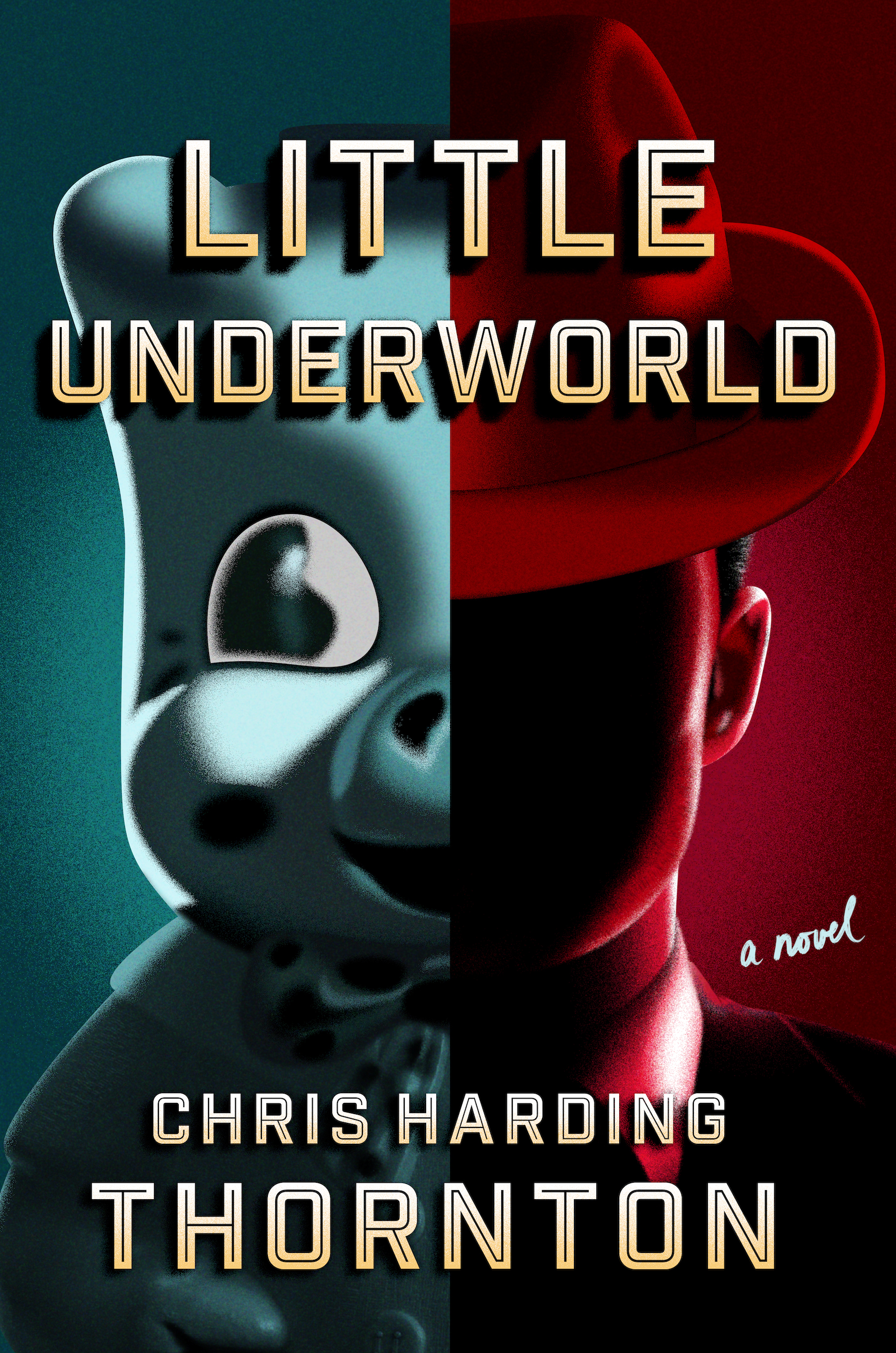
Little Underworld, by Chris Harding Thornton***

Chris Harding Thornton debuted in 2021 with Pickard County Atlas, a book I loved so much that I’ve had a finger in the wind ever since, hoping to score a galley of her next book. This is it. Sadly, I don’t love it the way that I did her first endeavor; perhaps I just loved the first one too much.
My thanks go to Net Galley and Farrar, Strauss and Girard for the review copy. This book is for sale now.

Our protagonist is Big Jim, a former cop now working as a P.I. He and his friend Frank, who is still a cop, take a man named Vern out to the river to beat the crap out of him for molesting Jim’s child. The plan is to smack him around and run him out of town, but at the last minute, Jim has a change of heart and snuffs him; Frank covers for him.  This is how the book opens.

My problem is that a great deal of information gets dumped at the outset, primarily characters, and by the thirty percent mark, I am still trying to keep them straight. It took me a ridiculous amount of time just to remember that Jim is the main character. I can’t recall the last time something like this has happened. There is rampant corruption in Omaha, Nebraska during the era of Prohibition, and there are a lot of local politicians whose names get thrown into the melee early. All of them are male and Caucasian, and while I believe that’s historically accurate for the time and place, it doesn’t help me keep them straight. By the halfway mark I have a better sense of who’s who, but I have reached a state where I have to force myself to read the book so I can write the review.

I would have liked to see at least one female character developed in here somewhere.

The pluses here—and there certainly are pluses—have to do with the author’s abundant skill as a wordsmith. This is grit lit, to be sure, and those with sensitive dispositions might want to steer clear. For me, though, when a character is described as “a guy whose canned meat had half the city’s fingers in it,” I love it. There are a few other moments of very dark humor that run along the same rails. What’s clear is that life is cheap, and Prohibition Omaha is a violent, vicious place to be. At one point, Jim wonders if there’s a single building in town that doesn’t have eight or ten corpses concealed in the concrete; in another, he reflects that “there wasn’t much risk of finding anyone innocent in Omaha.”

The second half of the story is better than the first half.

So there you have it. My advice is that if you want to read this book, get it free or cheap, but don’t pay full cover price for it. Meanwhile, I still have mad respect for this author; I look forward to seeing what she produces next.

The White House Plumbers, by Egil “Bud” Krogh and Matthew Krogh

Egil “Bud” Krogh was one of the men known as the “White House Plumbers,” which was a small group of operatives that dressed as tradesmen in order to illegally break into and ransack private offices for the purpose of digging up dirt on political opponents. Krogh’s job, together with E. Howard Hunt, was to lead a small team of men to burglarize the office of Dr. Fielding, the psychiatrist that treated journalist Daniel Ellsberg, in search of a way to discredit Ellsberg, whom President Richard Nixon regarded as an opponent.

My thanks go to Net Galley, St. Martin’s Press, and Macmillan Audio for the review copy and audio book. This book is for sale now.

Few people shy of the Boomer generation will have personal recollection of the Watergate scandal that brought down a sitting U.S. president for the first time, and the burglary of Fielding’s office was the first illegal event that set it all in motion. Nixon was furious that the Pentagon Papers had been released and that the U.S. Supreme Court had come down on the side of the First Amendment and the free press. Consequently, the president decided that the executive branch must go it alone, and sought a way to discredit the journalists behind it. That was how all of this came about. He howled about national security, and may or may not have believed it; or, he may have sought to cover up lies he had told to the American people about the war in Indochina, and  since he couldn’t force the publication out of circulation, the next best thing would be to persuade the public that its authors—or annotators, at any rate—were crazy and not to be believed. This background information comes from me, not from the book.

At any rate, this political memoir comes to us courtesy of Bud Krogh, and also his son Matthew, who completed it after Bud’s death. For the purpose of this review, I will use the name Krogh to refer to Bud, unless otherwise noted.

Krogh was brought into this mess by John Ehrlichman, one of the two advisors that were nearly as close as a second skin to Nixon during his time in office. Other accounts refer to both as cold-blooded thugs, and my earlier reading leads me to agree with them, but to Bud, Ehrlichman was a noble soul dedicated to his country and his president, a fine, devout individual that was like a second father to him growing up. It didn’t occur to him, initially at least, that anything he was being asked to do was corrupt or scandalous; here, I find myself shifting in my seat. Surely he must have wondered why this secret little group of men, not even government employees, were being tasked with this job, rather than the agencies that ordinarily do the cloak-and-dagger jobs? He claims that Nixon couldn’t trust FBI director J. Edgar Hoover, who was a slimy character, and that makes at least a little sense to anyone familiar with him. Yikes.

The writing as well as the accountability are uneven throughout this book. The prologue sounds sketchy to me. Those of us that have spent any time at all watching criminal trials take place is familiar with the vaguely nebulous language I see and hear at the beginning of this thing. Instead of saying that he has done something very wrong and is sorry, he says he has made bad choices, and he is sorry about “what happened.” This is the language that guilty people use when their attorney has told them to show remorse. Someone not listening carefully might think that the speaker has apologized, but they’ve actually distanced themselves from wrongdoing. During this portion of the memoir, I glanced at the text and also the device playing the audio, half expecting to see a little slime leaching from its margins.

And yet, at the end, the prose is more eloquent, and the accountability rock solid. Krogh goes to the psychiatrist in order to apologize in person, once he is out of prison. He visits Nixon to apologize to him (which baffles me, but okay.) He claims to have declined a presidential pardon. He never loses an opportunity to put on a hair shirt prior to his many speaking engagements. And so it goes.

One could surmise that the early portion was written by Krogh, and the end written by his son, but even if that is true, those speaking engagements were taken by Bud, not by Matthew, and likewise the specific apologies rendered. So who knows?

The narrator for the audiobook is Peter Krogh, who does a fine job.

If you are interested in studying the Watergate scandal and haven’t read any other books about it, this is not the one. Krogh’s involvement ended with the break-in to Fielding’s office, and he helped cover it up, lying under oath as he was told to do, but he had nothing to do with the Watergate Hotel burglary of the Democratic National Committee’s offices. In short, though famous enough to be remembered for his actions, he was not a central player. For those interested in reading just one book about this scandal, I’d go with All the President’s Men, by Woodward and Bernstein; The Nixon Defense, by John Dean; or Nixon: The Life, by John A Farrell. These are all fairly lengthy; if you are looking for something less lengthy, try One Man Against the World, by Tim Weiner.

As a general read for the uninitiated, I’d give this book 2.5 stars. For Nixon and Watergate buffs, I rate it 3.5 stars.