The Morningside, by Tea Obreht****

In 2019, Tea Obreht blew me away with Inland, a work of historical fiction—alternative history actually—so creative that I haven’t stopped thinking about it to this day. Her new book The Morningside is a dystopian novel that, while not as remarkable as the previous effort, is both intriguing and memorable.

My thanks go to NetGalley and Random House for the invitation to read and review. This book is for sale now.

Our protagonist is Silvia, and she and her mother are refugees from a homeland made dangerous by violent political turmoil. They were invited to live in The Morningside, a once grand old building fallen into disrepair by the flooding that comes with climate change. Silvia’s aunt, who arrives first, and her mother are to be caretakers and participate in the resettlement program.

At eleven, Silvia is full of questions. Her mother never talks about her father or about the past. Her aunt has photographs and stories; her mother is like the librarian that just wants everyone to stop talking. She is consumed by her fears. We readers have to wonder which of them is more realistic. Should the aunt stop blabbing, or should Sil’s mother get a grip? Silvia clearly prefers her aunt’s approach, but then, Sil is just a kid.

There’s a considerable wait list to get into school, so in the meanwhile, Silvia is bored, and bored kids have a tendency to get into trouble. Silvia becomes obsessed with the reclusive artist that lives in the penthouse. Nobody talks to her, because nobody is supposed to bother her. The one obvious thing about this neighbor is that she leaves home at the same time each day with her three dogs.

Silvia becomes convinced that the woman is a sorcerer whose dogs transform into humans—her three sons—for a portion of each day. My initial reaction is the same as her mother’s: don’t be ridiculous, Sil. Leave that poor woman alone. But then it dawns on me that this is fiction, after all, and this is Obreht, so…could the woman have supernatural powers?

Silvia is assisted twice in her spying mission, first by a neighbor that goes by Lam, and that is willing to exchange a pass key to enter the artist’s home for mail that was sent to him after he moved out.  I wonder about this; an eleven year old is approached by an adult man for secret purposes. What could possibly go wrong?

Her other confederate is a girl her own age whose family moves into The Morningside.  How starved Silvia has been for a peer!  Yet this girl is even gutsier than Silvia, and she leads her into dangerous waters more than once.

That’s all I’m going to tell you, except that the story is fresh and original, and although I tend to be skeptical when it comes to this genre, there is never a moment when I find myself stepping back and saying, no way.

With a young protagonist, one might be tempted to say this is for young adults, and that’s possible; yet the vocabulary is advanced enough that the younger reader had better have extraordinary skills in reading and comprehension, not to mention stamina.

I recommend this novel to those that love the genre.

The Hunter, by Tana French*****

In 2020, Tana French gave us The Searcher, the first in the Cal Hooper detective series. By that time I was already an established fan, but I loved that book particularly well, for reasons I’ll revisit in a moment. Now we have the second in the series, The Hunter, and if anything can reduce this crusty old English teacher to a blushing fan girl, this is it. Two books in, this is already on my short list of favorite series. My thanks go to NetGalley and the Penguin Group for the review copy. This book will be available to the public Tuesday, March 5, 2024.

The series debut introduced the characters, with the protagonist being a retired Chicago cop that found this tiny Irish village on vacation and, needing a new home far from his ex-wife, yet affordable, discovered a bargain fixer of a home and decided to stay. The story’s main problem revolved around a nearly feral tween that kept popping up at Cal’s place. The scrappy little stinker that was relieving Cal of food, occasionally, and doing other unsettling things turned out to be a girl; her name is Teresa, but she’s known as Trey. Her family was in dire straights following the departure of Trey’s father; her brother had left, intending to return, but never had. The mystery was where Trey’s brother had gone, what had become of him, and why. In the interim, she became greatly attached to Cal, who enjoyed her company and taught her some woodworking skills, but also kept a careful distance, lest rumors start and grow.

Now Trey is a bit older, and she is more civilized. She is close to both Cal and Lena, the local woman that Cal has been seeing. But as life settles into a civilized hum, one that would be comfortable had climate change not created a drought that has local farmers at the near end of their wits and their bank accounts, the unexpected happens once again: Johnny Reddy, Trey’s no-account father, has returned. Cal is prepared to step back, if need be, in case Trey wishes to bond with her actual dad rather than himself. Meanwhile, Johnny vows to visit Cal with some local moonshine, and “make a night of it.”

“Trey says nothing. If he does that, she’ll get Cal’s rifle and blow his fucking foot off, and see can he make his way down the mountain to Cal’s after that.”

Johnny never succeeds in bonding with Cal, who doesn’t like the look of him. “Johnny gives him the urge to pat him down and ask him where he’s headed. There are guys like that, who flunk the sniff test just going to the store; it’s a good cop’s job to work out whether they’re actually doing something hinky, or whether it’s just that they will be sooner or later, probably sooner.”

The village is a tiny one, and outsiders are few. Everyone in the vicinity knows that Johnny’s back; everyone wonders what he’s up to. They haven’t long to wait; he’s brought a man with him, one whose family once lived here, or so he says; and the man is interested in seeing if there’s gold on some of the local properties. “He has a rich man’s smile, easy and understated, the smile of a man who isn’t required to put in effort.”  Now the question is whether this “plastic Paddy” is a shyster trying to rip off the locals, or if he is someone that Johnny is seeking to fleece. Meanwhile, Trey has a different agenda, a private one.

The thing that makes this story so much better than your standard mystery is the characterization. If you are in search of a thriller that is all page-turning action, this isn’t your book. However, if you love a layered story with complex, convincing characters, this is for you. I said in my previous review of the first in the series that Trey is what makes an otherwise solid story a golden one, and that’s even truer here. One could even argue that it’s really her series, with Cal existing as scaffolding. Time will tell.

In particular, though, anyone that works with, or has worked with at risk youth cannot, must not miss this story. French has taken hold of my heartstrings hard, and I don’t want her to let go. Highly recommended.

The Book of Fire, by Christy Lefteri****

My thanks go to NetGalley and Random House Ballantine for the invitation to read and review. I found myself drawn to this novel because it’s different from everything else I have read. I’m fairly sure that I have never read a book set entirely in Greece; then there’s the fire, and the way that the forest interacts with the rural community living in and around it; many people have relied upon it, in one way or another, to make a living.  The Book of Fire is an interesting read, and it’s available to the public now.

Having said this, my first 25% or so of the story finds me with buyer’s remorse (or, reader’s remorse?) The thing is sorrow, grief, and more sorrow. I begin to think maybe I’ll abandon it, because eventually one disengages when there’s no hope of any kind for a brighter outcome. But just as these thoughts begin to crystalize, there is a subtle shift, and then the whole thing becomes more toothsome.

The story is told in alternating timeframes, with the current day being told to us in the first person, while the past is told as if it is a fairytale, and so in it, our protagonist, Irini, is referred to most of the time as “the mother,” her spouse is “the husband,” and their child is “the girl.” It took me a long time to figure out the protagonist’s name, but then there is dialogue, and that helps.

Initially, the protagonist confides to us what she has done. She found the arsonist in the burnt forest; he was on the ground beneath a tree with a rope around his neck. The branch above him is broken, so it’s either a botched lynching or a botched suicide, but not entirely botched, because he’s in bad shape. She begins to try to help him, but then she remembers what he has done, and she walks away from him. When she returns the next day, full of remorse, he’s dead. And so already we have this fact thrown in there along with the man’s own crime. We don’t know whether he did this or it was done to him until nearly the end.

In time more details emerge to muddy the waters of responsibility, so then she has a hundred little ethical questions to examine, and these are joined with a powerful environmental message. Because of this, I think this novel would be terrific for book clubs, and also for the high school classroom. There’s no sex in it, and the vocabulary is accessible. And despite my early fears, the entire book is not a portrait of grief and misery.

Recommended to those that enjoy literary fiction.

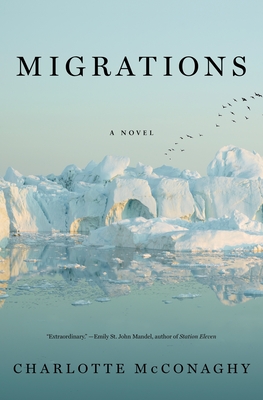
Migrations, by Charlotte McConaghy****

My thanks go to Net Galley and Flatiron Books for the review copy. I alternated my digital copy with the audio version I found at Seattle Bibliocommons; the reader does a fine job, and so if you want this book, you can’t go wrong in terms of print versus sound.

This is either exactly the right time to read this book, or exactly the wrong time.

Franny Stone has never been happy staying in one place, and now, when the walls are about to close in on her, she decides that one final voyage is in order. The Artic terns are about to make one final migration, and she means to go with them. Posing as a marine biologist, she persuades a fishing crew to take her along; she has the data to follow the terns, and the terns are following the fish. It’s in everyone’s best interest to work together here, now that so many species are extinct and the fish are so scarce. Once in motion, however, few things go according to plan.

The setting is the future, at a time when humanity has depleted most of the world’s wildlife. It is bleak, bleak, bleak.

Much of the story revolves around Franny’s character, and since we know from the get-go that she doesn’t intend to return alive once this trip is done, there are two questions that keep me turning the pages. I want to know why she wants to die, and of course, whether she does. The reason for her morbid plans is spooled out to us in small bits; whether she dies at the end is something the reader must learn for herself.

As for me, I had huge expectations by the time I began reading, because this novel shot up to bestseller level almost overnight. Perhaps that’s why I felt a trifle let down when it was done. It’s a good story, but I wouldn’t call it one of the year’s finest. Certainly, there is moral gravitas behind it, and yet those most likely to read it are not climate change deniers. For me to have loved this story, I would have needed more hope and less utter despair. When a story starts sad and ends sad, the little places in which it is slightly less sad aren’t enough to bond me to the narrative.

On the other hand, I am just one reviewer. There are a whole lot of readers out there getting all the feels and loving them. I recommend this story to anyone looking for a catalyst for a good ugly cry.