
Lucky Red, by Claudia Cravens*****

Larry McMurtry, eat your heart out. There’s a fine new word-slinger come to town, and her name is Claudia Cravens.
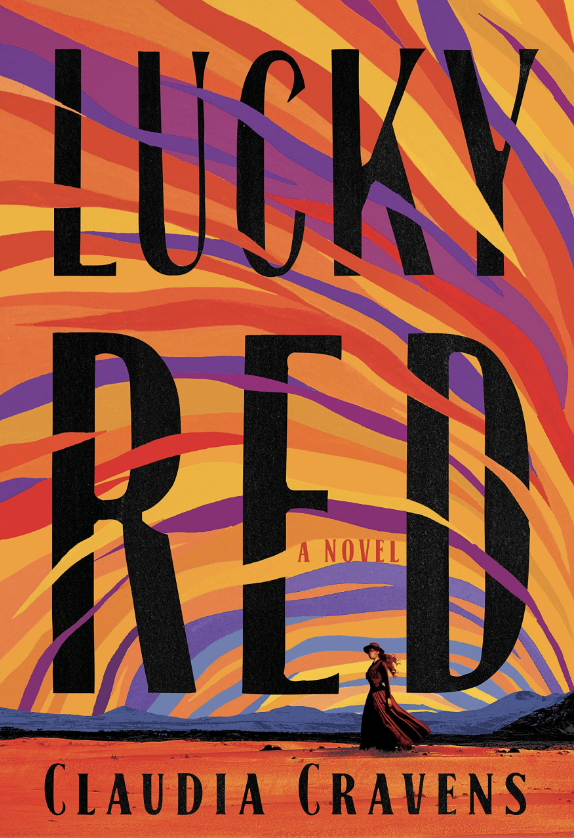
My thanks go to Random House and Net Galley for the invitation to read and review Lucky Red. This book is for sale now, and you should get it and read it.

Bridget lives a life of hardscrabble deprivation; her mother died in childbirth, and all she has is her pa. He loves her, but he’s worthless; when he finally gets a bit of money, he invariably drinks and gambles till it’s nearly gone. During one such episode, he gambles away their little house, and then buys a homestead, sight unseen and many miles away. What they find instead is a tar paper shack; there are no crops or tilled acreage, no tools or even a decent place to live. They crawl into the miserable hovel to get out of the elements, at least, and get some sleep; a rattler has the same notion, but when pa thrashes in his sleep, the rattler bites him in the neck, and then there is only teenage Bridget.

Bridget makes her way to Dodge City, and in no time, she is stone cold broke. She’s recruited to work in a brothel, the only one in town owned and run by women. She doesn’t mind the work and makes friends among the other “sporting women,” and is curiously removed from the process for which she is paid; slide prong A into slot V; moan a little, gush, and collect your pay. But later, she finds herself obsessed with a new sex worker; a lovely blonde woman named Sallie. Everyone around her understands the significance of this fascination, but Bridget herself doesn’t get it. She’s young, and she’s naïve. But when Spartan Lee, a female bounty hunter, comes to town and asks to hire Bridget, the sun shines and the angels sing.

This story is epic, and in many ways reminds me of Little Big Man, but with a female protagonist. And in many ways, what makes it so successful is its restraint. At the book’s outset, there’s a slimy man that wants to buy Bridget’s hand in marriage, which would give her father a nice chunk of change, but she hates the man, and her father doesn’t push it. A less capable writer would have done it the other way, but here, and in every instance where I predict what will happen because it’s so obvious, Cravens does something else. And the lesbian sex is brief and almost free of physical details—a sad thing for anyone looking for soft porn, but it serves to keep the story moving forward—with the emotion behind it carrying the internal narrative.

Although Bridget has no complaint about the work she does, and the management is more benign than in houses owned and run by men, Cravens keeps it real. One night, Sallie is attacked by a client, and Bridget bursts in to rescue her. It doesn’t go well. Sallie berates her for her naivete:

“You don’t see the first thing about this, though, do you. They all have a knife, Bridget. They all have a gun, and they were all born with two fists on the ends of their arms. You think you’ve got this all figured out, but any single one of ‘em could take a swipe at you some night and you’d be dead before you hit the ground.”

To tell you more would be to spoil it for you, so I’ll leave you with this: Lucky Red is the best debut novel of 2023, and one of the best books I’ve seen this year, period. Don’t miss it.
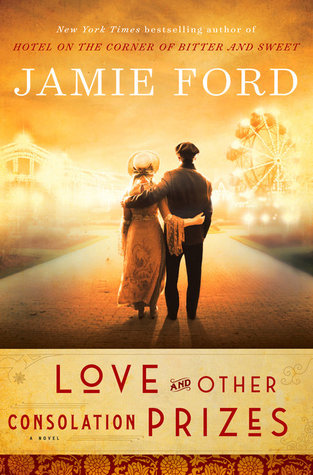
Love and Other Consolation Prizes, by Jamie Ford****

“‘We all have things we don’t talk about, Ernest thought. ‘Even though, more often than not, these are the things that make us who we are.'”loveandotherconsolation

Ford is the author of Hotel on the Corner of Bitter and Sweet, which is one of my favorite novels, and so I was thrilled when I saw he had written another historical novel set in Seattle. Thanks go to Net Galley and Ballantine Books for the DRC, which I received free in exchange for this honest review.

Ernest is a small child when his mother, who is dying, wrenches herself away from him and puts him on a boat to the USA. He attends a charity boarding school and then is raffled off, a free orphan to a good home, by the Children’s Home Society at the Alaskan Pacific World’s Expo. It is Flora, the madam of a Seattle brothel, that claims him and brings him to the city. There he is essentially a house boy, and he forms a warm friendship with two young women employed there, Fahn and Maisie.

The narrative is divided between two time periods, the first following Ernest as he leaves China and arrives in the USA at the dawn of the twentieth century, and the second in the early 1960s when he is elderly and his wife, Gracie, is suffering from dementia. There’s an element of suspense that is artfully played as we follow both narratives, trying to untangle whether the woman that becomes “Gracie” is Maisie, Fahn, or some third person.

But Ford’s greatest strength is in bringing historical Seattle home to us. The characters are competently turned, but it’s setting that drives this book, just as it did his last one. Ernest lands in the city’s most notorious area at the time, a place just south of downtown known as the Tenderloin:

He had never once been near the mysterious part of Seattle that lay south of Yesler Way, a street better known as the Deadline. His teachers had talked for years about sewer rats that plagued the area, and rattlesnakes, and about the wolves that prowled the White Chapel District, waiting to sink their teeth into the good people of Seattle, which a local song had dubbed the Peerless City. Ernest had imagined lanky, sinuous creatures with sharp claws and tangles of mangy fur, but as he looked out at the avenue, all he saw were signs for dance halls and saloons.


Ernest’s years at the brothel prove to be the best of his young life, primarily because the rest of it was so much worse. Every time a rosy glow starts to form around the brothel and the condition of the women that work there, Ford injects an incident that is stark and horrible to remind us that trafficking in human beings and their most intimate acts is criminal and should never be condoned. Miss Flora is a relatively benign madam because it is better for business, not because of any sentimentality toward the women she employs. This comes to us all the more starkly when her own daughter’s virginity is raffled off to the highest bidder.

All told, this is good fiction, poignant, warm, and moving. Two things give me pause: the ending seems a little far-fetched, and the depiction of the suffragists, who are some of my greatest heroes, is so hostile that it borders on the misogynistic. However, the latter is peripheral to the main story, winking in and out briefly, and overall this novel is an appealing read. It will particularly appeal to Seattleites and to Asian-Americans.

I recommend this book to you, with the above caveats, and it for sale to the public today.