
Flags on the Bayou, by James Lee Burke****

James Lee Burke is one of the finest prose stylists the U.S. has to offer. His brilliant, lush descriptions, quirky, resonant characters with interesting names, and his passion for the rights of the working class are the stuff of legends. My thanks go to Net Galley and Simon and Schuster for the invitation to read and review his latest novel, Flags on the Bayou. This book is for sale now.

Our protagonist is Hannah Laveau, a former slave who’s on the run from the law. With her is Florence Milton, an abolitionist from Massachusetts. Hannah is determined not to be caught, but also to retrieve her little boy, Samuel, a preschooler from whom she was separated at the battle of Shiloh. Her determination is singular. Along the way we have officers from both sides of the Civil War, corrupt rich guys, and bushwhackers. The story is complex, as are all of Burke’s novels, and the setting atmospheric.

All of these things being said—and I’ve said them many times before, since I began reading his work about a decade ago—there are some things that I would like to see done differently. Burke has always intertwined social and political messages within his novels, and so it’s the subtext in this book that jars me. In fact, it bothers me enough that I abandoned this story twice before I finally dug in, determined to finish it.

The first category here is the American Civil War, and the fallout we still deal with today. In past novels, Burke has told us that the slaveocracy was wrong, and that the war was indefensible. I feel as if he has retreated from that here. We have some ugly Confederate characters, to be sure, but we also have ugly Union officers, and General Sherman—one of this reviewer’s most beloved heroes—gets run through the mud multiple times. It’s as if Burke wants us to know that actually, both sides were bad, and that war itself is just plain awful. This is weak tea indeed.

The second is one I’ve been eyeing for the last few of Burke’s novels, and I have soft-pedaled it because of my great admiration for the body of his work, and for his ageing dignity, but I do have to say something here. His development of female characters needs work. Lots of it. All of his females are either Madonnas or whores (and sometimes, Madonnas that are forced to be whores, through no real fault of their own.) I would dearly love to see a female character in his books who is not there for her sexuality, and who is not either a victim or a potential victim. With Burke’s Dave Robicheaux detective novels, progress was made with a lesbian cop character, and I was thrilled. But she came and then went, and his experience creating her hasn’t overflowed into his other work.

More than any one thing, I want to see Mr. Burke write a book—just one, seriously—where there is no sexual assault, no threat of sexual assault, and no memory of sexual assault. It’s getting old, sir. You surely have the ability to provide female characters with other motivations. I want to see it.

I was nearly annoyed enough to rate this book three stars, but I liked the ending a lot, and so the fourth star remains.

So that’s my two cents, because as much as I love his work in general, this is getting in the way. There will doubtless be some blowback from his other devoted fans once I publish this review; bring it.

A final note: because I was struggling with this book, I checked out the audio version from Seattle Bibliocommons. The voice actors that perform it are world class. However, because the story is so complex, bouncing back and forth in point of view and setting, it is hard to follow in audio alone. The best way to read this is with both the printed word, whether on paper or digitally, accompanied by the audio.
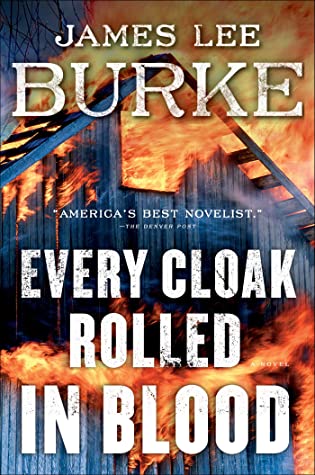
Every Cloak Rolled in Blood, by James Lee Burke***-****

James Lee Burke is an icon, a Grand Master who’s written mystery novels, along with the occasional work of historical fiction, since the 1960s. Now he is 85 years old, and he recently lost his beloved daughter, Pamala. This novel is a tribute to her.

My thanks to go Net Galley and Simon and Schuster for the invitation to read and review. This book is for sale now.

Every Cloak Rolled in Blood is the fourth in the Holland Family saga. Our protagonist is Aaron Broussard. He is an 85 year old novelist who has recently lost his daughter, Fannie Mae. He feels a “loneliness that is almost unbearable.” He tells us,

“I will not accept my daughter’s death. I will find a way to pull her back through the veil or untether myself and lie down in the bottom of a boat that has no oars and float down the Columbia and into the Pacific, where she will be waiting for me somewhere behind the sun.”

There’s a horrifying passage in which he places the barrel of his gun in his mouth; but he doesn’t go through with it, and later tells us that he believes he will not be permitted to join her if he leaves this world by his own hand.

The story commences with a young man vandalizing Aaron’s barn. Aaron recalls some local cops being unnecessarily nasty to Fannie Mae, so instead of turning the boy over to the cops, he makes a deal with him to have the kid work off the damage. There are other remarks laced in here and there that give a nod to our current national state of affairs regarding police brutality, and I appreciate these.

In fact, the story is laced with a number of social justice issues, and Burke is, as usual, on the side of the angels each time; foremost is the horrific manner in which indigenous people of the Northern Rockies have been treated by the U.S. government, and continue to be.

Over his last few novels, Burke has increased the amount of supernatural content in his work. For decades this aspect of his work was muted, smoldering as a part of the general ambience of the story. He’s always used the occasional Biblical reference, occasionally also borrowing from Greek mythology. In A Private Cathedral, a recent Robicheaux novel—the series that has met with the greatest public acclaim and for good reason—he included a scene that could not be perceived as anything other than supernatural. In fact, it is one in which both the protagonist and his lovable sidekick, Clete Purcel, witness the same event, so there can be no supposing it’s all in the protagonist’s head. It was brilliantly conceived and executed. Unfortunately, this book is not of the same caliber.

I wrestled a great deal with my rating and review; a large part of me thought that when a beloved novelist is in his eighties and has recently lost a child, I should just give him the five stars. Yet another part of me, the part that won the internal debate, feels that to do so is unworthy of the respect this author has earned. It would be patronizing to say this is a great book when I am so ambivalent about it. So I’m playing it straight here. The supernatural aspect, as it is used here, overwhelms this story and damages it organizationally. It also causes the pacing to lag a bit. It’s not a terrible book, but it’s not up to Burke’s usual standard.

But the aspect that bothers me most is the way the younger women in the story—not just one, mind you, but two—cannot wait, apparently, to get Aaron in the sack. Sister Ginny isn’t a good person, but she tries to seduce him anyway. Ruby Spotted Horse is a good, honorable woman, that rarest of all things: an ethical cop. She’s in her thirties, but when Aaron comes onto her, she doesn’t even hesitate. We learn that she was raising her niece, who died, and there’s a clumsy passage in which Aaron wonders aloud if Ruby is really up for a relationship with him given his age, but she assures him that they are bound together by their mutual losses.

Right. Whatever.

There are many lovely moments in this novel, all of them owned by Fannie Mae. There is such clear, obvious affection in the descriptions that I am a little surprised the pages don’t glow.

The denouement, a mighty struggle involving the living and the dead, leaves me shaking my head, though. And when one of the latter, an evil spirit representing a horrible cavalry officer that once lived and killed in the vicinity, tells Aaron, “Pardon me for saying this, but you’re not the good father you think you are,” I want to sit right down and cry.

This book is recommended to diehard Burke fans, and to anyone that needs a grief book.

A Private Cathedral, by James Lee Burke*****

A Private Cathedral is the twenty-third in the immensely popular Dave Robicheaux series, which began in the early 1980s. James Lee Burke has been called “America’s Best Novelist” by the Denver Post, and his books have been made into movies. Lucky me, I read this one free and early; thanks go to Net Galley and Simon and Schuster for the review copy. This book is for sale now.

Fans of this series—and there are many—will recognize all of Burke’s signature elements. Set in New Iberia, Louisiana, a small working class enclave about an hour from New Orleans, we find the usual wealthy, sleazy bad guys, in this case the Shondell family and the Balangie family; their victims, ordinary people with no money that scrape by the best they can; a pair of grizzly murders; and in this instance, a case of human trafficking. There’s always a woman or two ready to fling herself into Dave’s arms, even though he and Clete are supposedly getting old, and as usual, one of the women stands on the tops of his feet before she seduces him, or vice versa. (This has got to be some sort of private joke or reference on the author’s part, because you know that a writer with this level of skill cannot be inadvertently ascribing the identical quirky behavior to all of his protagonist’s romantic interests across over three decades of a series.)

And of course, best of all perhaps, we have Dave’s fiercely loyal best friend, Clete Purcell, a man that looks “like an albino ape” and whose impulse control is even worse than Dave’s, at least most of the time. He shows up in his pink Cadillac wearing his signature porkpie hat, and I smile. I can’t help it. Clete does this to me every single time, and I’ll bet a whole lot of other readers feel just the same way.

                “He was the trickster of folklore, a modern Sancho Panza, a quasi-psychotic jarhead who did two tours in Vietnam and came home with the Navy Cross and two Purple Hearts and memories he shared with no one. Few people knew the real Clete Purcel or the little boy who lived inside him, the lonely child of an alcoholic milkman who made his son kneel all night on rice grains and whipped him regularly with a razor strop…Nor did they know the NOPD patrolman who wept when he couldn’t save the child he wrapped in a blanket, ran through flames, and crashed through a second story window with, landing on top of a Dumpster…He hated evil and waged war against it everywhere he found it. I sometimes wondered if he was an archangel in disguise, one with strings of dirty smoke rising from his wings, a full-fledged participant in fighting the good fight of Saint Paul. “

My sole complaint, a key one I probably wouldn’t give any other writer a pass on, is the way the author deals with his female characters. All the women and girls are mothers, whores, lovers, or children, and in some cases more than one of the above. No woman comes into the stories on the merit of her occupation, her character, or her abilities, aside from Helen, a long-running character that is exempted by virtue or being a lesbian and androgynous in appearance. (God forbid she be gorgeous and gay, or gorgeous and straight and completely sexually uninterested in Dave.) But the fact is, Burke has been writing and publishing great novels since 1965, and now he’s an 83 year old author and it seems unfair to expect him to change direction with regard to his female characters, or to suddenly regard them as equals in all respects rather than to nurture the whole pedestal package.

Moving on.

The story commences with Dave suspended from the sheriff’s department, and he’s behaving badly, embarking on a series of “dry drunks,” a term used liberally throughout this series and that I’ve never seen or heard of anywhere else. He’s so far out of line that Clete has to reel him back, when more often it’s the reverse. A teenager named Isolde is being sold by her parents, and Dave is attempting to rescue her. But it’s a useless endeavor because there is so much money and power buffering the offenders. Meanwhile, Clete is kidnapped and hung upside down and tortured by a being that seems otherworldly to him—mostly because it is. And this is a departure for Burke, a good one, as it turns out.

Those familiar with the series and the author know that redemption is at the core of every story he writes, and given the amount of mystic imagery that appears in his prose, it isn’t a long stretch to go from imagined spiritual beings to actual ones, which is what he does here. And I can only bow in awe at a writer—even one with residual sexist attitudes—that can take a long-running, iconic series like this one, a series that has run for more than 30 years, and decide to expand it across genres now. This would be remarkable for anyone, but for an octogenarian, it’s jaw-dropping.

I also enjoy the way he develops the side character, Father Julian, who is heroic and who pursues pedophiles and brings them to justice. Way to fight stereotypes.

I love the ending.

Highly recommended to Burke’s many fans, and to new readers as well.

A heartfelt tribute, featuring a lot of famous writers:

https://www.youtube.com/watch?v=3cwNHIsoHG0