
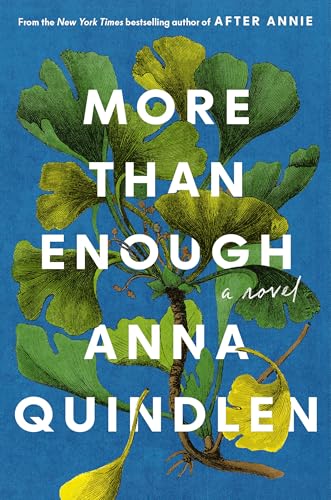
More Than Enough, by Anna Quindlen*****

More Than Enough, the new novel by Anna Quindlen, packs a great deal of intimacy into a relatively short book. My thanks go to NetGalley and Random House for the review copy. This book will be available to the public February 24, 2026.

The story arc here is not a traditional one in that there are several threads relating to the protagonist, and it’s hard to identify one as central. Instead, all of them are interwoven around a theme of knowing how to let go and move forward. Our protagonist, Polly Goodman, wants a baby desperately. She and her husband, a zoo veterinarian, have been trying for years. They’ve done blood tests, fertility treatments, and even in vitro procedures, but in the end, she comes away with an empty womb and no baby. The hardest thing is when she feeling vulnerable and someone is gentle with her: “I was one kind impulse from a kidnapping or a crying jag.”

In the midst of it all, she is momentarily distracted by the results of a gag gift given to her by her book club buddies. They present her with an ancestry kit, and the results are surprising. At the same time, she struggles with her parents. Her mother, a judge, is wedded to her career, and Polly has never been able to connect with her emotionally. Her father, whom she loves more than nearly anyone, suffers from dementia and lives in a facility. She visits him nearly every day.

And the best friend she has—one of the book club pals—has cancer, and it’s not going well.

All of these threads blend seamlessly within the narrative; Quindlen has such an engaging writing style that I’m not thinking about a central storyline because I feel as if I’m hearing from a friend. Usually I don’t enjoy reading stories about people that might be called upper middle class, because I cannot relate to them at all, but Quindlen magically bridges that gap.

I could go on, but I’m not sure I should, because I love this story enough that I want to tell you every single thing that happens, and that’s not a good idea. The one additional thing you should know, if you don’t already, is that Quindlen has a great heart for teachers and for teens, and so she portrays both in a way that is authentic and immediate. Again, I should not relate well to the private school where Polly teaches girls that come from well to do families, but Quindlen reminds me that all children have needs, and all children deserve not only an education, but an adult sensitive enough to understand them.

I hope Quindlen lives—and writes—forever, but when she goes, as we all must, she should be made the patron saint of high school teachers.

Highly recommended.

After Annie, by Anna Quindlen*****

After Annie tells the story of a family that is changed by the sudden death of the mother, a woman still in her thirties. My thanks go to NetGalley and Random House for the invitation to read and review. This book will be available to the public Tuesday, February 27, 2024.

I’ve read a number of books by this author, and I have come to notice a pattern. I read the synopsis, like the sentence I used to begin this review. I see what it’s about and shrug. Doesn’t sound like it would be all that special, but hey, it’s Quindlen, and I have liked her work before, so let’s give it a shot. After all, in past novels, the topics also didn’t seem engaging at the outset. One novel is about a family being forced to relocate due to eminent domain; another has to do with parking spaces in New York City. There’s a memoir about grandparenting, and another about—I kid you not—her dog. Nothing here seems all that appealing.

Yet in some ways, it is the very ordinariness of her subjects that draws us in. So many of us have had to move when we didn’t want to, and so we fought it; or we became so angry with a neighbor’s thoughtlessness that we fantasized about terrible revenge; or we dealt with a death that came out of the blue, striking down someone that was perfectly healthy, or that seemed to be. If we haven’t done any of these things, chances are excellent that someone else we care about has. By tapping into every day experiences and crises of various sizes, Quindlen finds commonalities.

But perhaps the most important feature of her books, particularly her novels, is the way that she crafts characters that are so visceral we would know them if we saw them on the street. Young Ali, the daughter who’s just beginning middle school, yet suddenly finds herself burdened by all of the things her mother did for the family, from child care to meals to housework, is so real to me that I nearly climb inside of her skin, and when Annie’s best buddy tries to tell Bill, Annie’s husband, Ali’s dad, that this isn’t okay and he blows her off, I want to cry out. We can see that he’s behaving selfishly, whether he knows it or not, because he is so poleaxed with grief. It’s hard to prepare a meal when you can’t stop crying. Hell, Bill can hardly go into the kitchen, because that’s where she died.

Grief was like spring, maybe. You thought you were getting out from under it, and then it came roaring back. And getting out from under it felt like forgetting, and forgetting felt like treason.

I began reading this story because I like the author, but it also serves as a grief book. I found this out when my sister died about halfway through. Unlike Annie, my sister was not in the prime of her life, nor was her death unexpected. She’d been horribly ill and in great pain for years on end. Her death was a relief, ending her pain, and ending the anguish of others that had been constantly seeing her that way, helpless to improve her life in any way. So I am not poleaxed like poor Bill. She didn’t leave behind a houseful of small children and a middle schooler trying to pick up all of the pieces. She didn’t have a six year old who would explain to everyone that his mommy wouldn’t be dead anymore once she came home from the hospital. But what I am saying is that I find this book more soothing than I would have guessed. If you or someone near to you is dealing with loss, After Annie may help you too.

Highly recommended.