Nirvana, by J.R. Stewart****

NirvanaNew rating and review based on updated DRC:

Larissa Kenders is a musician living in a post-apocalyptic world; her lover Andrew is missing. This newly revised young adult novel is a winner, and it will be published  November 10. Thank you to Blue Moon Press, Net Galley, and Adam Mawer at DigiWriting Book Marketing Agency for including me on the second spin. It was time well spent.

The problem on Earth began when the bees began to die. How can anyone grow food, flowers, or anything else if pollen can’t be transferred? And indeed, how does pollen get from one plant to another without the bees? Corporate giant Hexagon has created an alternate world, and humans are dependent upon the company for their sustenance. Nirvana is a virtual world that workers can visit, for a hefty price, on their days off. The question Larissa has, then, is whether the Andrew she sees in Nirvana is the virtual Andrew of her memories, or whether he may in fact still be living, hiding out from those that may wish him gone.

Various topics are explored, from alienation and the question of whom to trust—one that will resonate with teenage readers—as well as environmental issues such as GMOs, and more futuristic philosophical questions. Edward Snowden comes up, and why should he not, in a story in which many researchers have uploaded their brains to the Cloud so that their work will remain once they are gone?

I was one of a handful of reviewers that read the first draft of this book. I reported that it was dreadful because it lacked character development. This new and vastly improved version creates a Larissa Kenders that is believable, a character to whom we can bond. The remaining stereotypes, such as the jealous female that is our main villain, along with the preponderance of males rather than the usual fifty percent of the population, are problems that are so rife within the genres of science fiction and fantasy that it’s hard to hang the whole problem on this one writer, who has created a truly original and interesting plot .

Teachers considering its classroom use should be forewarned that there are a couple of sexual situations; the porn industry, a pet project of one of the villains, also gets multiple mentions. I should emphasize that this reviewer sees no problem with today’s teenagers reading the book, since most of them have seen far more explicit material on their own. But those that teach in school districts so conservative that the villagers bring everything but flaming torches to the school board meeting may want the information ahead of time prior to going out of pocket for a classroom set.

In revising his story, Stewart has plucked victory from the ashes; a job well done.


For the Dignified Dead, by Michael Genelin****

forthedignifieddeadThere’s a murderer on the loose, one that has killed across international boundaries. The weapon of choice? An ice pick. Happily, the case is assigned to total bad-ass Commander Jana Matinova, the best new female detective I’ve seen in emerge in crime fiction in decades. Thank you to Net Galley and Brash Books for the DRC. This title will be available for purchase November 3.

Part of what initially attracted me to this novel was the setting. Though Matinova finds herself crossing into various parts of central Europe, she is based in Slovakia, a country not even on my personal radar. By way of apology, I will point out that for most of my life, a giant swath of Europe and Asia was designated as USSR, and the satellite states lined up like faithful guardians around its perimeter included Yugoslavia and Czechoslovakia, both of which have been carved into different nations since the Stalinist realm crumbled. So I thought I’d learn a little bit about the contemporary contours of central Europe in the most enjoyable way possible—through fiction.

Genelin doesn’t disappoint. Along with Matinova, we have a collection of other cops, some of whom garnered truly fetching descriptions, such as this one: “With his thinning hair and lopsided smile he looked like a harmless, slightly unkempt beagle without its long ears.”

In addition we have the sinister Koba, a master criminal that Matinova considers akin, perhaps, to Holmes’s Moriarty. Koba’s role in Genelin’s story is complex and fascinating.

But most of all, I appreciated the development of Jana Matinova, both for her silver-bullet speed and cleverness, and also for that which is not included. We never hear about her hair, makeup, or her figure; we don’t need to know anything about her love life, and if she experiences any ambivalence about her lack of a domestic life, we don’t hear about it. In fact, Genelin treats his protagonist just as he would a male protagonist.

Now isn’t that a breath of fresh air?

The fifth star, which I would have loved to be able to add to this engaging story, is denied because of problematic passages that popped up often enough to warrant ten different notations in my kindle: “Too wordy! Tighten it up!” It seemed either as if there were two writers, one more capable than the other, co-writing the novel, or as if someone whose mother tongue is not English was struggling to say what needed saying. I noticed this was most frequent during passages of narrative, and less likely to occur during dialogue. Whatever it is, it could benefit greatly from either some rewritten passages or strong editing. But every time I found my eyes jerking through one of these verbose areas in the text, sooner or later we would come out slick as a whistle, and everything would commence to flow again. I don’t think a published text has ever confused me so much in this regard.

That being said, I would cheerfully read other books in this series given the opportunity. Because when push comes to shove, Commander Jana Matinova is a champ!

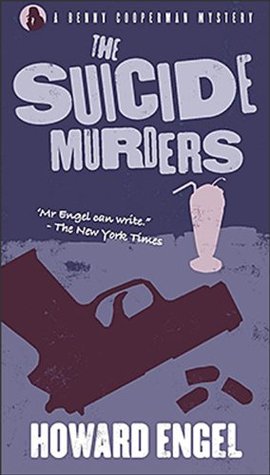
The Suicide Murders, by Howard Engel****

thesuicidemurdersThe cops said Chester killed himself. The gun was there, and he had powder burns on his head, powder on his hand. Everything tested out right. But he’d ordered himself a brand new bicycle just two hours earlier. Does a suicide do that? And then there was the very lovely wife that had been to see Cooperman, our detective protagonist, just before the unfortunate event, concerned that her man had perhaps been unfaithful. She’s caught him lying to her, and that makes a lady suspicious.

These things leave a guy like Cooperman with questions. True, he’s not a cop: “Me? I’m just a peeper. Divorce is my meat and potatoes.” But when something stinks, it’s in Cooperman’s nature to go find the source of the smell and air it out. And when others die after Chester, it makes Cooperman, who’s nobody’s fool, ask even more questions.

I received the DRC for this vintage novel, now available digitally, from Net Galley and Open Road Integrated Media. It became available for sale August 24, so you can get it now.

Engel is an experienced writer, and as he plays the thread out, with murder upon murder integrated deftly into the everyday life of Benny Cooperman, he strikes an excellent balance, building suspense and driving the plot forward with the occasional humorous reflection to keep things from becoming too ugly to be fun for the reader. And his character descriptions are particularly memorable, as with this local politician:

“He was a big man by anybody’s scale. His face looked like a roast beef dinner with all the trimmings, with a huge portion of nose in the middle. “

There were a couple of moments when the predictable occurred, but it wasn’t so dead obvious—excuse the pun—as to be an eye-roller. Rather, I experienced the satisfaction of having seen it coming and been right. And to me, as long as there isn’t too much of it, and there wasn’t, that is a sign that the writer has been fair to his audience. There are no sudden introductions of new characters during the last ten percent of the novel that change the solution in a way impossible to predict, and a lot of us like working the puzzle as we read. There are a couple of sexist references—“the kind of girl”, “bimbo”—that were commonly used in 1980 when this was first published that I didn’t care for, but they were infrequent enough that I was able to make a note to myself, and then continue to read and enjoy the story. In the end, the wry humor and up-tempo plot line makes this one a winner.

Although there are vague sexual references and infidelity is part of the plot, there is no graphic sex that should prevent a parent of a precocious adolescent mystery maven from handing the book down once they have finished it themselves. It’s hard to call any story that contains multiple murders a cozy mystery, but this one is in or near that ballpark.

Altogether a satisfying read.

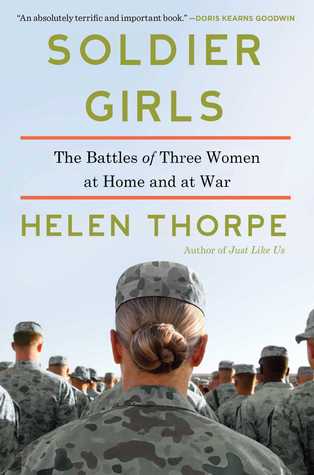
Soldier Girls: the Battles of Three Women at Home and at War, by Helen Thorpe*****

soldiergirlsNow that this title has created some buzz, I thought I’d reblog this!

seattlebookmama's avatarSeattle Book Mama

I was able to read this before its publication date, courtesy of NetGalley.com. Thanks, guys!

I am usually good for half a dozen books at a time, but I have to admit that this one story has dominated my reading hours for the past week or so. I had so many preconceptions (and yes, stereotypes) that I didn’t even realize I’d developed until I read about these brave souls who have gone to Afghanistan and in some cases, Iraq.

What kind of woman leaves the home she knows and signs up for the National Guard? Sometimes (often!) it is someone who needs money quick. Sometimes it’s a woman who is desperate to get out of her current living situation. And once in awhile, it is something done, at first, when one is dead drunk and out of control; the Guard will fix that quickly!

I’ve been a Marxist my whole…

View original post 115 more words

Liberty, by Garrison Keillor *****

LibertyKeillor is best known for his radio show, A Prairie Home Companion, on NPR. I have read many reviewers (not from the mainstream media, but amateurs like me, who review on amazon and goodreads) who insist that Keillor is only funny when he delivers the lines himself, and that once you put his work in print, the humor is lost.

Nonsense!

I like reading Keillor’s novels, though the collections of quirky philosophy and bits of his radio work set in print are worth a gander as well. This one is set in the home town he has made known to many of us. (If you haven’t read or heard anything by Keillor, you may still enjoy it, but I recommend reading his classic material first. Lake Wobegon Days is a nice launch-point). In some places it is dry and droll; at other times, I found myself doubled over and gasping for breath. And to be frank, I am not that easily amused.

In fact, I laughed out loud on the first page. People often say, and tritely so, “I couldn’t put it down”, and what they mean sometimes is that they read it often until it was done, and they really enjoyed it. But I genuinely never put this book down unless it was strictly necessary. It was an awesome weekend. I was recovering from surgery and had to be sedentary, and this cheered me up considerably. It is not poignant in the way the L.W.D. is; this is just plain FUNNY. It hit my funny bone from a sort of blind spot and then kept rolling.

Life is serious business, and most of us just don’t laugh often enough. Studies show that laughter actually helps us live longer. But if you get this book and laugh your way to a massive MI, and the last thing you remember is something this hilarious, I still say it’s the best way to go out.

Get the book right away; the Fourth is just around the corner!