
The Legacy, by Gary Gusick***

thelegacy Gusick’s hero, Detective Darla Cavanaugh, became an instant favorite of mine when I read the screamingly funny Officer Elvis, and so when I saw that Random House Alibi was about to publish this third book in the series, I scrambled quickly over to Net Galley to snatch up a DRC. Though Gusick is a tremendously courageous writer, one that seeks to stand uncompromisingly on the side of the angels, this time he’s stepped over a line in the sand that was better left uncrossed. I look forward to the next book in the series, but am not sure I can recommend this one.

The book will be available to the public December 6, 2016.

Darla has been planning a leave of absence. She and her husband, a doctor that runs the only remaining abortion clinic in Mississippi, have been unable to have a child of their own, and there’s a baby waiting for them in China. But she has to go quickly, or the adoption won’t go through. It is then that she receives a special request to investigate a murder. She says no; this is one time her family comes first. But the summons is from the governor. His daughter is dead, and he wants Darla to find out who did it.

This reviewer actually has an elderly relative that was tapped to investigate the murder of a governor’s aide in the 1980’s, and he didn’t want to do it either. There was a question of organized crime being involved, and it was dangerous. But as he pointed out at the time, there are some things you can’t say no to. It’s like being invited to tea with the queen; you have to go. And so it is with Darla.

By far the most endearing character here is Darla’s partner, Rita Gibbons:

“Rednecked Rita was…half a licorice stick short in the manners department, a deplorable character flaw in the state of Mississippi.”

When a witness that’s being interviewed coolly inquires as to whether Rita is a “Natchez Gibbons”, Rita tells her that she is actually a “Red Hills Trailer Park Gibbons”, from outside of Louisville.  And oh, how I wanted to engage, because this character is enormously entertaining, but there’s a problem, and it is at the core of the story’s premise.

You see, at the beginning of the story, we learn that Caitlin Barnett, the governor’s adopted daughter, who is African-American, was found hanging from a tree on the campus of Ole Miss. And once we have a lynching—whether it’s racially motivated and a real lynching, or whether there’s an ulterior motive and perhaps the body was posed there to deceive us—we can’t have any fun.

Here’s my litmus test to see if I am overreacting: I imagine giving this novel to one of my African-American family members to read, and I imagine what their reaction to it would be. Would they give Gusick props for pointing out that racism is still alive and flourishing in American society? Would they be glad that he has raised the issue of the Confederate flag? Or would they be slightly queasy, as I was? And immediately I knew that I would never, ever ask any of them to read this book, and if I did, they would probably take my husband aside sometime soon and inquire as to whether I was on any strange new medications.

In other words…no. Once there’s a lynching, or the appearance of one in a story, there can be no giggles, and we can’t rock and roll. It’s a hot stove top kind of issue; it’s not something we can touch, whatever our fine ultimate intentions might be, if we’re going to be partying anytime soon.

I still admire Gusick. Who else would have the rare courage to open oh, so many cans, and release oh, so many worms? But if one has the heart of a lion, one also needs some judgment, and this is where his story comes undone.

Although I cannot recommend this book to you, I look forward to reading this author’s work in the future. He’s done great work before, and he’ll do it again.
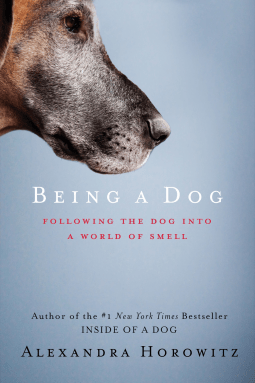
Being a Dog, by Alexandra Horowitz****

beingadogHorowitz is the author of Inside of a Dog, and here she follows it up with an examination of the sensory experiences a dog encounters, primarily that of smell.  I received my DRC courtesy of Scribner and Net Galley in exchange for this honest review. And though I’ve never been a science maven, Horowitz’s unbridled enthusiasm for dogs had me at hello. It’s a book bound to engage any dog lover.
So, do you have a dog?

I’ve had a dog nearly all of my 58 years, with a brief interim here and there.  I’ve never been dogless long, though; either a dog has found me, or I’ve gone looking for one. And so I was glad of the opportunity to read more about what makes my dog—right now it’s Ox, the oversized beagle puppy—work. I’d read a fair amount about dogs, particularly beagles, my favorite breed, and I thought I was well schooled, but I learned a great deal from Horowitz that I hadn’t known before, or in one main instance, in a way I had known intellectually, but not in my gut.

Almost every dog lover has heard at some point that a dog tends to be governed by its smell, and that this is its dominant sense. But until Horowitz took it apart for me and gave me the details, I didn’t grasp the implications. For example, when we throw the ball, the dog pauses before running after it, right? And with our last little dog, my husband and I would note that he wasn’t really looking in the right place, and we concluded that he was as dumb as a box of rocks. We’d yell; we’d point to it. And eventually, after he had sniffed its perimeter, he’d hone in on the ball and bring it back. And this book explains why that is exactly the correct way to do the job, if one is a hound (or other dog) rather than a human.

Sight is so important to us humans; next comes hearing. If we are in a carnival’s haunted house, and if the first room is sightless and soundless, what do we do? Do we sniff? Of course not! We fling out our arms in front of us or to the sides, partly to find out where things are, and partly to protect ourselves from slamming our face into a hard surface. And now when I consider Ox’s sense of scent, after which is hearing, I realize that by the time he has to look at something, he’s probably gained most of the information he needs already. Why would we fling our hands out in an ungainly manner if we can see and hear? And so indeed, why would my beagle do a visual scan if he can find what he wants through the use of sniffed air currents and hearing? After all, he always brings the toy back to us.

Chapters that engaged me less contained miniature chemistry and physics lessons, never my favorite, and some had longer passages having to do with human olfactory sense than I really wanted to read. I confess after the first few times the author moved from dogs’ senses back to those of humans I skimmed until we were back to the dogs.

There was so much here I hadn’t seen. For example, where does one find the best material for search and rescue dogs, or arson, bomb, drug, cadaver dogs, and so forth? I’ll give you a hint: I was crushed to find out that my beloved hound dogs aren’t necessarily the favorites here.  But it sure is interesting!

Once I had read this book, I felt that I knew my dog a lot better, and this new information solved many of Ox’s previously puzzling habits. To learn more, check out Horowitz’s new release, which became available to the public yesterday.

Because although I don’t know whether a dog is man’s best friend…I know he’s mine.

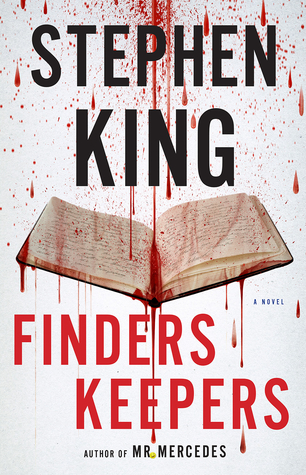
Finders Keepers, by Stephen King *****

finderskeepers“For your family, you do all that you can.”

When I read that one, simple sentence, it occurred to me that this common thread runs through a lot of Stephen King’s work, and it’s one reason he has developed such an easy simpatico with much of his readership, despite the murky waters his books bob into. It’s about our family, and about our common humanity, and the bad guys are the ones that can’t be tapped into, that violate that sacred reality.

As the book opens, we have our killer—or one of them—from Mr. Mercedes. And at this point, I have to tell you that if you haven’t read Mr. Mercedes yet, do that before you do this. (Mr. Mercedes is reviewed by me here: https://seattlebookmamablog.org/2015/04/24/mr-mercedes-by-stephen-king/.) Seriously. I’ve seen clueless-seeming individuals out there on social media wondering if it makes a difference, and oh my stars. Why, why, why.

I suppose if you are just stone flat broke and have no access to a public library, and by some stroke of luck you have a free copy of this book but cannot get the first in the series, then yes, King gives you just enough of the back story here to enable you to start midstream. But if at all possible, you really ought to read the first book first. There were so many little poignant moments—for example when Hodges thinks about Janey—that just made my insides do a back flip, and if you plunge into this story first, you’re going to miss so much of that. And in the end, you’re going to want to hunt down Mr. Mercedes and read it anyway, so why not try to do it in order?

All righty. So as our story opens, Morris, one of the murdering thieves from Mr. Mercedes, is an old man now, and he’s just getting out of prison. He’s been waiting a long, long time for this, because he has buried a whole lot of money as well as the last, hand-scribed novels of John Rothstein, a now-dead author whose work he has loved his whole life. He isn’t sure what he wants more, the money—well yeah—or oh my god, those notebooks! To read them! He knows the sensible thing to do is try to sell them, because they’re doubtless worth a small fortune, but first, just to read them. And now he’s out.

What he doesn’t know is that all those buried goodies have been found by a kid who happens to live and play in the area where Morris buried all of that. Nature has changed the contours of the woods where the trunk was interred, and a corner was revealed, just enough to make a naturally bright, curious kid want to know what it was. So that money is gone. It’s gone. In fact, it’s all gone.

The tension in this story builds a lot more slowly than most of King’s work, and at first I thought it was a sign that our author was slowing down. Au contraire, Pierre. Because really, it’s more about the pacing of the genre. When King writes his supernatural baskets o’spiders, he puts that pedal down on the floor, sometimes on the very first page, and it’s like the world’s most terrifying roller coaster until after the climax. The reader’s heart won’t stop slamming till the problem is essentially solved, at least for the moment—I’m talking about his horror novels here, not his mysteries, including this one—until that brief period at the end in which the loose ends are tied up, and the protagonists can laugh about the whole thing over coffee, or whatever.

The tension in a mystery like this one, on the other hand, is a much more gradual climb. It’s supposed to be that way. We get the tingle of dread, the near-misses, but instead of going from zero to eighty in chapter one, it’s more of a traditional hill, building, building, building. It never gets dull, but the reader will actually be able to put the book down to go make dinner, to do homework, to answer the phone. And that doesn’t make it weaker writing; it’s just a different type of story.

Once King gets to the top of that hill somewhere close to the 80% mark, we really have to stay with the book and finish it. Just finish it.

I did not read this as a galley; it was a Mother’s Day gift from one of my sons. They never miss a year, my boys, and they almost always get me one of my most coveted titles. I don’t put a lot of books on my wish list these days because I can get so many outstanding books free, but I had to have this one, and am glad my eagle-eyed son ferreted it out of my list and ordered it for me. Thanks, Benj.

Is it worth your hard-earned dollars? If you like really good mysteries and thrillers, absolutely, positively yes. BUT. You have to read Mr. Mercedes first!