The Christmas Train, by Rexanne Becnel****

thechristmastrainRexanne Becnel has written a brief, sweet, sentimental story that can only play at Christmas time. Were I to read this story in February, I would roll my eyes. In April, I would stick two fingers down my throat and make little retching noises.

Note that although the publisher bills this as a romance, it is really a love story between many family members, and the protagonist is a child. A great big thank you goes to Net Galley and Simon & Schuster for the ARC.

In October, in November, in December, I sigh contentedly. It really is about the season. Maybe those of us who celebrate this season find permission in it to drop our guards and bury our noses in sentimental stories. It did me a world of good!

Anna is ten years old, and her beloved Nana Rose, the grandmother with whom she has lived most of her life, has died. Her mother can’t wait to spend the money from the sale of Nana Rose’s house, and has no intention of raising her own child for those remaining childhood years. She sends a quick message off to Anna’s father in Iowa telling him the kid is coming and it’s his turn. Then she takes her kid to the train station and dumps her there. First, though, the rules require she find an adult for her ten-year-old to travel with. She finds a very elderly, fragile woman who is headed for the same train stop as Anna, and after a quick conversation to line things up, she drops her girl with the gran-stand-in and books it. Done.

Anna is devastated, and she is afraid of the father her mother claimed had never wanted her. She fantasizes about remaining with the sweet old lady, who reminds her a bit of her own late grandmother. But this old lady has problems of her own.

The tale is beautifully paced, and the characterizations absolutely believable. I could imagine being the child, and I could imagine being the elderly lady.

I dove into this tender bit of prose late one evening and waking with the flu, picked it up again and stayed with it till satisfied, when the last page was turned. After all, I couldn’t abandon the child, and I had to see to the elderly woman, too.

The ending was a little over the top, and if I had my way, I would delete one sentence, but hey, it’s Christmas. Well, almost.

Highly recommended for those who love Christmas!

All That Glitters, by Michael Murphy*****

allthatglittersThis was a quick read, and a fun one. Don’t be left out in the dark when it hits the shelves in January!

Jake Donovan and Laura Wilson have left the Big Apple in their dust and gone to Hollywood, where Laura is about to enter a new phase of her career with a lead role in one of the new talking pictures. All That Glitters, the new episode of Michael Murphy’s Jake and Laura series, a cozy mystery  if ever there was one, is full of Depression-era flavor, complete with celebrities from the time and place in which is it set. The writing is tight and sassy. Murphy has penned a winner! My thanks go to Net Galley and Alibi Publishers for the ARC.

Jake has promised Laura that his risky gumshoe days are over; he is a novelist now, a new leaf turned over for the woman he loves. Who would dream that Blackie Doyle, the protagonist of his series, would have to solve a real-life murder to clear author Donovan of a murder charge that has been tethered to him by scant evidence and lazy cops? Louella Parsons, a real-life celebrity journalist whom Murphy has borrowed to add spice to his already spunky story, wants to see him behind bars; just think what a scoop it represents!

The story is enhanced by one detective who carries a torch for Jake, and another who creates all manner of ridiculous situations with his obvious, bumbling surveillance. Murphy peppers the narrative and dialogue with generous applications of Depression-era slang that sounded to this reviewer as if it had fallen from the lips of her late parents. In other words: it’s a doozy!

Cold weather has come, and now is the perfect time to curl up in your favorite warm hidey-hole with this extremely entertaining mystery. You never know; you may become addicted to the series.

Stranger things have happened!

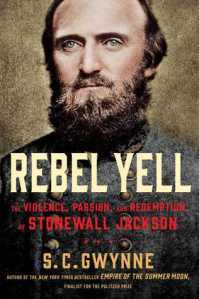
Rebel Yell: The Violence, Passion, and Redemption of Stonewall Jackson, by SC Gwynne ****

rebelyell

Available now! I had a sneak peek from Net Galley and Simon and Schuster; thank you twice, to both of them. Reblogging this for Memorial Day.

Gwynne describes his biography of Jackson as an amateur effort, and as such, it is a strong one. He documents meticulously, using both primary documents and highly respected secondary sources. It is a sympathetic portrait of Jackson, generally speaking, although the author maintains a reasonable professional distance and objectivity. Sometimes his point of view is that of the dispassionate observer, and at other times, he speaks as if he were Jackson’s friend, a quirky touch that I found oddly endearing.

Although I have read a good deal about the American Civil War (and taught about it), I have never read a Jackson biography before, so I don’t have a basis for comparison. This is a bare spot in my own Civil War scholarship that I hope to rectify.

I encountered one obstacle in reading this otherwise well written work, and also what I believe is a flaw. The obstacle–and it’s happened more than once and is no fault of Gwynne’s–is that history can’t be read really well on an e-reader. Elaborate battle plans are described, and then this teeny weeny map pops up. Even if I had been able to use the zoom feature (which on a galley is not offered), I still would have needed to see the whole picture at once to really understand what he did. If you are a reader who is satisfied to know that he did something unconventional and brilliant, this may not bother you, but much of the biography is devoted to specific military tactics, since it is primarily this that brought Jackson his fame. It only whetted my curiosity, and in one way or another, I will follow up at a later time and get maps of those battles on paper in a readable size. If you feel the same, and if you get this book, I strongly advise you to buy the hard cover edition rather than e-reader or audiobook (unless it goes to paperback, which would be both useful and more affordable).

The other thing that bothered me is that Gwynne tries to do too much. The first twenty percent or so goes off onto unnecessary tangents, trying to provide us with a thumbnail version of the entire Civil War from its inception to the time of Jackson’s death. This is both off topic, since the book is a biography, not a Civil War history, and of course also an inadequate history. At the end of the book he does the same thing, trying to thumbnail sketch the ultimate fate of every player in the parts of war in which Jackson participated, and some others also.

On the one hand, maybe this makes it more approachable to someone unfamiliar with the Civil War, but really nobody should plunge into a biography of a Civil War general without first becoming familiar with the basic facts of the war. I would have preferred he consider the basic outline of the Civil War to be assumed knowledge, and move forward, focusing exclusively on Jackson and whatever other information is necessary to set context.

I felt he did well in his detailed sketch of Jackson. His religion was an integral part of his personality, and though I am an Atheist, I have known others who have had the same capacity to carry their faith into everything they do. They don’t remind others constantly to give God the credit for whatever achievements bring them praise, but this is a different time; the period just after the Industrial Revolution saw a much wider and more visible Christianity throughout the US. Others were assumed to be Christians unless they went out of their way to say otherwise. Therefore I agree with Gwynne’s assessment that Jackson’s religious behavior was not a sign of mental illness, but merely a personal trait distinguished by its consistency.

Like other heroes of the Civil War such as Sherman and Grant (my own favorites), Jackson was not successful until the war broke out. He grew up poor and by his own determination succeeded in procuring a military education, which was tuition free. Afterward he became a teacher, but was by all accounts just dreadful. His delivery was mumbled and unenthusiastic, his discipline harsh even for the time, and his instruction consisted of assigning students to memorize passages of the text without his first explaining the meaning of the text or offering a chance for students to ask questions. Students called him “Tom Fool” behind his back and made fun of him in his presence.

The war transformed him, and somehow when it came to training soldiers, he was a wonderful teacher. Anyone who did not seem to understand what to do was drawn aside by Jackson and given one-on-one training. He wanted to invade the Northern states right away, under a black flag (so shoot everyone and take no prisoners). He found this entirely consistent with his religion, since like so many warriors before and after, he was persuaded that God was on his side. His most famous quote, perhaps, is to the affect  that it is good that war is so terrible lest we grow to love it too much. By all accounts, it lit him afire, with a light in his eyes that occurred at no other time. In modern times, he’d be known as an adrenaline junky, I suspect.

His men at first despised him for his long, forced marches through all kinds of terrible weather and terrain, but it was victory that made them love him. Most of them were young, and what better way to march into manhood than a structured situation in which one is guided in his actions, and meets with nearly immediate success? The battles were traumatic, to be sure, but given the circumstances, they would have been drawn into battle, one way or the other. Under Jackson they found an unassuming leader who took no luxuries for himself and didn’t ask his men to do anything that he himself would not do. He became the ultimate father figure for many.

His campaign in the Shenandoah Valley made him famous; his successes at both battles at Manasses (Bull Run), the 7 Days battle in the Wilderness, and others too numerous to list–in fact, I was surprised how many, since I had come to regard Jackson as a star who had shown brightly but briefly–made him a hero even Union soldiers would cheer, and the Confederate news source that claimed that “Stonewall” would become as much a legend as “Old Hickory” (Andrew Jackson) actually understated what posterity would hold for this humble man.

His fearlessness was due to his absolute and utter conviction that God had sent him on a mission, and nothing could happen to him until God was satisfied that his purpose had been fulfilled.

This gives me pause. At what point does one draw the line? He didn’t do anything clearly foolhardy such as jumping into raging rivers or leaping off cliffs, and yet he thought nothing of exposing himself to a hail of bullets near the front of the battle, convinced that he was covered by a magical shield provided by an omnipotent God. Again, I don’t say he was crazy, but it makes me curious. This is one character for whom I’d love to go back in time and have a conversation.

Gwynne’s writing style is lively, his transitions smooth as butter. Another book of his, which I’d like to read, was a finalist for the Pulitzer, and that word-smithery is evident here also. He turns a compelling narrative that at times may make one forget that this is nonfiction, not unlike The Guns of August (by Barbara Tuchman). If he were to refine his format to a more laser-like focus on Jackson, maybe he’ll be nominated again; hell, maybe he will anyway.

A wonderful read; get it in paper format!

Liberty, by Garrison Keillor *****

LibertyKeillor is best known for his radio show, A Prairie Home Companion, on NPR. I have read many reviewers (not from the mainstream media, but amateurs like me, who review on amazon and goodreads) who insist that Keillor is only funny when he delivers the lines himself, and that once you put his work in print, the humor is lost.
Nonsense!

I like reading Keillor’s novels, though the collections of quirky philosophy and bits of his radio work set in print are worth a gander as well. This one is set in the home town he has made known to many of us. (If you haven’t read or heard anything by Keillor, you may still enjoy it, but I recommend reading his classic material first. Lake Wobegon Days is a nice launch-point). In some places it is dry and droll; at other times, I found myself doubled over and gasping for breath. And to be frank, I am not that easily amused.

In fact, I laughed out loud on the first page. People often say, and tritely so, “I couldn’t put it down”, and what they mean sometimes is that they read it often until it was done, and they really enjoyed it. But I genuinely never put this book down unless it was strictly necessary. It was an awesome weekend. I was recovering from surgery and had to be sedentary, and this cheered me up considerably. It is not poignant in the way the L.W.D. is; this is just plain FUNNY. It hit my funny bone from a sort of blind spot and then kept rolling.

Life is serious business, and most of us just don’t laugh often enough. Studies show that laughter actually helps us live longer. But if you get this book and laugh your way to a massive MI, and the last thing you remember is something this hilarious, I still say it’s the best way to go out.

Get the book right away; the Fourth is just around the corner!

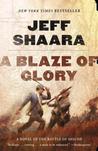
A Blaze of Glory, by Jeff Shaara *****

ablazeofgloryI am a longstanding fan of Jeff Shaara’s. I see occasional criticism of his work that sometimes approaches hysteria, and frankly, I don’t get it. Like his Pulitzer-winning father before him, Shaara uses a combination of extensive knowledge of the war; a fertile imagination; and considerable writing skill to turn America’s most pivotal war into stories. Story, in turn, is a tremendously effective vehicle for teaching about history.

At this point, I should mention that I got my copy courtesy of the Goodreads First Reads program; my thanks go to the publisher. This copy will hold a place of pride in my personal library, alongside the other books of Shaara’s that were given me as gifts or purchased outright for full jacket price. Is it worth full price? I say yes, with this qualification. It’s worth it if you have a serious interest in the American Civil War, and if you are open to reading historical fiction. It’s so named because any time one takes the known facts and adds dialogue, or inner dialogue, presuming to know the thoughts of historical characters, then of course part of it is made up. If you can’t live with that, either stick to nonfiction or go away.

Interest in the Civil War is key here because nobody can turn the battle of Shiloh into a fun read. It isn’t a fun subject. It was tragic. So if you want a fluffy beach read, this book isn’t that.

I was somewhat surprised to note that my own Goodreads shelves had listed this book as read by me, and the rating as 4 stars. I think it may have been an error, because I usually write a review, even if the book wasn’t free to me. However, another possibility exists: if I read it on the e-reader I owned when this book was first published in 2012, a reader now moribund so I can’t go in and check, it might have negatively influenced my perspective. Don’t read this book on your e-reader! You need to be able to see the maps, which are pivotal to understanding the action as Shaara describes it. If you didn’t need it, the author and publishers would not have devoted the space to it. I flipped back a few times to give those maps a second and third glance as I was reading. I do love my (new) e-reader and I use it a lot, but when possible, I read military history and historical fiction on paper. It’s more effective.

When I taught American history, I always kept some of Shaara’s other work on my classroom shelves. Fiction is often more accessible to students who have come to believe that history is a meaningless list of names, places, and dates. When story is used, the reader comes to understand that what took place involved real human beings and sometimes, they even recognize that their lives today might be different from what they are if things had unfolded differently back then. And had I not read Michael Shaara’s The Killer Angels, I might not have decided to read The Battle Cry of Freedom, the Pulitzer winning nonfiction tome by McPherson. I found this was also true of my students, that fiction was often a necessary conduit that made them more willing to read nonfiction on the same topic. And once that bridge is crossed, it doesn’t matter that there was no actual soldier named Bauer who did the things Jeff Shaara’s foot soldier did.

This brings me to the last thing I want to say about this well researched, carefully crafted book. Is a writer of strong historical fiction bound to include only real players in the story he reels out before us? Of course not. It’s fiction; he can write anything he wants to.

Well then, if he invents a character and gives him as much breath and life as the others, who were real, is his writing unworthy of our time and attention? I stand by the writer in this case. There were so many fresh-faced young soldiers out there who won no permanent place in our nation’s history. The working class, the lowest on the totem pole, are often disenfranchised by the fact that their history goes unwritten. For Shaara to create a single character to show that these men are not forgotten is gutsy and laudable. While leadership was critical to winning the war, it’s very important not to forget all those unknown boys and men who marched, slept in the rain and the mud, and sometimes died of dysentery before the next day’s march began. Others can say what they wish, but I really appreciate what Shaara has done in helping us remember the common soldier.

The more good historical fiction I read, the more I am inspired to read more of McPherson, Sears, and Catton. The Shaaras inspired me to read the memoirs of Grant and Sherman; I have a biography of Stonewall Jackson as my next-in-line galley. But the more I read of these masters of nonfiction, the more credible Shaara’s work looks to me.

Again, is this worth your bookstore dollars, or is it something only to be read free or cheap? If you have a strong interest in both historical fiction and the battle of Shiloh, there’s nothing better. Buy the book and read it; if you have to pay the full cover price, do it. It’s a worthwhile investment, and maybe some young person in your life will be inspired to borrow it. What could be more important?

Holy War, by Mike Bond *****

holywarThat was the best horrible story I ever read. Holy War is set in Lebanon during the civil war. There are three protagonists whose stories and points of view interweave throughout this complex, highly literate novel. The plot centers on these individuals, each with one or more relationships whose ruin runs parallel to the destruction and chaos of Lebanon by various opposing forces (with the author’s emphasis on the religious disparity as opposed to the political differences, and indeed it’s a pretty fine distinction to make in this case). I requested the book from Net Galley because I haven’t read anything set in Lebanon. I am aware of the tendency of US citizens to focus over-much on our own enormous nation, and since I haven’t had the opportunity to travel beyond North America physically, I make a point to read contemporary novels set in other places. In this case, it paid off. I learned a good deal. I had never regarded Beirut as having once been a thriving cosmopolitan city; all I’d ever heard on the daily news in past years was “war-torn”. I live in a city that’s so scenic it’s nearly magical, and I am hard to impress when I travel. I have never thought of Beirut as having been lovely, but the writer describes it as breathtakingly beautiful, and the descriptions that he inserts into the story, without breaking stride in his pacing, convince me that it is much more than just some arid chunk of rock and sand. Bond makes the reader want to weep for Lebanon, and for the characters whose lives are coming undone as they attempt to do the right thing; this is considered different, naturally, by each of the protagonists. During the first third of the book, I was distracted by trying to figure out the writer’s political line. He doesn’t really have one, though, apart from the wish that this beleaguered place might have peace. I also initially wondered why all the sex and relationship material was jammed into what is otherwise essentially a thriller; then I began to see the parallels (although I could really, really live without ever seeing the “c” word applied to women’s anatomy ever again). In the end, inevitably, the protagonists find themselves in the same place together after having missed each other by mere inches at times throughout the story line. I won’t tell you how that plays out; you’ll have to see it for yourself. By the story’s end, though, each of the main characters seemed so utterly lost and hopeless to me that I found myself rooting for the dog, which was supposed to be peripheral. I engaged enough with Bond’s novel that I had to go look at a world map (and happily, we have one on the wall in our hallway) to see where exactly Lebanon is located. As it happens, Israel is smack in the center between Lebanon and Palestine; hence the struggle of the Lebanese Palestinians. I also found myself wondering why Britain (one protagonist‘s homeland) and France (another’s) feel they have any right to determine what happens here. There is no American protagonist, and yet I know the USA hasn’t exactly kept its hands off or its voice silent, either. But Lebanon is a tiny, tiny place, dwarfed by Syria, and practically a fly on the wall in contrast to Saudi Arabia. So why are all the big dogs interested in this tiny place? Are the Americans looking for a military base to replace the one they lost in Iran when Reza Pahlavi was chased away by the Iranian people? Or is there money involved? (At one place fairly early in Bond’s plot, a character says that wherever there is a war, profit is driving it, and I agree.) A trip to Wikipedia tells me that there’s oil in the Mediterranean. Hypothetically, then, the whole thing should be left to the countries that border the Mediterranean, but it would be naïve to believe it could shake out that way. And just as the great cedar forests of Lebanon have been razed for the betterment of Europe, one wonders just what shape the Mediterranean will be in once the next great oil disaster occurs there. Of course, you can read this book without examining all of those questions. It’s a fine read right on the surface level, but you’ll need a strong literacy level and full attention for it, regardless. This is not a beach read. It’s serious stuff. For those who enjoy a good thriller or have an interest in Beirut, you should get this book as soon as you can.

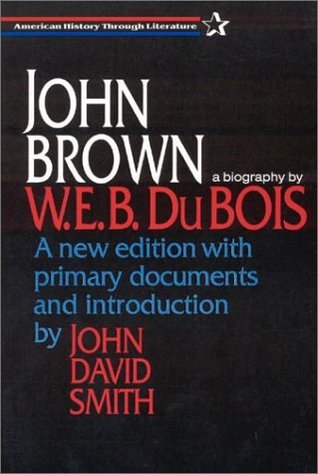
John Brown, by WEB DuBois *****

johnbrownThe class I took in college that featured John Brown as a small figure in American contemporary history dismissed him fairly quickly. He meant well, but was not stable, they said; in the end, he took extreme, hopeless measures that were destined for doom. He remained a hero to Black families (they admitted), South and North alike, as the first Caucasian man who was willing to die for the rights of Black people. Whereas many White folks (those with enough money for a fireplace and a portrait to go over it) featured a family ancestor or a painting of George Washington, Black homes often had a picture of John Brown.

The problem with that education is that no African-American scholars were included in this very central, pivotal part of the prelude to the American Civil War. I doubt anyone would doubt the credentials of this writer, whose urgent and compelling defense of Brown as a selfless but sane man with a perfectly good plan that went wrong due to a couple of the people in key positions of responsibility for the taking of Harper’s Ferry held my face close to the book (it is not the edition pictured; mine is so old, we’ve had it for so long, that the plastic lamination on the paperback has half peeled off, and it is not featured here!). The writer’s words forced me to read it, though I am no longer a student, with a pen in hand to underline and star key passages.

It’s tempting to leave it here, but I think I need to give you a couple of instances that may draw you, if you like history, care about the rights of Black people in the USA–because the oppression that started here is still not over (that’s me speaking; DuBois died in Ghana in 1963), if you are interested in the Civil War or Brown in particular, you have to read this book.

Tidbits that do not spoil, then: Harriet Tubman planned to be there with him. She became seriously ill and was confined to bed; otherwise, she meant to fight alongside him.

White writers have all assumed that his escape route was impossible. They have the WRONG escape route; DuBois explains the actual plan.

The Underground Railroad was run almost entirely by Black people, some of them wealthy, in the Northern US. DuBois points out that free Blacks owned over a million dollars worth of property, free and clear.
It was this same large body of free Blacks who provided the funding for Brown. He would have had more, if he had not become ill, and the loss of momentum removed most of his Canadian backers. Indeed, DuBois states that Brown most likely went to Harper’s Ferry physically ill and “racked with pain”, that he was very gaunt due to illness and poverty, but felt that to wait longer would be to lose his support and those he had gathered (a small group) for the initial attack.

To say might make you feel as if you have little reason to read this book. It is eloquently laid out as only a wordsmith such as DuBois is capable of doing. I am deeply sorry I waited so long to find time for it.