For the Dignified Dead, by Michael Genelin****

forthedignifieddeadThere’s a murderer on the loose, one that has killed across international boundaries. The weapon of choice? An ice pick. Happily, the case is assigned to total bad-ass Commander Jana Matinova, the best new female detective I’ve seen in emerge in crime fiction in decades. Thank you to Net Galley and Brash Books for the DRC. This title will be available for purchase November 3.

Part of what initially attracted me to this novel was the setting. Though Matinova finds herself crossing into various parts of central Europe, she is based in Slovakia, a country not even on my personal radar. By way of apology, I will point out that for most of my life, a giant swath of Europe and Asia was designated as USSR, and the satellite states lined up like faithful guardians around its perimeter included Yugoslavia and Czechoslovakia, both of which have been carved into different nations since the Stalinist realm crumbled. So I thought I’d learn a little bit about the contemporary contours of central Europe in the most enjoyable way possible—through fiction.

Genelin doesn’t disappoint. Along with Matinova, we have a collection of other cops, some of whom garnered truly fetching descriptions, such as this one: “With his thinning hair and lopsided smile he looked like a harmless, slightly unkempt beagle without its long ears.”

In addition we have the sinister Koba, a master criminal that Matinova considers akin, perhaps, to Holmes’s Moriarty. Koba’s role in Genelin’s story is complex and fascinating.

But most of all, I appreciated the development of Jana Matinova, both for her silver-bullet speed and cleverness, and also for that which is not included. We never hear about her hair, makeup, or her figure; we don’t need to know anything about her love life, and if she experiences any ambivalence about her lack of a domestic life, we don’t hear about it. In fact, Genelin treats his protagonist just as he would a male protagonist.

Now isn’t that a breath of fresh air?

The fifth star, which I would have loved to be able to add to this engaging story, is denied because of problematic passages that popped up often enough to warrant ten different notations in my kindle: “Too wordy! Tighten it up!” It seemed either as if there were two writers, one more capable than the other, co-writing the novel, or as if someone whose mother tongue is not English was struggling to say what needed saying. I noticed this was most frequent during passages of narrative, and less likely to occur during dialogue. Whatever it is, it could benefit greatly from either some rewritten passages or strong editing. But every time I found my eyes jerking through one of these verbose areas in the text, sooner or later we would come out slick as a whistle, and everything would commence to flow again. I don’t think a published text has ever confused me so much in this regard.

That being said, I would cheerfully read other books in this series given the opportunity. Because when push comes to shove, Commander Jana Matinova is a champ!

The Remarkable Rise of Eliza Jumel: A Story of Marriage and Money in the Early Republic***

theremarkableriseofelizajumelEliza was born in a brothel, but over the course of her lifetime became a very wealthy woman who took substantial joy in rubbing shoulders with the bourgeoisie in the USA, and in getting as close as she possibly could to the royal family in France. This scholarly biography is her story. Thank you to Net Galley and Chicago Review Press for the DRC. The book will be for sale November 1.
Eliza Bowen moved to New York at an early age and shed her last name and identity, realizing that socially and economically, she had nowhere to go but up. Her ambition was limitless, and her intentions entirely fixed upon her own well being. She married Stephan Jumel, a wealthy Frenchman living in the USA, and set to work spending his fortune. No home was too grand for her tastes, and once she had the place, she set to work making improvements beyond ordinary repairs and redecoration. Her husband trusted her business acumen sufficiently to put real estate in her name in some instances, and this was nearly unheard of during the period in which they lived.
When the Jacobins and Napoleon had been defeated and the Bourbons were back on the throne, Jumel wanted to go home and stay there. His wife had other plans. After his death, she married the notorious former vice-president Aaron Burr. The marriage was short-lived, and they divorced after only about a year of marriage.
The documentation and research Oppenheimer has done is excellent, once her story really gets rolling. The initial ten percent or so, during which Eliza’s predecessors and early life are covered, is almost entirely surmise, and so we constantly read “might have”, “probably”, and finally, “…we can only speculate.” Given the opportunity, I would edit that out completely. The story stands without it, and so it really is unnecessary filler. My recommendation to the reader is to skim up to the point where she meets and marries Jumel.
Eliza Jumel is not an appealing individual, and since the nature of Oppenheimer’s narrative is expository, she makes no excuses for Eliza’s avaricious and sometimes unprincipled behavior. The woman was more than a survivor; she was a predator. But Oppenheimer has been thorough in providing us with a picture of her climb, financially and socially, and she is meticulous both with details and documentation.
Jumel’s life story isn’t a particularly enjoyable read, but for particular aspects of research, mostly topics steeped in women’s history within the US, it is a very useful resource. Scholarly and well documented, students of women’s history in the US will benefit from it.

Pop Goes the Weasel, by M.J. Arlidge***

popgoestheweaselPop Goes the Weasel is the second in a detective series featuring Helen Grace. Thank you to Net Galley and Random House-Penguin for the DRC. The title goes up for sale October 6.

Arlidge is an experienced, confident writer. The opening of the book is among the best openers I have seen for quite awhile:

“The fog crept in from the sea, suffocating the city. It descended like an invading army, consuming landmarks, choking out the moonlight, rendering Southampton a strange and unnerving place.”

The tone is thus set for a grisly murder mystery, the perfect mood for an October read.

The premise here is that someone is murdering men that seek the services of prostitutes, and their slayer doesn’t merely kill the men, but eviscerates them without the courtesy of killing them first. Well, this may not be exactly evisceration: they aren’t removing their digestive tracts, but rather their hearts. And while I read that description before requesting this DRC, I should have dwelt on it a moment or two longer, because this particular story really passed my “ick” threshold, and it was my own fault for not being more careful in reading the promotional description.

That said, although it was a bit much for me, it probably won’t be for you, not if you watch a lot of cop shows on television or view a lot of adrenaline-pumping movies that feature violence. That said, I would also steer away anyone who has recently had a death in the family. The descriptions of the cadavers were so explicit that you may find your mind making leaps you didn’t count on.

Grace’s situation is linked to things that happened in Arlidge’s first in the series, and they are referred to often. You may be better off reading these in order. I didn’t read the first, and although I was able to keep up just fine in terms of following plot and character motivation, I felt a little as if I were a guest at someone else’s family dinner. There were so many little undercurrents that referred to Grace’s earlier experiences, as well as those of Charlie, another cop who’d been in the previous story as well, that I felt a bit left out. I also had difficulty, for the first half of the story, keeping Helen and Charlie distinct from one another, and this part I chalk up to the author’s failure to adequately describe each of them. Whether it is the first or tenth in a series, the author has an obligation to provide a clear picture of the protagonist as well as other important characters. That didn’t happen here. Eventually I understood the motivations of each, as well as a good deal of Helen Grace’s internal characteristics, but I never was able to form enough of a mental picture of their appearances to make a mental movie. At times, I felt as if the explicit gore and sex were substitutions for character development. The plot itself was a trifle formulaic.

For those that read the first in the series and enjoyed it, this second in the series is bound to please. It is to those readers that I recommend this mystery.

Wakefield, by Andre Codrescu ***

wakefieldWakefield is absurdist, dark humor written by award-winning poet and playwright Andre Codrescu. Thank you to Net Galley and to Open Road Integrated Media for permitting me to access a DRC. The title, originally published in 2004, will be available for purchase digitally September 8.

Wakefield is an anti-motivational speaker. He’s in great demand. People grow weary of the cheerful chipmunk types that show up with a big grin and a you-can-do-it attitude, and so corporations are seeking balance by also providing a guy that tells them it’s all a waste of time. As a natural cynic, Wakefield assumes, when the devil comes to call and tells him his time is up, that he ought to be able to strike a Faustian bargain. But oh what a surprise—the devil doesn’t want his soul. “You’re assuming, dear sir, that you have one…”

The devil wants one thing only: proof that Wakefield has found a “true life”. This broad brush stroke gives the author all sorts of leeway. At times, Wakefield’s search is savagely funny. There are some literary references that I thought were terrific; quirky philosophy; and, true to his poetic nature, some kick-ass figurative language.

The main problem is that the plot doesn’t really have a structure to hold onto. “True life” is too general, and so Wakefield wanders, both geographically, in his relationships, and in his own thoughts. The author is obviously a very intelligent man, but he’s relied too much on innate cleverness and not enough on the structural requirements of a novel. Even the most unconventional literature needs to be able to hold its audience, or it won’t be successful.

I confess I took issue with the author’s characterization of Marxism as a kind of religion; then as well, one might think that someone that spends his life considering matters philosophical would recognize that Marxism and Stalinism are not necessarily identical.

But this isn’t the reason for my rating. The three stars reflect a story that has moments of great strength, even ones that made me laugh out loud, but its inconsistency and lack of a problem that builds, peaks, and is resolved in one way or another, makes it hard to get a handle on. The result was that I found my attention wandering at times, which doesn’t happen much , and then I’d have to tab back a few pages and do some rereading. Even with notes in my e-reader, I can’t find any functional pattern. There’s an ending of sorts, but it seems to be sort of tacked on because the book has reached its required length, rather than because the plot has led us there.

Those that are familiar with Codrescu’s other work and are fans may feel differently, and so I recommend this novel to that niche audience.

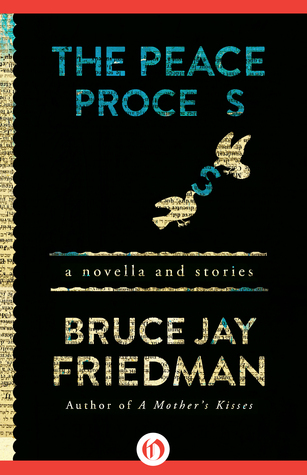
The Peace Process, by Bruce Jay Friedman ****

thepeaceprocessThe Peace Process is actually a collection of short stories plus one novella at the end. The writing is edgy all the way through and in a number of places it’s very, very funny. Thank you to Net Galley and Open Road Integrated Media for providing me with a DRC to read in advance. This collection will be available to the public October 13.

If any work of fiction you have read in the past five years or so has offended you in any way, the first selection in this collection is guaranteed to do so. It did me. Frankly, I am such a consistently fast, thorough reviewer that I could blow one off right now if I was disturbed enough by it, and I came pretty close. I don’t like to spoil things, but at the same time you ought to be warned. Is incest—even imagined incest, and with details—offensive to you? Is there a way to make a boy’s graphically imagined incest with an older sister acceptable, even funny? If so, then this is your collection. As for me, I almost wrote to the publishers to tell them that I wasn’t reading or reviewing one more story in this nasty little book; fortunately for me, I looked at the table of contents, figured out how much more of the book there was left to read, and decided to stick with it for one more story. And the next story, “The Storyteller”, was funny enough that I forgot—well, almost forgot–how mad I’d been a few minutes before.

But I seriously question the editor’s choice to put that one dreadful story right up front. It’s almost like begging the reader to throw the book out the window.

Moving on, the writing in all the other stories, from the second on through the last, is really strong. My imaginary red teacher’s pen sometimes comes out when I’m reading a galley, and I’ll think how much better the work would be if we could just nip this part here and take a meat-axe to another section. Not so for Friedman. Every word is well chosen, and the pacing is taut and brisk. Besides “The Storyteller”, my other favorites were “The Choice” and “The Strainer”. The endings always surprised me, and a couple of times, had I not had someone sleeping beside me as I read, I would have moaned aloud when I reached the denouement.

If I were to advise someone with tastes like my own as to whether to read the collection or leave it go, I would say get the book; skip the first story; read the rest of it. But then, you have to decide these things for yourself. I’ve done what I can, and the rest is up to you.

For fans of edgy, dark fiction, recommended with the caveat mentioned.

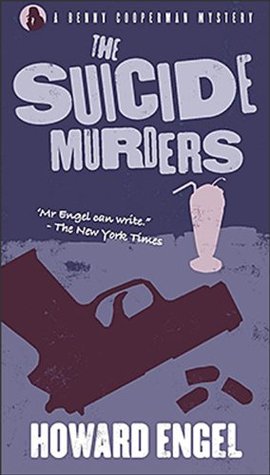
The Suicide Murders, by Howard Engel****

thesuicidemurdersThe cops said Chester killed himself. The gun was there, and he had powder burns on his head, powder on his hand. Everything tested out right. But he’d ordered himself a brand new bicycle just two hours earlier. Does a suicide do that? And then there was the very lovely wife that had been to see Cooperman, our detective protagonist, just before the unfortunate event, concerned that her man had perhaps been unfaithful. She’s caught him lying to her, and that makes a lady suspicious.

These things leave a guy like Cooperman with questions. True, he’s not a cop: “Me? I’m just a peeper. Divorce is my meat and potatoes.” But when something stinks, it’s in Cooperman’s nature to go find the source of the smell and air it out. And when others die after Chester, it makes Cooperman, who’s nobody’s fool, ask even more questions.

I received the DRC for this vintage novel, now available digitally, from Net Galley and Open Road Integrated Media. It became available for sale August 24, so you can get it now.

Engel is an experienced writer, and as he plays the thread out, with murder upon murder integrated deftly into the everyday life of Benny Cooperman, he strikes an excellent balance, building suspense and driving the plot forward with the occasional humorous reflection to keep things from becoming too ugly to be fun for the reader. And his character descriptions are particularly memorable, as with this local politician:

“He was a big man by anybody’s scale. His face looked like a roast beef dinner with all the trimmings, with a huge portion of nose in the middle. “

There were a couple of moments when the predictable occurred, but it wasn’t so dead obvious—excuse the pun—as to be an eye-roller. Rather, I experienced the satisfaction of having seen it coming and been right. And to me, as long as there isn’t too much of it, and there wasn’t, that is a sign that the writer has been fair to his audience. There are no sudden introductions of new characters during the last ten percent of the novel that change the solution in a way impossible to predict, and a lot of us like working the puzzle as we read. There are a couple of sexist references—“the kind of girl”, “bimbo”—that were commonly used in 1980 when this was first published that I didn’t care for, but they were infrequent enough that I was able to make a note to myself, and then continue to read and enjoy the story. In the end, the wry humor and up-tempo plot line makes this one a winner.

Although there are vague sexual references and infidelity is part of the plot, there is no graphic sex that should prevent a parent of a precocious adolescent mystery maven from handing the book down once they have finished it themselves. It’s hard to call any story that contains multiple murders a cozy mystery, but this one is in or near that ballpark.

Altogether a satisfying read.

My Life on the Road, by Gloria Steinem*****


mylifeontheroadI’ve been thinking a lot about Steinem since the recent unfortunate episode on a TV talk show. I was heartsick. What woman gets past 80 without a single regrettable senior moment? But most of us will be fortunate enough to have a spouse, partner, adult child, or other companion who will take us aside and suggest we rethink what we’re doing or saying. “Mom, I’m getting a little worried. Can we check your meds? What do you think?”

But Steinem doesn’t have that sort of support system. The women that were closest to her for a long, long time are already dead.

So I republish this blog post asking you to think, not about the single magic moment, for which she later apologized, but instead, for all the amazing accomplishments and selfless deeds she has done on behalf of women, and for her willingness in a time when most of white America kept to itself, to learn at the feet of women of color.

Because this is her legacy; her real one.

Feminist heroes are everywhere, but if I had to name half a dozen women that were at the core of the feminist movement that followed closely on the heels of the Civil Rights movement and the movement to end the US war in Vietnam, Steinem’s name would be among them. In fact, hers might be the first name out of my mouth. It was she who coined the salutation “Ms”, and who founded Ms. Magazine. When I saw she had written a memoir, I knew I had to have it, and when Net Galley and Random House gave me the DRC, I was delighted. But this is one of the few books that if I’d had to, I’d have been willing to pay full jacket price in order to read. Heroes are thin on the ground these days, and we treasure those that still walk among us.

My reading records reflect over 300 biographies, autobiographies, and memoirs I’ve read, and I didn’t even start listing them until about 3 years ago, so who knows how many? The one thing I know to expect, when someone really famous sits down to tell us about her life, is that the ego will be there. It might be veiled, especially if the person is famous for writing as opposed to something else, or it might be big and bold. Once in awhile it’s been so bald-faced that I came away wishing I hadn’t read the book so I could go on liking the author. So for one of the most famous of living feminists, I was braced and ready.

And this icon’s ego isn’t there. I don’t mean she hides it well; I just don’t find it. And it appears as if large amounts of time spent among Native sisters in struggle—Wilma Mankiller foremost among them—taught her so much about focusing on the circle, rather than a table that has someone at its head, a big-boss type, that she let go of whatever ego she might have been thinking about building. For example, when she works as an organizer, she dreads public speaking, but looks forward to the place at which one part of the auditorium begins to answer the questions from another part, and she knows a circle has formed, one in which she becomes just another person present. I was blown away!

Steinem began her career in journalism, and she is one of the finest writers whose work I have read. For a brief time in years gone by, I dismissed her because of her sometimes-attachment to Democratic party candidates, but the sum of her contributions has been so much more that I missed the forest for the trees during that time of my life. Now I want to read everything she ever wrote.

Travel is a great metaphor, but it’s also a material fact for Steinem. She grew up with a father who was a traveling salesman, and unlike most such men, he took his family with him. For most of her childhood, there was no home, merely a series of stop-overs. This rootless existence would leave some children traumatized. Kids thrive on routine, and not all would be able to translate constant travel into a sense of the usual. But Steinem mostly remembers it as a positive attribute, and credits her parents for their capacity to question social norms during a time most Americans were madly conforming. The fact that she continued to live out of a suitcase once she was grown and on her own is the greatest testament of all to her upbringing, and to her response to it.

There are oh, so many stories, some of which made me laugh out loud, and others that made me think. You can go winnow those out for yourself. And of course, my favorites may not be yours.

But the one thing I can promise you is a really great read, one with depth, yet not difficult to access. It’s friendly and feels as if we are having coffee with an old, dear friend, right at the table with one another. A circular table.

You have to read this book. It will be for sale October 27.

Storme Front: A Wyatt Storme Thriller, by WL Ripley*****

storme frontStorme Front, the second mystery in the series featuring former NFL player Wyatt Storme and his buddy, Chick Easton, is smart and sassy. Ripley proves that an action-packed thriller with a he-man protagonist is stronger, not weaker when it treats women respectfully, as equals to men. Thank you twice, first to Net Galley, and second to Brash Books. I received this DRC from them in exchange for an honest review. This title was released August 4, so you can get it right away.

When someone offers one a thousand dollars to make a single, simple delivery, it’s natural to be suspicious. But when it appears to also involve pulling a good friend’s cojones out of the fire, an experienced badass will sometimes agree, however cautiously, to tag along. So it is here. Drugs, guns, and bodies pile up, and all through it runs some kick-ass banter that made me laugh out loud a number of times. The exchanges are typically between Wyatt and Chick, but there’s some pretty strong humor, at times, in the interactions between Wyatt and his fiancée, Sandra Collingsworth, as well. As well as respect. I like the respect even better.

“No one likes smart, self-assured women, you know.”
“Except you,” she said. “And I’m glad.”

Complicating the picture without making it into a soap opera is the involvement, however peripherally, of an old flame of Wyatt’s. They split up a long time ago, and she married the man whose afore-mentioned cojones Wyatt is trying to salvage.

“His wife?” said Billy, smiling. “Ain’t she a sweet piece of—“
“Her name’s Kelly,” I said, interrupting. “But you can call her Mrs. Jenkins.”

The action is linear in format, so the fairly sizeable number of characters doesn’t create confusion. Then too, Ripley’s memorable character sketches certainly help:

“Snakeskins came around the truck. He had a big face, crooked nose. About thirty. A little overweight. Too many Coors in cowboy bars. Blond mustache, untrimmed, and a diamond stud in one ear. His hands were immense.”

Oh, there are so many more memorable passages, and I highlighted 78 of them, just for giggles. But the fact is, I would just hate to ruin it all for you. All told, the flavor is a bit like Sue Grafton’s, but with male protagonists in Colorado.

The examples I’ve provided show up early on, but the pace never slows till the last page is turned. In the end, I just wanted to read the next book in the series. And so will you.

Highly recommended for mystery and thriller lovers, or for anyone that needs a snappy, amusing beach read.

Everybody Rise: a Novel, by Stephanie Clifford****

Savagely funny, and newly released.

seattlebookmama's avatarSeattle Book Mama

everybodyriseAll Evelyn has ever wanted is to please her mother; all Barbara, Evelyn’s mother, has ever wanted is for Evelyn to be accepted into elite Eastern society. Barbara doesn’t care whether Evelyn is well read, but she had sure as hell better know which spoon to use, and what to wear to every occasion…and most of all, she had better know “everybody who’s anybody”. In other words, Clifford’s skewer of high society hits the mark in ways both wry and hilarious. This terribly amusing little tale goes on sale August 18—oh wait, was my rhyme a trifle tacky? Anyway, you can buy it soon, or you can order it in advance, but I was lucky and got a copy free from Net Galley and St. Martin’s Press for this humble review. Thank you to both of them.

Evelyn’s parents want different things, and it’s just her luck—she is their only…

View original post 337 more words

The Oregon Trail: An American Journey, by Rinker Buck *****

It’s for sale, and you should get it! Of over 100 DRC’s I have read and reviewed over the past year, this one remains a favorite.

seattlebookmama's avatarSeattle Book Mama

theoregontrailBuck is a journalist and author who replicated (to the extent possible in modern times) the covered wagon crossing of the old Oregon Trail, much of which still contains the original wagon ruts. A creature of the Pacific Northwest myself, I thought I had the whole Oregon Trail story down cold, but I learned a lot from Buck’s wonderful memoir, which threads his own experience with the historical information he gleaned from a variety of sources into a fluent, fascinating, accessible yet hyper-literate narrative. My great thanks go to Simon and Schuster and Net Galley for the ARC. The book will be available to the public in August of this year.

Buck discusses his experience, and the book, here:

The germ of Buck’s idea to travel the old Oregon Trail in a covered wagon came from a favorite childhood experience. Buck’s father took his large family on a covered wagon…

View original post 802 more words