Tricky Twenty-Two, by Janet Evanovich

tricky twentytwoHere’s the short version: she’s done it again! Janet Evanovich’s latest Stephanie Plum novel was one of only three titles on my Christmas wish list. I get most of my books free prior to publication, and the rest I can generally find at the library. But I wanted this one hard, and my eldest son came through. And for the first 36 pages, I thought our writer had lost her magic. Turns out she was just warming up; my first laugh was on page 37, but most of the fall-down-funny moments take place during the last third of the book.

This one starts out with Stephanie finally ready to get off the fence and make a definite choice between Morelli and Ranger. Just as she gets ready to commit, she is surprised to discover her charms are rejected. Bummer. But her bad luck has only just begun. She’s being stalked by an amorous stranger who knows where she lives, and what appears to be a fairly routine FTA re-schedule job turns out to be a madman on the loose, one that may be breeding biological weaponry.

In this installment Grandma Mazur discovers social networking in a big way; Stephanie discovers there are new and different ways to have her vehicle destroyed; and Stephanie’s mother breaks loose from her kitchen and kicks some ass.

You probably won’t want to miss this one! I read it in three evenings and was sad when it was over.

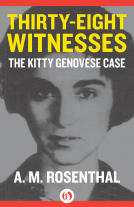
Thirty-Eight Witnesses: the Kitty Genovese Case, by AM Ronsenthal***

38witnessesAM Rosenthal was a journalist, but in the 1960’s he was moved to write this relatively brief book—if fictional it would be considered a novella—about the failure of neighboring New Yorkers to come to the aid of Kitty Genovese, a woman that was murdered in 1964. I received this DRC free of charge from Net Galley and Open Road Integrated Media in exchange for an honest review.

The crime, one that occurred before drive-by shootings and mass killings in schools and other public places became an all-too-frequent occurrence in the USA, horrified New York and all that heard about it. The killer attacked 28 year old Kitty Genovese as she returned home from work. She lived in a middle class neighborhood, and when police later investigated, they would learn that 38 witnesses heard her scream for help. Nobody called the police until it was too late to save her. This is especially horrifying given that the killer left her bleeding after stabbing her several times, and she had the time, while he moved the car, to approach an apartment building and make her way inside its doors. But before she was able to go further, her murderer parked the car and returned to finish the job. She screamed a number of times, and one man opened his window and yelled at whoever was down there to leave her alone. Later the coroner would testify that had any of the witnesses phoned the police sooner, Kitty could have been saved. Instead she bled to death.

Largely Ronsenthal uses this opportunity to wax philosophical, both about the callous nature of people in general, and of New Yorkers. One New York newspaper managed to infer that it was her own fault by referring to her as a “barmaid” and mentioning that she was not living with her husband; the takeaway from this appearing to be that had she stayed with the mister and been home raising kids, she would not have been in danger. In this instance I think we can surmise that half a century later, any journalist who got that kind of misogynistic garbage past his editor would have heard from readers.

I found this little nugget hard to review. Part of it was due to a stereotype I wasn’t aware I carried; I assumed this attack was somehow related to the mafia (note the Italian last name). Whoopsie! Yes, I know that not everyone that bears an Italian name has a mobster in the family. So it goes.

But also, it’s an unusual piece of writing in that it isn’t really a memoir, isn’t really philosophy, isn’t really sociology. But the overall thesis appears to be that human beings don’t take good enough care of each other. He also uses the occasion to speak in defense of New York cops, who performed their jobs as well as they could in this circumstance. But what timing, given the behavior of NYPD of late! The piece hasn’t really aged all that well.

The writer speaks of a time in India when he himself failed to help others, a time when he regularly strolled past beggars that were ragged, often badly disabled or diseased, and he didn’t help them. He brought this item back time and again to where it felt a little like breast-beating and gnashing of teeth. I wasn’t interested in providing the author with the catharsis he seemed to be reaching for. For that, get a therapist already!

In all, I think his narrative is probably geared more toward native New Yorkers, and since the event is long gone and doesn’t really have a modern parallel, the niche that may be interested has shrunk to New Yorkers of Social Security age.

The writing was fluent, as one might expect of a seasoned journalist, but its prime period has come and gone. I was happy to read it free, but would not have wished to pay for the privilege.

Chasing Ghosts: the Policing of Terrorism, by John Mueller and Mark Stewart***

chasingghostsI suspect just about everyone in the USA, or who frequently has to travel to the USA, is heartily sick of the extreme security measures that raise our taxes through the roof and cause so many delays, inconveniences, and even the confiscation of ordinary products that cost us a fair amount of money, on those occasions that we foolishly forget not to take them with us on the plane. The racial profiling makes it even worse. And so I requested this DRC from Net Galley and Oxford University Press with the expectation that I would agree with it wholeheartedly and immediately form the virtual simpatico with its writers that readers form with their favorite authors. Alas, not so much.

It’s not a terrible book, but it’s also not a great one. The writing style comes across as strangely antagonistic, odd given that I was ready to agree with them when I began the book. They make a lot of good points, particularly in comparing the expenditures of the Federal government to the amount that was spent on the Cold War and the anti-communist hysteria of the 1950’s. But whenever I read scholarly nonfiction, I am inclined to check out the end notes early on, and I was struck by the large number of times Mueller and Stewart quoted themselves (or sometimes one or the other of themselves separately). Their other sources were more likely to be newspapers and magazines rather than primary documents, which were used sparingly.

My sense is that if you’re going to challenge the status quo, you have to roll up your sleeves and do it right. In this case, a worthy thesis, at least to some extent, is less credible than it might have been with more diligent research and more legitimate scholarship.

My gut was inclined to rate this book two stars rather than three, but then I realized that my gut was responding to the ISIS mass killings in France. For the writers, it’s just pure dumb bad luck that the real terrorists created such tremendous outrage and heartfelt sympathy throughout the Western world, and in doing so underscored the reason such stringent security measures are in place, just as their book was nearing publication.

The most compelling argument against the Patriot Act and all of its associated agencies and agents is that when someone is willing to die in order to commit a mass killing, nobody and nothing can really stop them. The security measures being utilized are effective against people that want to enter an establishment or a vehicle and kill as many people in it as possible, then walk away and live to kill more people another day. This wasn’t the primary argument Mueller and Stewart rolled out. Their main argument, that the Bill of Rights is being trampled by the very government that was invented to uphold the Constitution, is a good one and I think would have been easier to get behind had events not unfolded as they did, and of course, had the source material been more impressive; yet the safety of all of us will always preclude individual liberties. So in a sense, ISIS gives the conservative, locked-down wing of the ruling class a red-carpet invitation to clamp down on civil liberty; but that would not have made a book that would sell, and perhaps that is why the authors didn’t make this their focus.

If this is an area of interest to you, you can get a copy November 30. I wouldn’t pay hard cover price for it unless you have tremendous interest and very deep pockets, though.

The Lake House, by Kate Morton *****

thelakehouseAs a rule, I am not fond of British fiction; I prefer working class protagonists to the silver-spoon variety; and I like urban settings more than pastoral ones. But The Lake House is written by the author that produced The Forgotten Garden, and so when I had the chance to grab the galley, I went for it. And once more, experience proves that a brilliant writer can sell any story, in the setting of her choice, with the protagonists of her choice, and she can make it flow smooth as warm butter.

This deep, luminous story came to me from Net Galley and Atria Books, a division of Simon and Schuster. Thank you once, twice, and a third time too, because Morton has done it again. The book is a must-read for all that love mysteries and literary fiction.

Sadie Sparrow works for the Metropolitan Police, but her job hangs by a thread because she has become over-involved in the case of a missing woman. A toddler was found abandoned in her home, and Sparrow is haunted by the insistence of the child’s grandmother that her daughter would never, ever leave the child intentionally. Sparrow has been told to take some time off and stay away from the case; she retreats to her grandfather’s home in Cornwall, and becomes transfixed by an older, colder case, that of the mysterious disappearance of a child that lived in the beautiful old home nearby, Loeanneth, where a baby boy vanished many years earlier. Sadie sublimates her urge to follow up on her current, forbidden case by poking into the old mystery in Cornwall.

Morton takes us deftly from one setting, both time and place, to another so seamlessly that we cannot help being spellbound; this is literary fiction at its best. We meet the various members of the family that once summered in the once-lovely, now neglected Cornwall estate, and we watch across the years over three generations of the Edevane family that lived there, both in the years before World War II up to the present, with its elderly descendants that remain living.

Rather than a gripping page-turner, this is a well-crafted tale to be sunk into, like a feather bed or one’s favorite chair, with the phone turned off and a steaming cup of coffee (or tea, if you must) to go with it. Those without the stamina for a complex, well-developed story of the necessary length will find themselves frustrated; this one is for true literature lovers, so be prepared to give it the time it deserves.

The characters are developed so expertly that they feel like people we have known a long time. My favorite was Eleanor, who in my own mental movie appeared as a young Vanessa Redgrave; readers of a later generation than mine will choose some other face to match Morton’s description. Every possible stereotype one might create having to do with women of that time and social station has been cleverly sidestepped in a fully credible manner. Even the haughtiest among them is presented with dignity and a certain grace.

Some will find the ending a little too perfectly resolved perhaps; I find it congenial.

For those that like visuals to go with their fiction, here’s a clip of grand homes in Cornwall:

Liar, by Rob Roberge*

liarApologies, dear reader; I hate having to pan a book. I only request galleys that I believe will be either good or great, but when I inadvertently find myself with a terrible book, I have to call it as I see it. I have another review about ready to post that will occupy this space soon.

I received this DRC free of charge from Crown Books and Net Galley in exchange for an honest review. To be honest, it is the second-worst galley I have ever read. (The very worst lacked punctuation and was unreadable.) I wondered how a book like this wound up with such a reputable publisher; an internet search tells me that he has written other books that were well received. But I can’t find any redeeming value here. I actually came out of it feeling as if I’d been played, and I read it free.

This memoir is billed as a testament of sorts to the writer’s mental illness. I have a relative who struggles with bipolar disorder, and I like the idea of educating the public and of advocating for greater support and funding for those struggling with mental illness and also addiction issues, which are another key part of this book (If it can be said to have parts at all). The two often go hand-in-hand, the mentally ill using alcohol and/or street drugs to self-medicate. So I was on board when I began reading. But soon, I found excuses to read other DRC’s instead. Today, I made myself finish this thing so I could write the review and move on.

Liar isn’t even really a memoir. Let’s start with the title; some of what is in the book is true, some of it is invented, and we don’t get to know which is which. As if that weren’t bad enough, random dark matters (the death of the last passenger pigeon is one) are dropped into the text in no particular order. In fact, the text itself is not linear. This is clearly intentional, with things that happened (or didn’t happen) from 1977 dropped in between what happened (or not) in 1995, or 1982, etc. to let us see how confused is the mind of the mentally ill individual. The whole book is a mishmash of horrors that may or may not have transpired, just as the stricken person’s mind may not always be able to discern the real from the imagined. But for that, we hardly need a whole book; one short chapter would do the trick. I wanted to believe it would prove to be an artistic and if hard to read, avante garde approach to bipolar disorder; by the end, my head hurt and I was pissed.

How can anyone charge money for this?

Part of the reason I wanted to read Roberge’s galley is because it is billed as “blackly comic and brutally frank”, but it isn’t comic, and it isn’t frank. I found two (very, very darkly) humorous moments roughly between the 15% and 20% mark and thought maybe this was where the story would get rolling. Not so much. Nothing else—and I mean nothing else—was amusing. If it had been billed more accurately as merely dark and brutal, I would not have gone anywhere near it, nor do I recommend it to you. If it were at least entirely truthful, however disorienting and disjointed its telling, I could say it shines a light on the mental health crisis in the U.S., but since some of it is just tossed in for the hell of it and didn’t occur, I can’t even, in good conscience, recommend it to those researching bipolar disorder. How could a researcher cite this book in an academic publication?

The only positive thing I can say about this shipwreck of a book, apart from its accurate punctuation, is that no matter how bad your own life looks right now, it probably looks better than this.

Pawn’s Gambit and Other Stratagems, by Timothy Zahn*****

pawnsgambitPawn’s Gambit and Other Stratagems is a collection of kick-ass science fiction stories, including a novella, produced digitally for the first time. This is the cool thing about Open Road Integrated Media: the publishers find outstanding work from the pre-digital era and bring it to present-day readers anew so that it can be widely read and appreciated all over again. But though these stories were written earlier, many of them have never been published in book form before. I got to check out the collection free in exchange for an honest review, and I struck oil. I wondered why I hadn’t found this writer earlier, since I have been known to binge on sci fi now and then since the 1990’s. What Zahn is best known for is the Star Wars series, which I didn’t read. In passing it by, I nearly missed a fine writer, and I will watch for him in the future.
The settings, situations, and moods within this collection are artfully staggered, ranging from the ethical and philosophical dilemmas that the fertile imagination runs up against when what if scenarios are presented, to surprisingly funny situations. I love the characters Zahn creates, and the way they drive his stories forward. From that first “multi-tentacled grin” of the “Sk’cee” in The Price of Survival, I was hooked. The Giftie Gie Us had an infuriating ending that left me thinking of alternative possibilities. My own personal favorite, Cascade Point, was apparently the favorite of many others also, because it won the Hugo Award in 1984.

A couple of times I noted some gender stereotypes, but for work of its time period in a genre rife with this issue—which is probably why I need time out from my sci fi binges to read other things—it was surprisingly muted. Of 82 marks I made while I read it, only 2 related to gender stereotyping.

There are no weak links, nothing that seems like filler in between good stories; everything here is strong. At a couple of points I had to bite back the urge to laugh out loud while cruising through late at night while my spouse slumbered next to me. My second favorite story is the title novella, Pawn’s Gambit; I found it unexpectedly hilarious.

This brilliantly crafted collection goes on sale January 5, 2016. The only real question for the science fiction lover is how you are going to wait that long. Mark your calendar; you won’t want to miss out on this one.

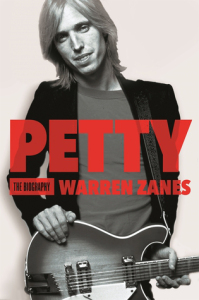
Petty, by Warren Zanes*****

It came out at the end of last week, so I’m running my review one more time…cause you won’t want to forget this one if you love rock and roll!

seattlebookmama's avatarSeattle Book Mama

pettyOh my my, oh hell yes! If Tom Petty and the Heartbreakers is a band that lights your fire, you have to read this biography, which comes out Tuesday, November 10. You’ll be happiest if you can do it near a source of music, and the very best of all is to be near a desktop or other screen where you can view and hear the music videos as you read about their inception. Petty made it big just as I graduated from high school. By the time my first-born entered elementary school, I had a backseat full of little kids who bounced their heads along to the unquestionable rhythm of his music playing on the radio. And right about now I am supposed to tell you that I got this DRC free for an honest review, courtesy of Net Galley and Henry Holt Publishers.

Zanes has really done his…

View original post 646 more words

The Last Good Place, by Robin Burcell****

Oh hey, look at all the great books being released today! This one is for sale now, for all you mystery lovers out there.

seattlebookmama's avatarSeattle Book Mama

thelastgoodplaceWhat a treat! They say all stories have already been told once, but I’m telling you, this one hasn’t. Oh, trust me! And my thanks go to Net Galley and Brash Books for a wonderful DRC. This one will be up for sale November 3.

Some may recall the TV series “The Streets of San Francisco”; the show was based on a set of police procedurals by Carolyn Weston. Characters Casey Kellog and Al Krug became TV characters Steve Keller and Mike Stone. In bringing the series back to us in the twenty-first century, new co-author Robin Burcell was asked to update it, since some of the over-the-top methods used originally could get a cop fired these days, and the old methods would not resonate with the public. Burcell has a lengthy background in law enforcement, and now I know that she is also a capable novelist. The pages flew…

View original post 481 more words

For the Dignified Dead, by Michael Genelin****

This one goes up for sale today. You should read it!

seattlebookmama's avatarSeattle Book Mama

forthedignifieddeadThere’s a murderer on the loose, one that has killed across international boundaries. The weapon of choice? An ice pick. Happily, the case is assigned to total bad-ass Commander Jana Matinova, the best new female detective I’ve seen in emerge in crime fiction in decades. Thank you to Net Galley and Brash Books for the DRC. This title will be available for purchase November 3.

Part of what initially attracted me to this novel was the setting. Though Matinova finds herself crossing into various parts of central Europe, she is based in Slovakia, a country not even on my personal radar. By way of apology, I will point out that for most of my life, a giant swath of Europe and Asia was designated as USSR, and the satellite states lined up like faithful guardians around its perimeter included Yugoslavia and Czechoslovakia, both of which have been carved into different…

View original post 368 more words

Glory Road, by Bruce Catton*****

This must-read for Civil War buffs and students is available for purchase today.

seattlebookmama's avatarSeattle Book Mama

gloryroadBruce Catton was known as a popular historian when he first published books about the American Civil War, because of his narrative nonfiction format. All of the books being released digitally now are ones previously published in a non-digital age. This reviewer hunted down Catton’s three volume Centennial History of the Civil War at a used bookstore some time back, and although they were among the best I have ever read by anyone on this topic, I was convinced that anything he had published earlier on the subject was probably repackaged in this trilogy, and so I stopped reading Catton, thinking I was done. Thank goodness Net Galley and Open Road Integrated Media posted the galley for this second volume of Catton’s Army of the Potomac trilogy. Now that I am disabused, I will have to find the first and third volumes also, because Catton is so eloquent that he…

View original post 609 more words