All In, by Joel Goldman and Lisa Klink *****

all inThis one is 4.75 stars, rounded up. Thank you to Net Galley and to Thomas and Mercer for the DRC. This absorbing thriller will be available September 8 for purchase.

Cassie Ireland is an asset recovery specialist; she views herself as a modern-day Robin Hood whose job it is to steal back money, goods, or even really embarrassing videos from those that originally stole them. Her employer is a shadowy individual code-named Prometheus–a moniker chosen because Prometheus was the sneak thief of the gods. Ireland’s nimble, silent in her work, and careful in trusting others. She really can’t be played.

Her job here is to steal select items from the home safe of crooked-wealthy magnate Alan Kendrick. In order to gain access to his treasure trove, she must first make it past a sophisticated security system, to which she gains access by deceiving Kendrick’s wife, Gina. Once Cassie found her way into that safe, I stopped breathing until she was out again. I think my fingertips turned blue. But once she’s been in and out, things once more begin to unspool at a heart-pounding pace.

Jake Carter is a professional gambler, and he too has a grudge to settle with Alan Kendrick. He plans to beat him at poker; he’s fast, smart, and fair. Unfortunately, the last whale he took down has sent goons after him. They want the money he took from Theo at the table, and they also want him dead. Jake’s challenge is to go after Kendrick while dodging Theo’s assassins.

Ultimately, Cassie, Jake, Theo and Kendrick all land on the same enormous floating gambling casino. You can run…but only so far. You can hide, but sooner or later, you’ll be found. On the other hand, you can also turn your stalkers into your prey, if you’re cunning and well organized, and if you can gain the loyalty of others nearby. And then too, you might be able to grab a helicopter!

All In is fast, escapist fun. Ordinarily I would call this a four-star review. Four stars are my default for books that are anywhere from pretty good to really good, but that don’t meet the gold standard of five stars. My four star reviews are big houses with a lot of rooms. If I hate a book but concede that others are likely to enjoy it, I will go with four stars and explain what I didn’t like. I also give four star reviews to books like this one that I like a lot, but can’t see them as the very epitome of their genre. Five stars means excellence that is above and beyond ordinary work.

The tipping point here that knocked this up to five stars is the use of race and gender. Nobody wants to be preached at in the middle of a thriller, and Goldman and Klink don’t do that. Rather, it is by the assumptions that are inherent in their choice of protagonist (Ireland is African-American, female, smart as hell and way more fit than any gum shoe I can recall); the way the plot unfolds, with no helpless damsels waiting for great big men to come save them; and the way secondary characters are handled, the butler foremost among them. It reminded me a bit of Barbara Neely’s writing, and so I wanted to stand up and cheer.

Fall is coming, and whether you are still basking in the sun on weekends or huddled by a fire, it’s a great time to treat yourself to a tightly paced, accessible thriller by authors that show their respect for all people, especially the working class, in the way they sculpt their characters and plot. It looks like a winner to me.

Why not order it while you can?

Trust No One, by Paul Cleave *****

trustnooneMany times my daughter has come upon me reading a book and asked, “How is it?” And almost every time I have said, “I don’t know. I haven’t read the end yet.” This is completely true for this one. And oh my my my, what an ending. No, stop worrying, I have no intention of giving away anything.

But I will thank Net Galley and Atria Books. I appreciate the opportunity to read a free DRC in exchange for this honest review.

You can purchase this book Tuesday, August 4, or you could save the hassle and order it now.

Above all…you don’t want to forget. If you forget this, you might be forgetting other things, too. That’s a slippery slope that nobody wants to slide down.

Jerry is just 49 years old, and he has Alzheimer’s. After the diagnosis, he starts a journal, partially with the idea of recording all the things he doesn’t want to forget so that he can come back and find them later. But fate has other ideas for our protagonist, and for his nom de plume, Henry Cutter–a cute play on the actual author’s name…or is it his pen name?

As we find ourselves gradually creeping down that long dark tunnel with poor Jerry, the journal becomes more and more confused. Is he a killer? If so, how many people has he killed? Why can’t he remember doing any of it?

But then, he can’t remember much of anything these days…

Trust No One is a brilliantly paced, tautly written piece of psychological fiction, and it is proof that, contrary to the old saying, not all stories have already been written. And the title answers his question, a very good question: who can he trust?

The problem here is that someone in Jerry’s position has to be able to trust someone. And as the plot moves further along, the reader can’t help wondering whether all of the characters in the story actually exist.

Those searching for an absorbing vacation read—or even one to curl up with at home, hunkered under the air conditioner or fan on a dog-hot day—can’t really ask for anything better than this. Cleave gives the reader every possible frisson in this impossibly complex, yet strangely accessible novel.

Highly recommended.

The Murderer’s Daughter, by Jonathan Kellerman *****

kell__jkt_all_r1.inddGrace Blades is a psychologist helping victims of violent trauma, those she mentally refers to as “The Haunted”. And she should know; as a small child, she watched her mother murder her father, and then more or less eviscerate herself before Grace’s own tiny eyes. So yes, she knows. But a client has come to her with a concern that is more than it appears to be, and it dovetails with a harrowing part of Grace’s past. In fact, she has reason now to believe she may be in danger, and it’s up to her to sort out the pieces and save her own life. This riveting DRC came to me free from Net Galley and Random House-Ballantine Publishers; thanks go to both. The book is for sale August 18.

Fans of Kellerman’s have likely bonded with his Alex Delaware series. Although Delaware’s name is coyly inserted into the background text a time or two, this book isn’t about him, it’s a stand alone. It’s a strong story, and Kellerman’s initial career as a child psychologist makes Grace wholly believable. Someone that has gone through the multiple traumas her childhood has visited upon her would probably have trouble bonding with others, and indeed, Grace goes through life neither wanting nor having real friends her own age. She trusts one social worker, as well as the psychologist who together with his wife ultimately adopts her. And even with them, she has to force herself to smile, to show affection; these are never spontaneous behaviors, but ones learned by observation.

Readers of my blog know that I generally don’t review books about wealthy people. I don’t relate to the rich, and it generally seems like a coward’s way out on the part of the author, because they can excuse their protagonist from the daily financial obstacles that most people have to deal with. But Grace has gone through so many hells by the time she reaches her wealth that this book is different; then too, Jonathan Kellerman is such a crazy-good writer that it would be hard to leave a galley of his by the wayside in any case.

In addition, I appreciated the strength and intelligence of this protagonist. Although the sexual (and sexually violent) content makes the book unsuitable for younger teens, it’s still great to have a strong female character that doesn’t need to be saved by men. And thank you, thank you Mr. Kellerman for avoiding the nearly-obligatory kidnapping scene as part of the climax. I have often wondered why exactly so many sleuths, particularly female ones, end up bound, gagged, and in the trunk of a car at some point near the story’s crescendo, and I was heartily glad not to find it here.

In short, fans of Kellerman’s will get their money’s worth and more, whereas those that have never read his work but love a good mystery can dive in here and also be deeply satisfied. Terrific work by one of the best mystery writers out there.

Mrs. John Doe, by Tom Savage *****

mrsjohndoeTom Savage is master of the high octane, full-speed-ahead espionage thriller. Last year he gave us Penny for the Hangman, which kept me up late at night, and this year if anything he has improved upon it with Mrs. John Doe. Thank you to Net Galley and Random House-Alibi for the DRC. Now that’s I’ve finished it, I can breathe again!

Nora Baron is a widow. Her husband Jeff has been killed in the line of duty as a CIA operative in Britain. She goes to claim his corpse, get him cremated and take him home…and then all hell breaks loose, because nothing, nothing, nothing is as it seems.

Savage’s thriller style is both fast-paced and psychological. We never know who Nora can trust, and so we are constantly on edge. Sometimes it irritates me when a writer messes with my head, but the way Savage does it just makes me want to sit up and howl for more. From one friend-who-can-help (or is it a foe-who-will-turn-on-her?) to another, we are constantly cheering for Nora, advising her (good gravy, NO, don’t get in that car!), and every time we feel we have a pretty good grip on what ‘s going on and what’s going to happen next, it turns out we couldn’t be more mistaken. Savage accomplishes all this without resorting to trickily withheld information or any of the other shabby cheats and foils that lesser authors deliver. The story arc that would, in another thriller, start to pick up past the halfway mark and really accelerate at 85%, instead picks up almost from the get-go and keeps us furiously turning the pages until after the climax, when we finally wind down just enough to know what happens to our protagonist after the ride is over.

Those that read my reviews know that I can’t so much as tie my own shoelaces without looking for political content, so I also want to mention that the anti-Pakistani slurs and assumptions that all characters from the Middle East are terrorists get taken care of tidily.

Ultimately, having the woman depicted in such a positive, capable fashion is a touch that boomer-feminists like me, as well as the younger, newer wave of feminists, will appreciate. And while once in awhile something implausible slides into the text, we have to buy the premise anyway, because Savage isn’t going to pause long enough to talk about it, and we have to know what happens next. So as usual, an excellent writer can make us believe almost anything, whereas an indifferent one can’t make us bond with the everyday and the ordinary.

When this thriller comes out October 6, get a copy and hold on tight. It’s going to be one frenzied, wild ride!

Killing Maine, by Mike Bond ***

killingmaineNote: Usually my blog is reserved for books I recommend, that merit 4 or 5 stars. Once in awhile I review a galley and find that my obligation to the author and publisher have bumped up against my blog policy. This is one of those times.

Killing Maine is a thriller, and like the one other book by this author that I’ve read, it’s a tale of grief, alienation, and grave concern regarding environmental degradation. Thank you once to Net Galley, then again to Mandevilla Press for the DRC. This novel can be purchased July 21.

The story starts out in high gear. Our protagonist, Pono Hawkins, has been called from his home in Hawaii to Maine. A man who saved his life during his years in military service has been jailed for a crime he didn’t commit. Pono has done time twice, and both times he was innocent. He’s been exonerated, and yet still has a criminal background that comes up when cops run him through the system. And as he talks about the ways in which America’s so-called justice system is broken, I hear him loud and clear.

From there, however, he takes the plot all over the place. There are three different women, and he falls madly in love with one named Abigail, but there is so little of substance about their first meeting that instead of engaging, I’m left scratching my head. Seriously?

Most of the plot, which takes wing when someone is shooting at him out in the frozen Maine hinterland, is built around the wind power industry, which is referred to here as the “Wind Mafia” and “Big Wind”. But instead of using it to move the plot forward, there is so much repetition that it seems to bog us down. He lays it on thickly enough that at the beginning I wonder what can be done about problems involving the use of wind energy and the environmental problems he tells us it creates. We have to have some form of energy other than fossil fuels, right? Coal is a bad solution. Hydroelectric power can only take us so far, especially with global warming causing some water sources to dry up, or nearly so. And so I am on board, and I am thinking about the problems with wind (politicians being corrupted by big businesses, be they wind or something else, seems like a given these days, and didn’t particularly move me), and wondering what alternatives we might have.

Bond uses the novel to address about half a dozen social and political issues—the wars in Afghanistan and Iraq; lousy medical treatment of veterans; Agent Orange and Vietnam; and of course, environmental despoliation—and for ninety percent of the book, I am in complete agreement with him on all the issues he raises. How will a reviewer that disagrees with some or all of it see this novel?

Because when we come back around to Pono, the plot has so many holes in it. Pono doesn’t like Bucky, the man he has come to rescue, and Bucky will no longer see him when he drives to the jail to visit. The local heat is starting to harass him, and if he doesn’t leave the state soon, they’re going to tell him he can’t leave. Meanwhile, he is due in Fiji in a few weeks for a tsunami; he’s been hired to do a job there. And since there doesn’t seem to be a whole lot of anything—the guy he doesn’t like that won’t see him; an old flame is one he’s decided not to rekindle—I can’t figure out why the protagonist wouldn’t just get on the plane and head for Fiji early. Surely he doesn’t genuinely believe that one man can derail the entire wind industry, along with the governor, senators, and other heavy-duty politicos, by himself and with the law hot on his trail.

Meanwhile, the writer continues to rail against “Big Wind” until I just want to throw up my hands and call it quits. And to be honest, were I not obligated to review the book, I probably would have just abandoned it at the point where the environmental concern turned into a diatribe. Enough, enough. I get it.

But I do read it, and so we continue, and there is one scene that seems real and is wonderfully done, in the midst of all of this other stuff, and that is the farewell scene between Pono and his dying father, which is poignant and moving; entirely authentic. It’s hard to see what schism makes it possible to write that scene so well and yet have so many plot problems elsewhere.

Had I still been on board at the point where he speaks about Gone With the Wind as if it is historically accurate, and paints General Sherman, one of my own greatest heroes, as a man who went in and wrecked everything, using the whole thing as a misbegotten metaphor for Maine, I think I would have stepped back a bit. If a novelist wants to be accurate with his real-world facts, then get all of them straight. But the fact is, after about the first half of the book I wasn’t really on board.

Readers of Bond’s who have grown fond of his writing style may have a good time here. For me, it seemed like a good opportunity lost.

The Expats, by Chris Pavone *****

theexpatsChris Pavone spins one fine espionage thriller. I was introduced to his work when I read a galley of The Accident, the white-knuckle suspense story that follows this one. I was sufficiently impressed that I checked to see what else he had written. This first effort, which I borrowed from the Seattle Public Library, earned him the Edgar Award and a number of other kudos also. It’s a real page-turner.

Katherine is a mother of two young boys, and although her husband doesn’t know it, she works for the CIA; she has told him she is a government employee, and that she sits around all day writing position papers. She never inquires too closely into the life he led before he met her because she is afraid of the quid pro quo that must surely follow such questioning. The consequence is that she has been married for years to a man she doesn’t really know all that well. But he and the boys are really all she has; she has no other family to speak of.

She’s sitting on a mountain of unspoken experience. She has killed more people than she cares to remember. The reader is fed tiny shards of her memories in gradually increasing tidbits, and it is very effective in building toward the conclusion.

Her spouse Dexter, meanwhile, springs the surprise on her one evening: his work requires him to move from Washington D.C. to the tiny European secret-banking center Luxembourg. He works in I.T. in the banking industry as a security consultant, preventing hackers from thieving the bank’s massive resources. That’s what he tells her, anyway.

Relieved in a way, Katherine quits her job. The CIA doesn’t lift her cover, but they let her go little by little. Now she can finally focus on her sons, on her home, on her marriage…and so she sets up housekeeping in Luxembourg, enrolls the boys in school, enrolls herself in cooking classes during the day…and is bored out of her mind.

It was easy to buy the scenario as Pavone presents it, because it all figures. Who would join the CIA but a real adrenaline junkie? And what woman that has stalked other people, killed people, dodged those that stalked her or that sought retribution…what woman in such circumstances would not be bored out of her mind by cooking classes and shopping for area rugs and shower caddies?

It isn’t made easier by the fact that Dexter is always at work; that’s what he says, anyway. He is at work, on the road, in a meeting all the goddamn time. He spends an awful lot of time with Bill, another American expatriate, whose wife Julia seems a little too friendly to be true.

So is she merely acting like a CIA employee, governed by auto-suspicion? Or are these people setting off her spook-dar for a more substantial reason? And just what the hell is really up with Dexter? You would think the guy could show up for Thanksgiving dinner, for heaven’s sake!

If you have never read anything by Pavone, read this book first, and if you like it as much as I did, get The Accident second. Each is a stand-alone novel; they aren’t a series or sequential. But the second book is just a tiny bit better than this one, and I found myself slightly let down by an ending that seemed slightly too tidy. And in truth, I don’t think I’d have felt that way if I hadn’t already read something of his that is even better. In other words, judged against other thrillers written by other writers, this one is a sure-fire five star novel. Judged against Pavone’s subsequent work, the score shrinks a tiny bit.

The best part of all may have been the afterword. I always wondered about the research that went into writing spy thrillers. How the hell does anyone find out anything about the CIA, unless they are employed there and sworn not to tell? And Pavone tells us how he did it: he made it up. And that’s why it’s called fiction.

Guaranteed to absorb your attention for a long weekend and make all your own troubles look small.

Long Way Down, by Michael Sears ***-****

longwaydownMichael Sears’ Wall Street spy thriller is an interesting and enjoyable read; 3.5 stars. Thank you to Putnam Adult Books, Above the Treeline, and Edelweiss books for the ARC. This book will become available in early February.

Jason has gone to prison for insider trading, and now he’s out. In reading this first person narrative, I learned a few basics about the capitalist market system, including the definition of an insider trade. In years gone by, I always told my students that there was never going to be a time when they felt they had accidentally gained too many (legal) skills or learned too much, and so I took that advice, Marxist though I am, and looked on with interest.

That said, the protagonist was only mildly sympathetic to me. The development of the character via his child, a first grader with autism (specifically Asperger’s Syndrome) made him more real and more likable. The writer injected just enough of this aspect of his character’s life to help shape his character, without permitting it to become a diversion. I was also very grateful that he didn’t take the cheap-way-out many mystery and thriller writers take, in having a bad guy kidnap, scare, or hurt the child. When the time came that it could be a threat, our affluent business consultant took his son and the nanny and flew them to the tropics, out of harm’s way.

And yet this is where an obstacle presented itself. Because he went to jail with a tidy sum salted away in an off-shore bank, our protagonist has far more money than many of us will ever see, even over the course of our lifespans. I was distracted by the number of coats he destroyed and then threw away, gave away, or just left lying somewhere. Cars, wardrobes…one can understand how anyone would do such a thing if his life was on the line; there’s surely no coat I’d die for. But it came to a head for me when the narration whined about the flight to Washington D.C. being too long, even for those in first class. I weep for you, I wanted to respond. Try flying from the West Coast to DC on the red-eye flight. Fly coach. Stand in the sun for six hours waiting for your part of the human chain to start marching and chanting; then repeat the red-eye flight home, and then go to work. Don’t snivvle over the hardship faced by first class passengers. And for heaven’s sake, don’t tell me about how the first class passengers look down their noses at business class.

It was telling that on his many airline flights, our fancy man never even mentioned flying coach as an option.

The story line follows our protagonist as he seeks to defend the man he’s working for when the latter is suspected of murder. All sorts of chase scenes, internet hacking, ducking into doorways, hiding, chasing, and fighting abound. And I have to say it kept my attention. The writer’s environmental concern is well integrated into the character’s narrative most of the time, but there is a scene at the end where it feels as if a public service announcement has been interjected. You’ll know it when you hit it.

Would I read more of Sears’s work? I most likely would, if I could find it at the library or used bookstore. I think he falls into the category of second-tier writers on my wish list: I would prefer to read his work to that of an unknown writer’s, but I also wouldn’t pay full jacket price for his work, or put it on my Mother’s Day wish list.

For those who enjoy a fictional romp among those with money and privilege, though, this will be a surefire hit.

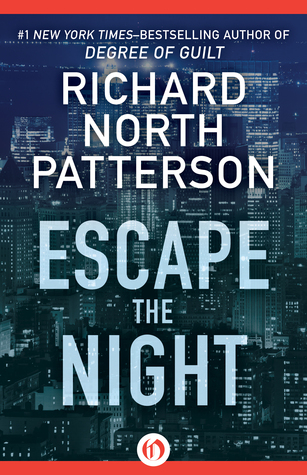
Escape the Night, by Richard Patterson ****

EscapethenightEscape the night? Envision being trapped in a tunnel, inside of a tunnel, inside of a tunnel. Some are metaphoric or symbolic, but there’s a whole lot of darkness in this espionage thriller, a suspenseful tale that will play with your head more than once before the author is done. Thank you to Net Galley and Open Road Media for the ARC.

The setting at the outset is New York City during the McCarthy era. Black Jack Carey owns a publishing house that carries work by a left-leaning writer that is being watched by the CIA. Pressure from HUAC comes to scrap the writer’s work. Son Charles, eldest and best-loved son of Black Jack, refuses to yield to the pressure. Resentful younger son Philip, weaker in character and more easily swayed, takes the side of the government. He hopes his sensible nature will cause his father to will Van Dreelen and Carey to him rather than Charles.

At multiple places within this white-knuckle thriller, I had to put the book away because even with the assistance of sleeping pills, I knew I could not fall asleep if this story was in my hands. Were it not for that, I surely would have finished it sooner. This title along with a nonfiction galley have occupied my interest and attention far more than any of the other four books I’ve been reading.

Our villain, a well-drawn government spook named John Joseph Englehardt, becomes obsessed with the Carey family:

“Englehardt had learned that men who spied on other men, out of the loneliness of such a job, came to like or dislike their chosen quarry. But in his soul, he knew that the secret passion for the Careys grew from something stronger.

“The brothers’ rivalry was also his.”

Eventually Englehardt is officially ordered to abandon the Careys, but his psychosis is too thoroughly developed to let go. He turns to the CIA and is able to extend his surveillance. Phillip Carey’s cause has become his own. He despises Charles and is determined to do whatever dark thing is necessary for Phillip to inherit everything.

Generally speaking, I don’t read books about wealthy folk, and this is for a variety of reasons I won’t go into here. But the characters of John, Phillip, Englehardt, and later, Peter Carey, are so intimately sculpted that I had to buy the author’s premise. Once I did so, the pace picked up and the story was unstoppable.

The ending came with hairpin turns and swift kicks to the reader’s solar plexus, but everything that occurred seemed eminently believable, because the main characters and setting were so palpable.

My one small quibble with the writer–and it’s a common problem in literature not specifically geared toward women, but someone has to talk about it–is that the people who were well developed and occupied center stage were all men. Women existed here only as a foil for what was going to happen to someone else. For the novel to go beyond “really good” to “outstanding”, a novelist needs to be able to develop characters of both genders.

That shouldn’t keep you from buying this title, though. It’s one helluva ride. But don’t think you’re going to read it in small easy pieces. Once you pass a certain point, you have to keep going, and you may see the new day dawning and wonder where the night went.

Also, you’ll want to avoid tunnels for awhile.

The Boyfriend, by Thomas Perry ****

TheboyfriendThree and a half stars, rounded up.

I’ve been a fan of Thomas Perry’s for decades. In the past, he has written such adrenaline-coursing thrillers that I’ve actually had to put his novel down in order to calm down and breathe normally for a moment. And while The Boyfriend is an interesting story, it doesn’t measure up to the body of work I associate with this writer.

Here is the premise: we have two protagonists, a good guy and a bad guy. Our bad guy is a hit man and a serial killer. At first I really liked the author’s work here. It’s a twist I hadn’t seen before. The bad guy is hired by clients from Latin America who he hypothesizes are perhaps having him take out individuals who are also from Latin America, but who fly north to assist Washington D.C. in its attempt to take those cartels apart. He doesn’t really know, though. He was recruited by an American who also worked for them, and who became his partner. The partner was killed by one of the targets, and now our hit man, who takes a variety of names throughout the book, is a one-man killing squad. He makes a lot of money, but needs to stay below the radar and be impossible to track. The women he kills are escorts that he persuades to trust him. He behaves like the opposite of a typical john, nonthreatening, considerate, and gets them to invite him to live with them. Voila, free lodgings where the Feds won’t be looking for him. And each time he leaves, he kills his hostess in order to avoid leaving a witness behind, even though they have no idea he is a killer. The dead men he has assassinated cause a lot more flash and ruckus, so the death of a high-priced hooker doesn’t get much air time on the news or much attention from police.

I had a little trouble buying this scenario, but the author also draws out a story from the killer’s youth that shows that in shopping for an escort wherever he is staying, the man subconsciously looks for the same woman over and over again. They look alike. Again and again, he finds and kills this woman. Taken from that sort of perspective, I could buy the premise. But this part of the premise falls apart halfway through the novel with a one-sentence explanation that left me scratching my head. What the hell?

Our second protagonist, of course, is the guy who is tracking the killer. He Needs to Find Him Before He Can Kill Again. Jack Till is our good guy. Till is a private detective working for the parents of one of the escorts. They loved their daughter; they have money; they want their daughter’s killer found and brought to justice.

Till uses the internet to track where he believes the killer will go next. The clues he uses at first are believable, and the story line, if not gripping, is interesting. But I had real problems buying into the amount of wealth he was able to expend in order to not only travel all over hell and back, but in buying breathtakingly expensive gadgets to assist him:

“He drove into Boston and bought several items: a night vision scope, a sixty-power spotting scope, and a plug-in microphone that he could listen to by telephone.”

We don’t have a sense that Catherine Hamilton’s parents are members of that bottomless, one-percent, ruling rich. They give him 100k and tell him to let them know when he needs more, but for all we know, they could be looting their retirement accounts or double-mortgaging their home. It’s believable that grieving parents would do these things. But multiple plane tickets, hotels, and expenses like the ones in the quote above (not his only stop, not his only purchases) gave me pause.

In addition, I wondered at the blithe assumption that a store, even in a major metropolis such as Boston, would have these items sitting under glass ready to be sold. Wouldn’t some of these items have to be special-ordered? That’s expensive, very specialized stock. But I will admit I don’t know a lot about firearms or spying devices; it just felt like a stretch to me.

If you are concerned about spoilers, by the way, I have confined myself to the first twenty percent of the story. Most of it is not in this review.

But I am thinking back now to the series that hooked me and a lot of other readers, when Perry was a relatively new writer. This man wrote the Jane Whitefield novels, stories about a modern-day Seneca Indian woman who uses the skills of her culture to cover the trail of endangered individuals. The series was absolutely riveting, but the nature of her work also kept it from being a more or less permanent series. Each time she did her good deed, she was that much closer to being discovered and murdered. Perry had to close that series off and write some other things, and he came up with a number of other really strong novels, some of them on par with that beloved series. And because of his sterling track record as one of the best thriller writers out there, I came to this novel with higher-than-usual expectations.

The Boyfriend holds together really well in places, and is a little clunky in others. I was lucky enough to read a free copy, not as an ARC, but as a library book brought home for me by a thoughtful family member. As such, I enjoyed it, even though I was a trifle disappointed. But at the same time, I was glad I had been able to knock it off my Christmas wish list, because there are many things I would rather unwrap than this book.

My advice to you, reader, is similar. If you find this book lying on a table of 99 cent paperbacks, or if you can read it free from the library or borrow it from someone, give it a try. See what you think. If you are new to Perry’s work, you can read it free of the high expectations I brought with me when I read it.

But don’t toss the full jacket price on the counter unless you have a budget as generous as Jack Till’s.

Folly, by Laurie R King *****

follyWhoa Nellie! King is one of my favorite authors, and I like her best when she gets away from the Holmes’ wife series and into strong contemporary fiction like this.

Rae Newborn is our protagonist, and she’s been having some mental health issues. She takes herself off to do a project on a remote island, property owned by her uncle. She has a feeling she is watched all the time, and so she is glad she is somewhere that she knows she has all to herself. Who the hell would come all the way out here? There’s no ferry service. You’d have to go to a lot of effort to get there, and there’s really nothing on the island beyond her uncle’s house, which needs a lot of work.

Unfortunately, that creepy feeling intensifies once she is on the island.

I started reading and an invisible hand reached out of the pages, grabbed me by my shirt’s front and yanked me in. I was on that island, and let me tell you, it got smaller, and smaller, and smaller…heart-pounding and absorbing, I could not stop till it was done.

I gave it to a friend to read when I was finished. When she had finished it, she asked me not to give her any others by this writer, because it was so adrenaline-pounding that “it was a little much for me.” And it is a lot. It is a psychological thriller by a master of the genre.

Often by now I acknowledge whoever gave me the galley to read free, but not this time. I bought this book at cover price from my own pocket, and I am telling you, it was worth every cent.

If you have a low threshold for really gripping prose, (or if, like my friend, you have recently experienced a loss and are tender around the edges), get something a little bit tamer. But if, like me, your favorite roller coasters are between book covers, this one is for you. Brilliantly plotted with a story line that accelerates and whips you around until it’s over.