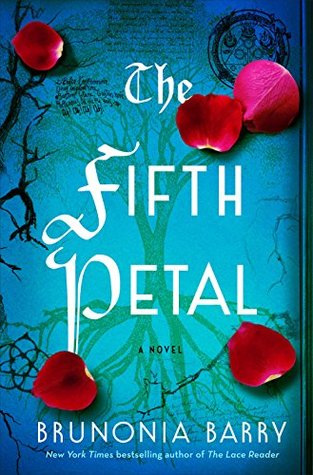
The Fifth Petal, by Brunonia Barry***

thefifthpetalA teenage boy named Billy Barnes dies on Halloween night; everyone knows that he was trouble, and no one is too surprised to see him come to a bad end. But police chief John Rafferty has a job to do, and he sets out to discover who the killer is. The setting is Salem, Massachusetts, the location of the Salem Witch Trials centuries ago and now the Mecca of Wiccans and others that practice witchcraft of various types, not to mention throngs of tourists that show up every autumn.  Chief Rafferty wonders what the connection is between this murder and those of 25 years earlier, dubbed “The Goddess Murders”.

Thanks go to Net Galley and Crown for the DRC, which I received free in exchange for an honest review. This book will be available to the public January 24, 2017.

Barry is an experienced novelist, but her work is new to me. This title can be read as a stand-alone novel, but there’s a tremendous amount of detail here. Perhaps having read The Lace Reader, an earlier novel that other reviewers tell us has some of the same characters that are present here, would make this book less complicated and easier to sort through; then again, if Barry had chosen fewer secondary threads to follow, the reader could relax more and enjoy the book anyway. More on that in a minute.

Rose Whelan is a Salem native, has shouldered the “unofficial blame” for the Goddess Murders; she maintains that a banshee took up residence in her body and left her with no choice. Rose has gone from the psych ward, to homelessness, and back again; Rafferty and his wife Towner have offered her a room indoors, but she won’t leave the tree outside their home for long at a time, lest bad things happen. She has bad memories, and they give her unquiet dreams:

“On that horrible night, after it happened, after the shrieking stopped, the world had quieted and then disappeared.  Rose had found herself staring into an eternal emptiness that stretched in every direction and went on forever.  When the keening began, Rose had believed that the sound was coming from her own lips. Then she’d seen the tree limbs and branches start to move with the breath of the sound itself, their last leaves burning in the black sky like crackling paper. Then the trees had begun to speak.  Come away now, the trees had said. Come away.”

The imagery here is amazing, as you can see; this aspect is the story’s greatest strength.

Our protagonist is Callie, who’s new in town. Rose had been her surrogate mother after her mother, one of the Goddesses, died. She had lost contact with her and is stunned to find her in such bad shape.  Brunonia does a fine job of highlighting the challenges of helping the homeless, not to mention the stereotypes that follow them. There’s a lot of Celtic lore that I also really like reading about.

The parts that disturb me are those throughout the book that reinforce the stereotype of women as being constantly in competition with one another, unable to get along and help each other.

However, the main thing that gets in the way of this being a really great read is the vast amount of detail about way too many things. At the 60 percent mark, my notes indicate that I wish the author would decide what, other than the primary plot line of the whodunit, she wants to feature. We have witches past; witches of the present; mean nuns; and way more about the healing properties of quartz bowls than I ever want to hear about. At this point in the book I am ready to throw in the towel and call it a 2 star read; I felt as if the mystery had degenerated into a New Age infomercial. I note that I can scarcely recall who’s dead, and who’s accused.  But it’s a DRC and I have an obligation, so I forge on.

And that diagram! The diagram of a five-petal flower is created, changed and discussed in such infinite, numbing detail that my eyes are half-crossed by the time we make our way to the climax. Once we’re there, though, the story becomes more cohesive and I like the way she resolves it.

Those that have read Barry’s other books and liked them will enjoy this one; likewise those that are drawn to various aspects of modern spiritual healing and Wiccan practices will also be pleased. For myself, I would enjoy her work more if she didn’t try to jam such an extensive collection of minutiae into a single novel.

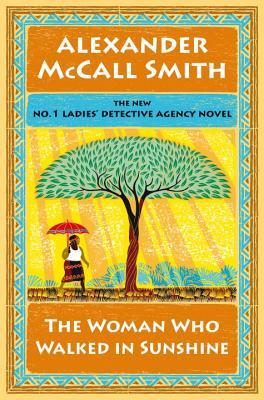
The Woman Who Walked in Sunshine, by Alexander McCall Smith*****

thewomanwhowalkedThe first week or two after Christmas is a sumptuous period for me as a reader. Nearly every book I read these days, fiction or non-, is a DRC, or Direct Reader’s Copy sent to me digitally by publishers via Net Galley in exchange for an honest review.  However, each year there are invariably half a dozen titles, sometimes more, that I really want to read and haven’t been able to obtain free of charge. Sometimes I discover a book after it’s already been published some time ago, and sometimes it’s a book that I couldn’t get as a DRC. These books land on my wish list, and my family is faithful in purchasing them and placing them, clad in pretty paper and ribbon, beneath our Christmas tree. By Christmas night, I’m snuggled deep beneath a pile of fluffy covers, my spouse and hound dog snoring sonorously while I immerse myself in the books I am just about guaranteed to love, bathed in a soft yellow bedside light. This ritual is as significant to me as the more widespread traditions of feasting, wrapping gifts, and hanging stockings. I can’t recall a Christmas without it.

This year we had our gift exchange on Christmas Eve, and by bedtime I was snuggled up in flannel and reading this paperback book, the 16th in the series. The series, for those unfamiliar, is of the cozy variety rather than the pulse-pounding thrillers that absorb a good portion of my reading life. Precious Romotswe is the owner and founder of the #1 Ladies Detective Agency, and a good portion of those that read this book will already be familiar, as I am, with the main characters and their stories. Mma (Ms.) Ramotswe is married to JLB Matekone, who owns and runs the automobile repair shop adjacent to the detective agency; Mma Makutsi , Mma Ramotswe’s eccentric but capable assistant, believes that it’s time for her mentor to take a vacation. And indeed, Precious has never gone on holiday before; it’s about time, isn’t it?

Mma Ramotswe is reluctant. She hates to leave her business in anyone else’s hands; then too, she’s disconcerted when she learns that her husband, his employees, and her own assistants have discussed her need for time off when she wasn’t present. Is it a conspiracy, or is it loving concern?

The mysteries to be solved include the problem on which the temporary assistant hired on for the duration of Mma Ramotswe’s holiday stumbles; an additional situation involving a child named Samuel, an orphan who’s been trained to shake down drivers for coins in exchange for not damaging their cars; and a new school bearing her signature “#1 Ladies” logo, which appears to be not only misappropriating her trademark, but shady in other ways as well. Yet much of the story is dedicated to character development and the personal lives of the main characters, and it’s this that keeps me coming back.

Ultimately, the story is about trust, kindness, and learning to let go sometimes.

It occurred to me for the first time that I don’t know how the majority of Botswana feels about this series. McCall is a native-born Botswanan with Scottish predecessors. Are these characters true to the way the people of color in Botswana see themselves and their people?

Yet another part of me recalls that we are in the land of fiction. Unless I see some sign that the series is objectionable or offensive to those it represents, it will continue to be a happy retreat for me.

Highly recommended to those that love a cozy mystery and an opportunity to drop their blood pressure; the mesmerizing cadence here is better for us than any bottle of pills, and far cheaper than therapy.

Best of 2016: Mystery

This category includes everything within the same zone: thrillers, suspense, detective fiction, crime fiction. If it’s related, I’m rating it here. I expected this to be my toughest call because I read so many books of this genre, but when I had a look at the original titles I’d seen this year, and then eliminated those crossover novels that had already been awarded as the best of some other genre on this site, it was down to three books. Unbelievable…but not at all mysterious.

MY TOP THREE:


The Roanoke Girls, by Amy Engel*****

theroanokegirlsAmy Engel makes her debut as a writer of adult fiction with this title, having begun her career writing fiction for young adults. The Roanoke Girls is smoking hot, a barn burner of a book, diving into some of society’s deepest taboos and yanking them from the shadows into the bright rays of Kansas sunshine, where the story is set, for us to have a look at them. It’s not available to the public until March 7, 2017, and frankly I don’t know how you are going to wait that long. I received a DRC for this title from Net Galley and Crown Publishing for the purpose of a review.

Lane grows up in New York City, raised by a mother that shows no sign of warmth or affection, a woman that seems to either cry or sleepwalk through most hours of most days. When she hangs herself, Lane bitterly wonders what took her so long. But then a surprise comes with the social worker assigned to her case. It seems there are grandparents in Kansas, who not only are willing to have Lane, but that actually want her.

Soon Lane finds herself being driven up the private drive to Roanoke, the family manse, a rambling, welcoming hodgepodge of a house, complete with a same-age cousin waving with manic joy from the front porch. Allegra is spoiled, and now Lane will have all the same luxuries. The ostensible farm on which they live is more of a gentleman’s farm, as it happens; the real money comes from oil. And so Lane, who has scraped for every scrap of clothing and food alongside her struggling mother for 16 years, suddenly has the whole world at her beck and call. Allegra takes her to their grandfather’s study and shows her where all the credit cards are kept, and she assures her this is not something they are sneaking or stealing; it is assumed that if they want something, they can buy it.

It seems almost too good to be true…and it is.

There is so much simmering just below the surface, unspoken but thick and almost tangible. Take, for example, the portraits of the Roanoke girls that have gone before them, whose photographs line a main hallway. The collection begins with Grandfather’s sisters, continues with their daughters, the mothers and aunts of Lane and Allegra. What has become of all of them? Allegra explains:

“Roanoke girls never last long around here…In the end, we either run or we die.”

Lane’s picture isn’t included among those in the hallway, and she isn’t sure she wants it there. And as time goes by and the contours of the family’s pathology become clearer, Lane decides it’s time to save herself, and she hits the road, covering her tracks to the best of her ability. She stays away until ten years later, when her phone rings. Her grandfather tells her that Allegra has vanished; they need Lane to “come home” to help the family search for her.

Lane’s interaction with her grandfather is mesmerizing. When he calls her with the news of Allegra’s disappearance, the first thing she asks is how he got her number. Yet once she is back in the Roanoke house, she recognizes that

“…behind the secrets and the horrible truth, under the shame and anger that beat like a heart, there still lives a terrible kind of love.”

The fascinating, intimate narrative Engel weaves is a thing that can’t be taught. There’s no degree, no series of workshops that gives a voice such clear authority. She plays out the story’s thread in careful increments, and the bone-c hilling tone is heightened rather than lessened by the fact that we have a very good idea of exactly what happened to Allegra. I know whodunit halfway through the book, but it doesn’t matter. The author binds me to Lane’s story in a way that is completely undeniable, and I have to see this thing through with her. Toward the end of the book, instead of commenting to myself about aspects of the book or particularly compelling passages to quote, I’m engaging with the text itself. More than once my notebook simply says, “No.”

The reader should know that there are triggers all over the place. Those that are in a sensitive place may want to have someone else read the book first and tell you whether they recommend it to you. But for those that want a chiller of a mystery, and for those that care about women and the ways that society turns people into products for consumption, this is a must read. Or you could just read it because it’s brilliant, and no one else is writing anything like it.

The Big Book of Christmas Mysteries, edited by Otto Penzler*****

TheBigBookofXmasNote to the reader: I originally posted this when my blog was just a few months old, and I was still struggling with basic issues, such as how to insert the book cover into the text. Now the holiday season is here again, and I am running my review–with some basic technical adjustments–one more time, because in the past two years, I haven’t found a Christmas book I like better than this one. It’s the only book I’ve found since I’ve been writing reviews that I found worth actually buying not just one but two copies at full price to give as gifts. For those that love Christmas stories and mysteries, this one’s for you!

I received this wonderful collection last year as an ARC from the “first read” program via the Goodreads.com giveaways. At the time, I didn’t have a blog; I reviewed it on Goodreads and because I liked it so well, I also reviewed it on Amazon. Then, while I was on the site, I bought two copies to give as gifts. I have never done that with an ARC before or since (so far), but it is so wonderful that I wanted others to have it, and I wasn’t willing to share mine.

Now the season is upon us. This blog will be punctuated by worthwhile Christmas books of a secular variety. I guess it is a typical retired-teacher behavior to decorate my home with brightly jacketed Christmas books when others are getting out their craft supplies and hot glue guns. At any rate, if you buy just one Christmas book for yourself or someone else, and if the reader enjoys mysteries, this is the best you will find.

The stories are organized according to category in a format and layout that is congenial all by itself. There are ten sections, starting with “A Traditional Christmas”, with the first entry being one by Agatha Christie; it is a story that has aged well, and I don’t remember having read it even though I thought I’d read everything by that writer. There are a few more, and range from just a few pages, double columns on each page, to 25 or 30 pp. Then we move on to “A Funny Little Christmas”. The first there is a story by the late great Donald Westlake, and I gobbled it up and then felt bad that I hadn’t saved that story for last, because I adore his work and he’s gone and can’t write anything more. But I perked up when I noted that yet another section, “A Modern Little Christmas”, has an unread (by me) story by Ed McBain. There are many others. The final section, “A Classic Little Christmas”, bookends the anthology neatly by finishing with Dame Agatha. All told there must be about sixty stories, maybe more.

The anthology, edited by the brilliant and acclaimed Otto Penzler, is billed as having a number of rare or never-published short stories, and I think it’s a true claim. There are many mystery writers I’ve read and enjoyed here, and others I had never even heard of, but found immensely entertaining. I haven’t skipped any yet, but even if I find something I don’t care to read, the book is worth owning. I know that already. It is also billed as an anthology to warm the heart of any grinch, and indeed, there has been at least one story with a satisfyingly creepy ending.

One of the charming things about anthologies is that one can read a single story in a sitting and not feel too bad when it’s time to put the bookmark in and go get something done. Then it waits there to greet us as we return from executing less pleasurable tasks, a reward that invites us to sit down, curl up with good cup of coffee or the dog or both and have a cozy read. It also makes the book a lovely thing to keep where guests can access it, because they can enjoy it even if they haven’t time to read more than a story or two in between other activities.

…but I’m keeping you. You could be reaching for your car keys, your bus pass, or even better, going to another window to find this book online and order it. Once you see it, you will most likely feel as I do…unwilling to part with your own copy, yet yearning to get at least one more for somebody else! Get the plastic out and do it right away.

Good Behavior, by Blake Crouch****

goodbehaviorcrouchLast spring I advance- read and reviewed the riveting sci fi thriller Dark Matter, which was my introduction to author Blake Crouch, who has already met with success as a screenwriter. When I saw that something else he had written was up for grabs at Net Galley, I landed on it eagerly. Thanks go to them as well as Thomas and Mercer at Amazon for the DRC, which I received in exchange for this honest review.
Good Behavior consists of a trilogy of Letty Dobesh stories, along with a brief narrative that follows each one explaining how it was tweaked (pardon the pun) as it was adapted to television. Our protagonist herself is, in fact, a recovering meth addict, and there is only one activity that comes close to the rush she experiences when she uses it, and that’s crime. Not just the seamy survival type of theft; not just cleaning valuables out hotel rooms while the guests are off in tourist-land. A big theft with huge risk and a potentially tremendous payday provides the adrenaline rush Letty needs to stay clean, not forever, but for one more day.

Letty is a kick-ass character, a woman who’s been knocked down a million times and gotten back up a million and one. I love the way Crouch works her motivation. Actor-director Jodie Foster once commented that when men in the film industry want to reach the core of a character’s motivation, they reach every damn time for rape, and I’ve noticed that male authors do this with female protagonists a lot also. It’s a fascination they can’t seem to let go of. I am cheered to see that Crouch does something much different, with Letty’s main motivation being the need either to stay clean, or on bad days, the need to score. Behind the need to stay clean is the possibility of seeing her six year old son, Jacob, again. He is living in Oregon with his paternal grandparents; he’s in a stable, loving environment, and though Letty yearns to see him, she won’t let herself go there until she is convinced she can stay clean. But there are triggers out there in the everyday world that some of us could never have imagined:

“She could almost taste the smoke. Gasoline and plastic and household cleaners and Sharpies and sometimes apples. Oh yes, and nail polish.”

Around every corner, temptation calls to her. She can’t even get a pedicure without the fumes invoking a primal craving.

My hunch is that Letty will be with us a long time, and I am curious to see whether this child will remain six years old forever; grow up, but more slowly than real-time chronology; or be aged as if in real time. I can think of some hit mystery series that have been frozen in time to good effect. Crouch could keep Jacob small throughout the life of the series, and this might make more sense than having him grow up and be independent; on the other hand, this series is so full of surprises already that there’s no telling what will happen.

To see the first television episode, in which the protagonist’s name is different from the book:

https://www.goodbehavior.tntdrama.com/?sr=good%20behavior%20video

The first story involves a murder for hire. The second is a complicated rip-off of a billionaire who’s about to go to prison. The last and by far the best is a scheme to knock over a casino. The casino plot is proof positive that a relatively old concept (theft of a casino’s funds) can be made brand new in the right hands.

I believed Letty nearly all of the time; the only weak spot I see is when she considers dialing 911, a thing that former prisoners just never, ever do. No matter how big and ugly a situation gets, for someone who’s been in jail, and especially for those that have gone to a penitentiary, calling cops will only make it worse. Even if the caller is Caucasian, and even if she believes she can do so anonymously, cops are never desirable. They’re just not on the menu of choices anymore.

This is a super fast read, one that might make for a fantastic holiday weekend. There’s lots of dialogue, crisp and snappy. Best of all, it has just been released, and so you can get a copy now. If the turkey is dry and the marshmallows on your yams catch fire, Letty Dobesh can knock everything back into perspective for you.

Recommended to those that love dark humor and big surprises.

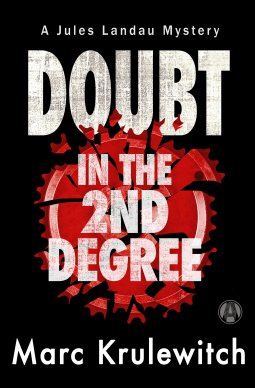
Doubt in the 2nd Degree, by Marc Krulewitch*****

doubtinthesecondThis is the fourth and best installment to date in the Jules Landau series. Thank you Net Galley and Alibi for the DRC, which I scooped on the date of publication in exchange for an honest review. This title is for sale now, and if you like a good whodunit, you should get it too.

The shores of Lake Michigan are inhabited by rich white people, and Jackie Whitney is one of them. Once she is found dead and stuffed on the shelf in her own walk in closet, however, the good times are over.  Kate, Jackie’s girl Friday who hails from Appalachia, is arrested and the public defender asks Jules to look into the case. She doesn’t trust the state’s own people to find reasonable doubt without some outside assistance, but she cautions him that she isn’t going to pay him to find out who did it; all she needs is for him to muddy the waters enough to prevent conviction.

She might as well spit into the wind.

Landau is fired up, and he knows that Kate will be convicted if he can’t find another suspect. Partly this is because cops like to wrap up a case, and once they think they have someone they can convict, they stop looking anywhere else; but there’s another reason, too:

“Corruption and Chicago followed each other like conjoined twins.”

The more rocks Landau turns over, the more suspects he finds. It’s getting to the point where he hardly has time to get home and feed the cat. There are many wry remarks that give this story its kick; it’s a novel that’s part noir, part cozy locked-room-mystery, and whereas the author’s disinclination to settle himself neatly into one area of the genre may cost him in sales, I have to admit that I really like it this way. His clear eye on class divisions and his snarky sense of humor lit me up like Christmas, and I can’t wait to see what he does next.

Although this is the fourth book in the series, I think it works just fine as a stand-alone novel.  Highly recommended!

Murder in Dragon City, by Qin Ming**

murderindragonIs there a killer on the loose in Dragon City, one that’s trailing body parts everywhere he goes?  I received my DRC in exchange for this honest review, thanks to Net Galley and Amazon Crossing.  This collection of stories l is written by a Chinese medical examiner, translated to English by Alex Woodend. I’m always up for something new, and so I took my galley and curled up. Unfortunately, this one just never gelled for me. I tried setting it aside, reading other things and coming back to it, hoping that with fresh eyes I would like it more than I had before; finally I had to face the fact that I couldn’t write a happy review and also be honest.

It happens.

Undoubtedly the strongest aspect of this story in my view is, as one might expect, the forensic detail and physical knowledge the author commands. But that can cut two ways, if you’ll pardon the expression. Some of us just love gore, and the more fleshy fingers or toes that land in sizzling oil, the more we eat it up.

On the other hand, some of us are completely grossed out by frequent, grisly findings, and this author put his thumb on my “ick” button and never took it off.

One other thing I like and that’s consistent is that Chinese cops that find corpses or find themselves in strange, scary situations don’t feel compelled to feign indifference. There’s no noir to be found here, just honest cops that yelp when they are scared and that dive when they hear a loud noise near a crime scene. The candor is refreshing and sometimes funny.

Obviously, each story has a different spin to it, but the tone overall is much the same.

I confess that the last time I studied Chinese government and culture was in the post-Mao period, before the largest Stalinist types of government fell apart; I don’t know what life is like for women these days in China. But the author never seems comfortable portraying women as people that are female. Women are featured and discussed as political bigwigs, servants, and technicians, but we never see them acting in concert with men or each other. There’s a clump of men, and then…there’s this woman. Sometimes. The woman is always featured as “other”. The male cops gather and discuss whether any woman would be ruthless enough to commit the crime in question, but by this point I was so green around the gills that I didn’t want to find out whodunit or why. I just wanted to be done, which I am.

The Legacy, by Gary Gusick***

thelegacy Gusick’s hero, Detective Darla Cavanaugh, became an instant favorite of mine when I read the screamingly funny Officer Elvis, and so when I saw that Random House Alibi was about to publish this third book in the series, I scrambled quickly over to Net Galley to snatch up a DRC. Though Gusick is a tremendously courageous writer, one that seeks to stand uncompromisingly on the side of the angels, this time he’s stepped over a line in the sand that was better left uncrossed. I look forward to the next book in the series, but am not sure I can recommend this one.

The book will be available to the public December 6, 2016.

Darla has been planning a leave of absence. She and her husband, a doctor that runs the only remaining abortion clinic in Mississippi, have been unable to have a child of their own, and there’s a baby waiting for them in China. But she has to go quickly, or the adoption won’t go through. It is then that she receives a special request to investigate a murder. She says no; this is one time her family comes first. But the summons is from the governor. His daughter is dead, and he wants Darla to find out who did it.

This reviewer actually has an elderly relative that was tapped to investigate the murder of a governor’s aide in the 1980’s, and he didn’t want to do it either. There was a question of organized crime being involved, and it was dangerous. But as he pointed out at the time, there are some things you can’t say no to. It’s like being invited to tea with the queen; you have to go. And so it is with Darla.

By far the most endearing character here is Darla’s partner, Rita Gibbons:

“Rednecked Rita was…half a licorice stick short in the manners department, a deplorable character flaw in the state of Mississippi.”

When a witness that’s being interviewed coolly inquires as to whether Rita is a “Natchez Gibbons”, Rita tells her that she is actually a “Red Hills Trailer Park Gibbons”, from outside of Louisville.  And oh, how I wanted to engage, because this character is enormously entertaining, but there’s a problem, and it is at the core of the story’s premise.

You see, at the beginning of the story, we learn that Caitlin Barnett, the governor’s adopted daughter, who is African-American, was found hanging from a tree on the campus of Ole Miss. And once we have a lynching—whether it’s racially motivated and a real lynching, or whether there’s an ulterior motive and perhaps the body was posed there to deceive us—we can’t have any fun.

Here’s my litmus test to see if I am overreacting: I imagine giving this novel to one of my African-American family members to read, and I imagine what their reaction to it would be. Would they give Gusick props for pointing out that racism is still alive and flourishing in American society? Would they be glad that he has raised the issue of the Confederate flag? Or would they be slightly queasy, as I was? And immediately I knew that I would never, ever ask any of them to read this book, and if I did, they would probably take my husband aside sometime soon and inquire as to whether I was on any strange new medications.

In other words…no. Once there’s a lynching, or the appearance of one in a story, there can be no giggles, and we can’t rock and roll. It’s a hot stove top kind of issue; it’s not something we can touch, whatever our fine ultimate intentions might be, if we’re going to be partying anytime soon.

I still admire Gusick. Who else would have the rare courage to open oh, so many cans, and release oh, so many worms? But if one has the heart of a lion, one also needs some judgment, and this is where his story comes undone.

Although I cannot recommend this book to you, I look forward to reading this author’s work in the future. He’s done great work before, and he’ll do it again.

The Vanishing Year, by Kate Moretti****

thevanishingyear 3.5 stars, rounded up for this one. I received my copy from Atria Books and Net Galley in exchange for an honest review.  I am impressed most by the first half of the book, and particularly with regard to character, Kate Moretti is a rock star.

Our protagonist is Zoe Whitaker, and we learn that Zoe grew up as Hilary—with one “L”, and no political baggage—and then chose to adopt “Zoe”, the name on her birth certificate prior to her adoption. There’s a lot more mess here than there needs to be, the adopted-child angst, the guilt over having not given her mother Evelyn the funeral she deserved, and fear, fear, fear.

Moretti does a wonderful job of building suspense, and part of this is the vague but real tension, the constant shoulder-checking, wondering if someone has found her. It makes us wonder who, and it makes us wonder why. Bit by bit, she unspools tidbits of the past in the way you might expect someone that needs a friend and is learning to trust a new confidant might do.

Moretti’s main character is beautifully sculpted. Some novelists that withhold information to build tension hang onto so much that we don’t get to know our protagonist, but I was perched right on Zoe’s shoulder, or hanging out with her newly discarded friend Lydia, asking her why the heck Zoe is so passive. Is fear the only language Zoe knows? I felt close to Zoe, and I wanted her to tell me more.

Meanwhile, there’s the marriage. Henry Whitaker, an immensely wealthy man, sees Zoe across a crowd and homes in on her. Those familiar with the patterns common to abusive relationships know that this is a red flag; the guy whose gaze lights on a partner and from then on wants full possession of every move, every thought, and every minute. He makes a snap decision like lightning and then never lets up. And Henry has plenty of other red flags too, but he’s not a stereotypic abuser; Moretti is too cunning to permit any caricatures into her novel.

For the first half of this story, I relished the meaty ambiguity, not only in Zoe’s life but in what it represents. Yes, Henry is too possessive, too bossy, but on the other hand, this young woman that has never been known for her remarkable beauty or extraordinary talent has the Cinderella marriage without the stepsisters.

“I might be under someone’s thumb, but I have money now.”

Zoe has no living relatives to her knowledge, apart from the birth mom she hasn’t located and that may not want her when she does. She doesn’t have a degree, and is working at a florist’s shop in Manhattan when Henry finds her and whisks her away. He is devoted to her, provides her with every small thing her heart desires. She has a car and a driver, she has servants, she has clothes, jewels, and the whole nine yards. Everyone defers to her. There’s no restaurant that won’t make room for her at the front of the queue. Tickets to a sold out event? No problem.

It is easy for us to moralize from afar, we feminists with our principles, but economic want can shorten a woman’s life significantly. As this reviewer heads into retirement, I look at the lives of the women I knew when we were school girls, and no matter how clever or talented, their material well being seems tied, more than anything, to who they married and whether they remained married. Ask any woman over age 50 who’s looking for a job and watching those past-due notices land in her mailboxes, both electronic and physical, and many of those same women would be more than happy to let someone else tell them what to wear in exchange for such a well-padded safety net.

And so as Henry’s behavior escalates, I grow more entranced with the story’s Virginia Woolfish aspect, and I expect Moretti to take us up that mountain. How much is too much? At what point does one relinquish the guarantee, if there is one, of not only the basic requirements but luxuries one may quickly grow accustomed to, in exchange for breathing room, the dignity that comes with independence, self-respect, and with apologies to Woolf, possibly a room of one’s own?

But Moretti doesn’t go in that direction; at the last minute she tosses in a tremendous amount of new information that is original yet seriously far-fetched. Those that want a white-knuckle thriller with a female protagonist may be very happy here, but I was sad, left feeling as if the waiter had decided not to serve me and abandoned me after the hors d’oeuvres.

This title was released on October 4, and so if you are eager to see what all the buzz is about, get a copy, and then let me know what you think.

One way or another, Moretti will be a novelist to watch. The subtlety and nuance that escaped her as this novel progressed are still hers to be had, if she chooses to use them. I know I can’t wait to see what she publishes next.