
| review | “The most eloquent man in the world”? It’s entirely possible.
This hyper-literate narrative inside a narrative inside a narrative unfolds as a simple tale at first, then becomes more complex as this deft tale-spinner pulls the scope out one notch at a time. In addition, we are provided with a passionate re-telling of the atrocities visited on the Irish by the Anglo and Irish-Anglo ruling class. Delaney puts such genuine feeling into the narrative of the republican movement as it progressed in the early 20th century that I am surprised the writer doesn’t find himself on the do-not-fly list. His honesty and appreciation of the struggle is refreshing, at times surprisingly witty, and disarming. At the story’s beginning, I really do not care much for Charles O’Brien and his stalker-like behavior toward April Burke. No means no. What’s WITH this guy? But then later, the narrator (who is a character within the story) says more or less the same thing, and in due time, I find myself warming toward this awkward but well-meaning fellow. And as the narrator’s camera zooms out and encompasses so much more, I read more closely. Occasionally I made the error of trying to read it AFTER I took the sleeping pills, and found I had to go back the next time and reread. It is not a story for the short attention span or one who wishes to multitask; it is absorbing, and requires one’s entire focus. But I found it rewarding enough to devote the necessary time and attention, and even found myself doing web-crawls to see how much of one or another historical detail was true, and how much was fictional or unknown. In the end, my book was jammed full of sticky notes, and I felt as if I had traveled over oceans and centuries. An eloquent story, indeed! |
|---|
Category Archives: history
Rebel Yell: The Violence, Passion, and Redemption of Stonewall Jackson, by SC Gwynne ****

Available now! I had a sneak peek from Net Galley and Simon and Schuster; thank you twice, to both of them. Reblogging this for Memorial Day.
Gwynne describes his biography of Jackson as an amateur effort, and as such, it is a strong one. He documents meticulously, using both primary documents and highly respected secondary sources. It is a sympathetic portrait of Jackson, generally speaking, although the author maintains a reasonable professional distance and objectivity. Sometimes his point of view is that of the dispassionate observer, and at other times, he speaks as if he were Jackson’s friend, a quirky touch that I found oddly endearing.
Although I have read a good deal about the American Civil War (and taught about it), I have never read a Jackson biography before, so I don’t have a basis for comparison. This is a bare spot in my own Civil War scholarship that I hope to rectify.
I encountered one obstacle in reading this otherwise well written work, and also what I believe is a flaw. The obstacle–and it’s happened more than once and is no fault of Gwynne’s–is that history can’t be read really well on an e-reader. Elaborate battle plans are described, and then this teeny weeny map pops up. Even if I had been able to use the zoom feature (which on a galley is not offered), I still would have needed to see the whole picture at once to really understand what he did. If you are a reader who is satisfied to know that he did something unconventional and brilliant, this may not bother you, but much of the biography is devoted to specific military tactics, since it is primarily this that brought Jackson his fame. It only whetted my curiosity, and in one way or another, I will follow up at a later time and get maps of those battles on paper in a readable size. If you feel the same, and if you get this book, I strongly advise you to buy the hard cover edition rather than e-reader or audiobook (unless it goes to paperback, which would be both useful and more affordable).
The other thing that bothered me is that Gwynne tries to do too much. The first twenty percent or so goes off onto unnecessary tangents, trying to provide us with a thumbnail version of the entire Civil War from its inception to the time of Jackson’s death. This is both off topic, since the book is a biography, not a Civil War history, and of course also an inadequate history. At the end of the book he does the same thing, trying to thumbnail sketch the ultimate fate of every player in the parts of war in which Jackson participated, and some others also.
On the one hand, maybe this makes it more approachable to someone unfamiliar with the Civil War, but really nobody should plunge into a biography of a Civil War general without first becoming familiar with the basic facts of the war. I would have preferred he consider the basic outline of the Civil War to be assumed knowledge, and move forward, focusing exclusively on Jackson and whatever other information is necessary to set context.
I felt he did well in his detailed sketch of Jackson. His religion was an integral part of his personality, and though I am an Atheist, I have known others who have had the same capacity to carry their faith into everything they do. They don’t remind others constantly to give God the credit for whatever achievements bring them praise, but this is a different time; the period just after the Industrial Revolution saw a much wider and more visible Christianity throughout the US. Others were assumed to be Christians unless they went out of their way to say otherwise. Therefore I agree with Gwynne’s assessment that Jackson’s religious behavior was not a sign of mental illness, but merely a personal trait distinguished by its consistency.
Like other heroes of the Civil War such as Sherman and Grant (my own favorites), Jackson was not successful until the war broke out. He grew up poor and by his own determination succeeded in procuring a military education, which was tuition free. Afterward he became a teacher, but was by all accounts just dreadful. His delivery was mumbled and unenthusiastic, his discipline harsh even for the time, and his instruction consisted of assigning students to memorize passages of the text without his first explaining the meaning of the text or offering a chance for students to ask questions. Students called him “Tom Fool” behind his back and made fun of him in his presence.
The war transformed him, and somehow when it came to training soldiers, he was a wonderful teacher. Anyone who did not seem to understand what to do was drawn aside by Jackson and given one-on-one training. He wanted to invade the Northern states right away, under a black flag (so shoot everyone and take no prisoners). He found this entirely consistent with his religion, since like so many warriors before and after, he was persuaded that God was on his side. His most famous quote, perhaps, is to the affect that it is good that war is so terrible lest we grow to love it too much. By all accounts, it lit him afire, with a light in his eyes that occurred at no other time. In modern times, he’d be known as an adrenaline junky, I suspect.
His men at first despised him for his long, forced marches through all kinds of terrible weather and terrain, but it was victory that made them love him. Most of them were young, and what better way to march into manhood than a structured situation in which one is guided in his actions, and meets with nearly immediate success? The battles were traumatic, to be sure, but given the circumstances, they would have been drawn into battle, one way or the other. Under Jackson they found an unassuming leader who took no luxuries for himself and didn’t ask his men to do anything that he himself would not do. He became the ultimate father figure for many.
His campaign in the Shenandoah Valley made him famous; his successes at both battles at Manasses (Bull Run), the 7 Days battle in the Wilderness, and others too numerous to list–in fact, I was surprised how many, since I had come to regard Jackson as a star who had shown brightly but briefly–made him a hero even Union soldiers would cheer, and the Confederate news source that claimed that “Stonewall” would become as much a legend as “Old Hickory” (Andrew Jackson) actually understated what posterity would hold for this humble man.
His fearlessness was due to his absolute and utter conviction that God had sent him on a mission, and nothing could happen to him until God was satisfied that his purpose had been fulfilled.
This gives me pause. At what point does one draw the line? He didn’t do anything clearly foolhardy such as jumping into raging rivers or leaping off cliffs, and yet he thought nothing of exposing himself to a hail of bullets near the front of the battle, convinced that he was covered by a magical shield provided by an omnipotent God. Again, I don’t say he was crazy, but it makes me curious. This is one character for whom I’d love to go back in time and have a conversation.
Gwynne’s writing style is lively, his transitions smooth as butter. Another book of his, which I’d like to read, was a finalist for the Pulitzer, and that word-smithery is evident here also. He turns a compelling narrative that at times may make one forget that this is nonfiction, not unlike The Guns of August (by Barbara Tuchman). If he were to refine his format to a more laser-like focus on Jackson, maybe he’ll be nominated again; hell, maybe he will anyway.
A wonderful read; get it in paper format!
Gettysburg, by Stephen Sears *****
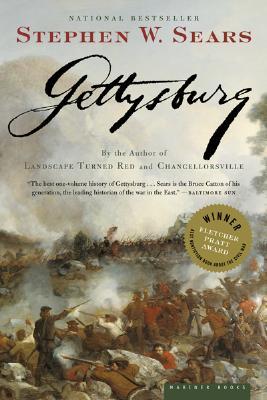 This is the most thorough and brilliant account of the Battle of Gettysburg (all three days, plus the approach and the departure) I have ever read. This is the most thorough and brilliant account of the Battle of Gettysburg (all three days, plus the approach and the departure) I have ever read.
I have to laugh at the reviews that claim there is too much detail here. Hey, folks, look at the title, and look at the number of pages. If you aren’t ready to have the complete, detailed account, you should know before you buy it or check it out from your library that this isn’t for you. I used to teach about the American Civil War, and it continues to be a strong area of interest for me. I wouldn’t have wanted this to be my first, second, or third book about this war; actually, for the serious reader who is just getting started, McPherson’s Battle Cry of Freedom (which won the Pulitzer) is the best starting point. For those not interested in as thorough an account, it may be easier to start with historical fiction, and then move to nonfictional accounts of the war to help you straighten out the facts from the frills. For me though, I was ready to get down and resolve some conflicting ideas I had read. Some who specialize in the Confederate angle blame JEB Stuart for not coming in when Lee expected him with the intelligence that was needed. Some blame Longstreet for not enthusiastically embracing and supporting Lee’s plan of attack. And still others say the buck stopped with Lee, who after all was in charge and made the call. Sears says this was overall (from the Confederate side) a case of great overconfidence. Earlier in the war,Stuart had ridden all the way around Union commander McClellan’s forces twice to upset him and cut off his communications. This was intended to be trip #3, and it was expected to net similar results, apart from the foraging. The rebels were looking forward to gaining food and other supplies from the well-fed Pennsylvanians. Indeed, when Stuart did finally return–too late to do any real good regarding Gettysburg–he had an enormous trainload of wagons filled with the things Lee had sent him to get. But the Union’s forces had cut Stuart off, had come between him and Lee, and he and his cavalry had the very devil of a time safely making their way around the Union and back to Lee. Overconfidence; Sears makes a convincing case. Another blunder attributable to overconfidence was in waiting an extra day to attack, if they were going to attack without further intelligence from Stuart. Sears makes an excellent case that if they were going to attack Union forces, it should have been later (once Stuart was there to fill them in) or right away, because there were a lot of Union forces making their way toward Gettysburg (and the Confederates knew this much) that would be there the following day–when the battle actually began–who were not yet there. And Ewell, in general a strong commander, makes a terrible, terrible blunder in telling Lee that the Yankees who occupy Cemetery Ridge will be rendered harmless because Jubal Early is occupying the hill that is east of them, and higher. He reasoned that if the rebels had Seminary Ridge to the west and Culp’s Hill, the Union would be wedged in between opposing forces and rendered harmless. But the critical mistake is in giving Jubal Early “discretionary” orders to occupy this hill, and not telling Lee this. Early waits, deciding to send another force under him, headed by Johnson, to occupy Culp’s Hill, and in the time wasted, the Union takes the ground, changing things dramatically. Shifting to the Union perspective, we see that the forces are led overall by Meade, who has led the Army of the Potomac for exactly four days. Through intrigue among the generals below him, Hooker, a good general whose rank and file loved him but whose immediate inferiors found abrasive, was robbed of the glory of taking the field after he had made the plans and set them in motion. On the second day of battle, Sickles, a political general (meaning that he was given command because of his high governmental office, rather than military leadership or experience) refused Meade’s orders repeatedly. And this is one thing I greatly appreciate about Sears: some writers will tread softly when criticizing a commander who later becomes a casualty, as though printing word of the officer’s stubbornness or stupidity and its consequences for the men beneath him might be a breach of etiquette. But the fact is, a lot of men there got dead because of the stupidity or wrong-headedness of those who exercised authority over them, and in the case of this battle, both sides have let their own men know that flight or failure to fight will result in their summary shooting, so it isn’t as though a man could just duck behind a log and wander away from battle, as happened in some other really poorly conceived fights. The truth should be told exactly as it occurred, and in a thorough, well-documented, linear way, Sears lays the story, the exact truth unvarnished, before us. As things unfold, the carnage for which this three day battle is known takes many of the bravest and best down right away. John Reynolds, one of Meade’s ablest generals who was offered overall command and refused it,was shot through the throat and died within the first hour of battle. John Bell Hood was injured and incapacitated, but recovered to fight again, but not at Gettysburg. The most notable action on the second day is the Union’s Chamberlain’s decision not to retreat or surrender when faced with the fact that they are surrounded and completely out of ammunition. Looking down at the desperate rebs trying to climb that hill, he shouts, “Fix bayonets!” and with this, the rebels surrender. A heroic moment! On the second day, Union efforts are hampered by the “continued obtuseness of Slocum” and Sickles’ failure to occupy the ground assigned. By the time Meade gets to Sickles in person after Sickles has refused orders sent to him multiple times, it is too late for Sickles to move, and the damage is done. When Sickles loses his leg,an officer in the Second Corps remarks, “The loss of his leg is a great gain to us, whatever it may be to him.” Hancock, a far more capable commander, is placed in command, and he does the job right. The statistics, both regarding loss of able leaders on both sides as well as the rank and file, particularly for the rebels on the third and most gruesome day, are appalling. Many times Sears refers to this as “Fredericksburg in reverse”, and indeed, Union soldiers can be heard crying out, “Fredericksburg!” The aftermath is controversial. Initially, Lincoln was gravely disappointed to hear that Meade had let Lee and the rebels that still lived “escape”. Yet I cannot help but wonder, if he had stood in the pouring rain that came down on a sea of bodies, one acre of which was completely covered with corpses, some three days dead, and more than one body thick in places; if he had seen that there were only four of the original ten commanders still alive and fit to serve; if he had watched the 17-mile long hospital train of wounded Confederates that groaned away toward the Mason-Dixon line; if in viewing all of this, Lincoln himself would not have said, “Enough. Enough for now. Let’s bury our dead and treat our wounded, and get in out of the rain.” I hope I have conveyed the level of detail you can expect from this tome. If my review is a mite lengthy, you may not want to read five hundred pages plus notes on the topic. Sears writes better than I do, of course, but this is a study only for those who can already tell Sickles, Slocum, Sykes and Sedgwick apart. If you are still getting to know the players, this ballgame may be too long for you. But it is the ultimate detailed account for those who know some, but don’t feel they know enough. I often am forced to give books away because of the finite amount of space in the home library my family has collected, but this particular volume will retain a place of pride as long as I am here. |
Neptune: The Allied Invasion of Europe and the D-Day Landings, by Craig Symonds *****
Eloquent, thorough, focused, and well documented; Neptune, by Craig L. Symonds, is a definitive work regarding maritime’s most immense project, the invasion of Normandy during World War II.
That said, I urge the reader to get a hard copy of this book, because the e-reader version as I saw it had charts that were useless; in addition maps, so important to a work like this, are simply impossible on a tablet. For a book of this importance that should hold a place of pride on the shelves of any professional or serious personal library, it is worth the investment to procure a hard cover copy.
Symonds’ narrative opens with strategizing and secret diplomacy regarding American aid to Britain, which is in far worse condition during the war against Nazi Germany than I had ever understood. Just as a plan begins to gel, word comes that the Japanese have bombed Pearl Harbor. Months of careful planning must now be carefully reexamined and new plans made. Should the USA fight on one front, or on two? Should it attack Japan first, or go straight to Europe (as most US advisers were inclined to do), or follow Churchill’s suggestion that the fight begin in Northern Africa? Americans tended toward quick action and massive investment of resources; the British were careful in husbanding materials and preferred to examine every aspect of every possible plan before moving forward. Frankly, I am glad I didn’t have to be there during the debate.
Symonds has put together a narrative different from any other I have read regarding this period, and the only work I have read that deals exclusively with the invasion of Normandy from the naval viewpoint. I have also never seen any writer try so valiantly to balance the perspectives, the strengths and challenges of both Britain and the USA. It was in reading the ways in which cultural attitudes not only created friction but directly impacted military positions that I realized how completely American I am. He further explains how the decisions that were made came about and all of the careful compromises and considerations that went into the events as they unfolded.
Because this is such a momentous work, I found myself marking far too many pages—a weakness when I become overly enthusiastic—and now it would be too much to go back and refer to all of them. The vantage point was enormously enlightening, and I came away feeling as if I had only just begun to grasp the enormity of this horrific conflict.
Highly recommended…in hardcover, not tablet form.
All Quiet on the Western Front, by Erich Maria Marque *****
This has been labeled the best anti-war novel ever written. I agree. We see the first world war (“The Big One”) through the eyes of a young German soldier.
Some have held “Johnny Got His Gun” to be the best anti-war novel; I disagree, because that novel holds out no hope. When all is lost at the beginning and never gets better, it fails to draw the reader’s emotion. Marque is singularly skilled at reaching right down into the reader’s chest and wrapping his scholarly fingers right around our heartstrings. (Don’t look for this term in a physiology text.)
AQWF, on the other hand, develops character and setting sufficient to take us there, to nearly climb inside the skin of someone going through the experience.
Is there such a thing as a war worth fighting and dying in? I think so…but very rarely so, and this novel helps us understand the need for restraint and caution.
Note to teachers: though this is outstanding literature and many students enjoy it, it requires a very strong reader in terms of ability and vocabulary.
Billy Bathgate, by EL Doctorow *****
I have to admit, E.L. Doctorow is one of those writers whose work is a sure fire hit for me. I love historical fiction, and I admire great word-smithery. Doctorow is skilled with both.
This one is a period piece, a look at a hard time and the ugly risks that some folks took from desperation and perhaps a misplaced idea of what greatness might look like. To be sure, the government wasn’t exactly setting a good example; those who searched for less-than-conventional means were, in my view, right to reject the American Dream as a lot of smoke and mist. But organized crime is another form of corruption. Doctorow shows that pretty well too.
All told, it isn’t the moral I seek in a book like this, so much as a good story. Doctorow is a master storyteller, and the reader will always get his or her money’s worth.
I buy a lot of books used, but for this man, I pay full cover price and am glad it’s available. A treasure.
The Worst Hard Time: The Untold Story of Those Who Survived The Great American Dust Bowl, by Timothy Egan ****
I should probably give this book the fifth star it really deserves, but I was so demoralized at the end, I couldn’t bring myself to do it.
What makes it worth going there, just when you know already your heart will be broken, is that this is a chunk of US history that rarely gets covered in K-12 education, and like most, I came away not knowing much about it. In fact, I was qualified to TEACH history before I knew much about it. Curiosity was the only thing that got me to go there, between those pages.
It’s a story with no heroes and no real survivors. It’s a grinding, miserable nightmare of a story. The environmental message is its raison d’etre, but of course, very little grassland in America is allowed to lie fallow, save perhaps that inside national park boundaries.
Why would ground so hospitable to grass, not accept wheat? That’s the question I went in with (being no kind of scientist) and I came out with an answer. As we look for ways to mend the annihilation humans and corporations have wrought on this earth, this particular ecological (and very human) story is one that has to be told. I read it, because I just had to know. I recommend you do the same.
The American Sisterhood: Writings of the Feminist Movement from Colonial Times to the Present, by Wendy Martin*****
Please note that this resource is copyright dated 1972. You’ll have to consider the word “present” in the title with a grain of salt. It would be great to see an updated version published, but right now, the word “feminist” carries such strangely negative connotations that no new edition may be printed…at least, until the pendulum swings back where it belongs. This, like most political assertions, is a matter of perspective. Now you have mine.
This out-of-print, unpretentious-looking volume is a treasure trove of speeches and letters from feminist luminaries, from Sojourner Truth and Elizabeth Cady Stanton, on up through Emma Goldman and Charlotte Perkins Gilman, to the so-called radical feminists of the 1960’s, such as Gloria Steinem and Robin Morgan. If you are interested in American history, the history of women’s rights, or in need of primary sources regarding same, snap up a copy of this if you can lay your hands on it. Mine is in woeful condition, and the ISBN page fell out; I had to get it from Amazon’s website! A scholarly edition I am so glad to have kept over many years, many moves, and the occasional furtive looting of my shelves by children no longer at home. A must-have for students of the history of women.
Cloudsplitter, by Russell Banks *****
 This book is a novel based on what truth is available. The story centers on Owen Brown, the youngest and last living son of John Brown. What I was looking for, of course, was information about John Brown himself. However, because he understood the need for secrecy in his movements, considered himself (and usually really was) a hunted man, he did not leave copious journals. In fact, writing was not one of his talents. What he did care about were the 3 million men, women and children shackled to the plantation system, sometimes literally. He was the only white man recorded in history to have been friends (real friends) with Black people, who understandably were deeply suspicious.
Telling it all through Owen’s eyes is a strong device. Banks is a really good writer, and I think this is my favorite among his published works.
The question that hangs in the air for historians interested in this time period, and in Brown in particular, has always been whether he was sane or a madman (and as a history teacher, I have to say that at least one text mentions him only briefly, and comes down strongly on the side of his being a crazy man).
There is one undeniable fact, whichever side one takes: he was the first white man to kill and die for Black men. At that time, and for a long time after, his name carried great respect among Black men and women in the U.S. I am inclined to agree with them.
In these modern times, we know that it is possible to be mentally ill, and yet not be unable to function. I’m willing to bet that most families, if you trace the lines hard and long enough, will have at least one such person. And reading this novel convinced me that this was the case with John Brown.
Owen’s life was not an attractive one. At times, it appeared that their father had deserted the family; he would go away on one religious/political (for Brown, they were inseparable) mission or another, and not come back for years. There were times that the children of the family nearly starved to death, and their lives were not only desperately poor, but beset by constant danger. The stress alone might be enough to unhinge almost anyone.
I think I should leave the story as Banks tells it to the reader. His prose is brilliant and compelling. This is a very long book, but I finished it pretty quickly, because I couldn’t leave this family in danger until I had seen the very end. Banks brings characters alive in a way few writers do. I was a member of the Brown family until the book was over; their struggle became mine, and each poor decision made me flinch and my stomach felt leaden. Doom!
It also left me with the question we can never answer: what if Brown had waited another (roughly) ten years to lead the revolt? Might he have met with greater success?
If you like seeing characters developed well and also like historical fiction when it is done well, this book is terrific. (It is also very large, and heavy. If you have a nook or Kindle and it is available, consider reading it that way).
Battle Cry of Freedom, by James McPherson *****
If you only choose to read one (challenging and sizable) resource on the American Civil War, this is the one. It won the Pulitzer, and although it is a large, serious piece of work, it is immensely readable. It begins with the Mexican-American War because that is where much of the Civil War’s military leadership is forged. It also makes it much more interesting to see whose fortunes rise, and whose fall (although these are, naturally, secondary to the issue of the war itself).
This is unquestionably the most thorough and accurate volume about America’s last righteous war. It requires a high level of literacy, but with that caveat, it is a surprisingly accessible narrative, from a man who documents everything and knows what he’s talking about.
One other thing: I find that in discussions about the Civil War (still referred to in much of the South as “the war between the states”), though it is long past, in some ways it isn’t over. Feelings are sometimes still surprisingly heated. And indeed, anyone who writes history is subjective, even if it is only by the facts they include (and which are emphasized); what sections or titles are named; and which generals are given the most air time. So though nobody is entirely objective, I think McPherson is the most reliable, knowledgeable, yet objective writer I’ve found yet.
 Seattle Book Mama