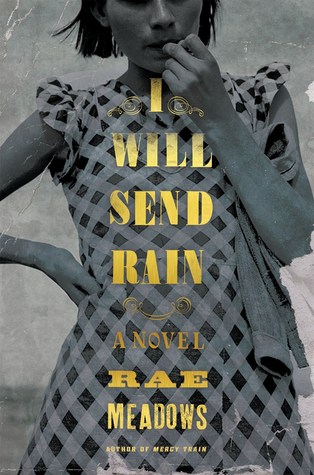
I Will Send Rain, by Rae Meadows****

Happy release day! I can’t wait to hear what you think of Meadows’ thunderous tale of redemption. It’s available today.

seattlebookmama's avatarSeattle Book Mama

iwillsendrainAnnie Bell could have chosen to marry a well-to-do member of the gentry in her home town, a man with fine china and a full time kitchen servant. Young and buoyant, she chooses love instead, and moves to Oklahoma with Samuel Bell to start a brand new life on the free land that’s been provided. What could go wrong when two young people are strong and dedicated to one another? Oh, it’s an old, old story in so many ways, but Meadows makes it brand new. Thanks to Net Galley and Henry Holt Publishers, I read it free and in advance in exchange for this honest review. It will be available to the public August 9, 2016.
When we join the Bells they are no longer newlyweds; a lot of water has gone under the bridge. They have Birdie, a teenager determined to find a way out of Mulehead, and…

View original post 512 more words

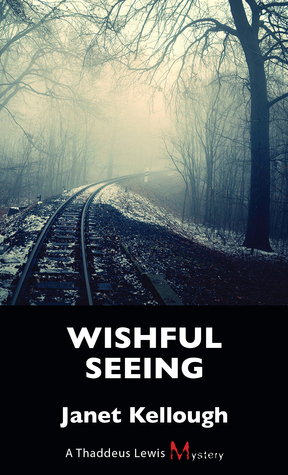
Wishful Seeing, by Janet Kellough****

wishfulseeingThaddeus Lewis, the traveling preacher sleuth, is back on the road again. He’s headed to speak at a gathering of Methodist Episcopalians when he finds himself involved, once more, in a murder case. This cozy mystery is my second in an endearing series by Janet Kellough. I snapped up the DRC when I saw that Dundurn had made it available on Net Galley, so I read it free in exchange for an honest review. This title will be available to the public this Saturday, July 30.

A body has been found in Rice Lake, and there are witnesses that saw Major Howell and his wife Ellen, the woman in the blue dress, near the scene of the crime “in the right place at more or less the right time”.  In the Canada that existed back then, that was enough to put Mrs. Howell in jail; her husband would be there too, but he is nowhere to be found.

Lewis finds himself drawn toward her case. Is it because he saw bruises on her arm that suggested her spouse may have handled her ungently? Is it because she is lovely, and he wishes she were with him instead? Or is it because Lewis just can’t scratch that legal-eagle itch enough times to be rid of the urge?  Likely it’s some of each.

The main draw card here is setting. Kellough has done a good deal of research in laying out both the area around Toronto during its frontier period. The result is a historical mystery with a travelogue feel to it. Kellough takes us to a time and place nobody can visit anymore except through literature, and she does a great job of it. She includes a lot of interesting details about the history of the Canadian legal system that drew my attention, because it was very different from what those of us raised in the US have come to expect. I found this aspect of it fascinating.

I also really enjoyed the part played by the little dog, Digger. I wouldn’t care to see him start solving crimes, but I hope we see him again in a future installment.

The only weak part is—perhaps unfortunately—at the beginning. There is so much of Thaddeus’s inner narrative, so much soul searching and comparison of beliefs among the various Protestant denominations that if I had not read Kellough’s work before, I would have wondered if I had inadvertently stumbled across Christian fiction. In fact, my notes show that at one part I wondered anyway.

Yet in another way, if there has to be a slow part, let it be at the beginning. And it’s clear that Kellough is not attempting to put together a thriller that grabs the reader by the throat, but rather is treating us to a relaxing story that one may take to the hammock and flop down with.

Nevertheless, by the time all the groundwork has been laid, it is a hard book to put down.

So this is your beach read. Take it to the shore, to the mountains, to the river, or even your own back yard, but don’t cheat yourself by passing it by. You can have it this weekend, and those that enjoy both historical fiction and mystery wrapped up at once are in for a treat.

I Will Send Rain, by Rae Meadows****

iwillsendrainAnnie Bell could have chosen to marry a well-to-do member of the gentry in her home town, a man with fine china and a full time kitchen servant. Young and buoyant, she chooses love instead, and moves to Oklahoma with Samuel Bell to start a brand new life on the free land that’s been provided. What could go wrong when two young people are strong and dedicated to one another? Oh, it’s an old, old story in so many ways, but Meadows makes it brand new. Thanks to Net Galley and Henry Holt Publishers, I read it free and in advance in exchange for this honest review. It will be available to the public August 9, 2016.

When we join the Bells they are no longer newlyweds; a lot of water has gone under the bridge. They have Birdie, a teenager determined to find a way out of Mulehead, and their younger child Fred, a child beset with heavy health issues. He’s sturdier, however, than the baby that didn’t make it. So Annie and Samuel have had success, some fine fertile years on their farm when the wheat was tall and the rain came when it was needed, but they’ve also endured some heartache. Regardless, every Sunday they gather at the only house of worship in town and send up their thanks and prayers for the blessings of nature, and perhaps to ward off its curses as well.

But then, things deteriorate in a horrifying way. Without the sturdy prairie grasses to hold down the topsoil, it is depleted and finally just blown away in the horrible wind storms that come in terrifying intensity, a veritable hurricane of dust instead of water. There is no insulation that withstands the fierce and immeasurable storms, ones that turn day dark as night and fill every crevice in every home, barn, and public building with a layer of grit. Dust isn’t just on the bed, it’s in it. Dust is everywhere, including inside the lungs of little children. And so it is that Fred is stricken with dust pneumonia, an ailment akin to Black Lung disease but without even a paycheck to show for it.

In the midst of it all, Samuel has a message from God: the rain will come, and Samuel must build a boat. And so as the wheat dies beneath the remorseless sun, as the water is rationed and the cattle grow thin, Samuel goes to the barn and commences planning and building the ark that will save his family from the flood.

Everyone in town is laughing at him, but that doesn’t matter to Samuel; he has heard from God.

Meadows is a clever wordsmith, and her capacity to spin setting and develop character are impressive. Young Birdie is in so many ways her mother all over again, and yet Annie is unable to breach the abyss that separates her from her teenage daughter. Annie has learned a lot and she’s learned it the hard way, through experience; Birdie wants nothing to do with any of it, or with Annie. At times I longed to grab that girl by the shoulders and send her into the kitchen for a chat with her mother, but if I could have done so, she wouldn’t have listened anyway. Hopefully this gives the reader a glimpse of how real these characters became to me.

Most of the way through this compelling novel I was sure it would merit five stars, yet the ending left me dissatisfied. Even if I could explain this without spoiling it for you, I’m not sure what the writer should have done instead, but the denouement felt contrived to me even though in many ways it seemed like a reasonable ending. Perhaps you will feel differently.

You may have read other historical fiction set in the Dust Bowl, but you haven’t read anything like this. Check it out and see what you think. I’d hate for you to miss it.

City of Darkness, City of Light, by Marge Piercy*****

cityofdarknesscityoflightPiercy is a legend among feminists, and her writing was pivotal in my own development during the late 1970s and early 1980s as a newly-hatched adult. When this title, a novel based on the French Revolution, came out in 1996, I put it on my Christmas list and read it hungrily once I received it. When I noticed that it was released digitally this spring, I scored a digital copy from Open Road Integrated Media and Net Galley in exchange for this honest review. It’s a novel that is definitely worth reading twice.

Piercy is brilliant not only in bringing characters to life—and she did a prodigious amount of work before doing so, reading piles of biographies, memoirs, letters and other documents—but also in conveying the reader to the time and place In question. I think it’s because of this that her novel helped me to understand how such an amazing, incredible thing, the revolution, the democratic impulse that overthrew a monarchy, could end so badly. Dry history texts chronicle the “excesses” of the Jacobins. Say what? How meaningless is that? And it is by being able to see the roles played by key figures in the revolution, including the women that are usually left out, that I can see why the leadership degenerated as it did. An inexperienced working class with no background in how to organize a struggle ultimately paid the price, but in the end, the nation was still better off than it had been beforehand.

Using the grammar and conversational conventions of today for easier access to a popular audience, Piercy transports us back to a time when a life expectancy was less than fifty years for most people; open sewers flowed through the streets of Paris, causing horrible illnesses and a high infant mortality rate; and a starving seven year old child could be publicly hanged for stealing bread.

In fact, the bread riots led by the women of Paris were where it all began.

One thing readers should know if they read this novel digitally is that there is a glossary of sorts, a long list of characters and a few basic facts to identify them, but it’s at the back of the book, so you will want to go over it before you start and then refer back to it when you find yourself confused. The topic is huge, and you may need this cheat sheet, so it’s good to know it’s there. There are so many historical characters here, and if you aren’t fluent in this area, you may lose track of Robespierre, Danton, Madame Roland, and oh of course, Marat. And back then, Camille was a man’s name!

Piercy tells the story using the points of view of a wide range of figures important to this struggle. She gives a fair hearing to the perspectives of those that stood left, right, and center in this conflict, denying a sympathetic ear only to royalty—and even Marie Antoinette is treated with surprising sympathy. I came away feeling as if I knew so much more about the French Revolution and its terrible conclusion when I had read it, and rereading it was even more helpful, because it’s a lot to digest all at once, even if one is already aware of the broad contours of this pivotal time in French history.

When I love a book hard, I push it at everyone that comes within my reach, and I have pushed this particular novel at a lot of people over the years. Given how many times I loaned out my own (purchased) hard cover copy, it’s surprising that it isn’t falling apart, and maybe even more surprising that it’s always been returned to me.

Whether you prefer to read digitally or to purchase a paper copy, City of Darkness, City of Light is the most readable, accessible treatment of the French Revolution that I have seen. The fact that Piercy includes the key role played by women, both among the toiling masses and the elite salons of the intelligentsia makes it even better.

Recommended wholeheartedly to anyone that wants to understand the French Revolution!

The Last Road Home, by Danny Johnson****

thelastroadhomeThe Last Road Home, bold and impressive new fiction by Pushcart Prize nominee Danny Johnson, came to me free thanks to Net Galley and Kensington Books in exchange for an honest review. It tells the story of Raeford “Junebug” Hurley and his friendship with neighboring twins, Fancy and Lightning Stroud. Junebug is Caucasian; the twins are African-American, politely referred to during that time as ‘colored’ or ‘Negro’. The story is set during the Civil Rights movement of the early 1960’s, but in rural North Carolina, the Klan stands tall and strong and absolutely nothing has changed in terms of race relations. Junebug finds himself riding on the fence rail from hell. This fascinating tale will be available to the public in late July. Those that love good historical fiction should read it.

The book begins with one horrible loss after another. At age 8, Junebug’s parents are both killed in a car wreck, and he goes to live with his grandparents.  His life is pleasant and stable, helping his grandpa run the farm, but then his grandpa dies too. And by the time his grandmother dies, I have decided that the theme of this story must be grief and loss, or given the number of religious references, perhaps there is some sort of Christian redemption theme here. And on both counts, I find I am mistaken. Johnson is a masterful storyteller, and there is nothing simplistic in how this novel unfurls.

For while Junebug has plenty of questions about the religious fervor that pervades small towns of the South during this era, by the time he buries his grandma, he has had it with religion. “The preacher said a prayer, asking the Lord to be with me in this time of grief. I’d had all of God’s shit I could take and didn’t need His sympathy. If he said it was ‘God’s Will’, I might choke him.”

I wanted to stand up and cheer.

At age 15, orphaned and the sole remaining member of his family, he is on his own. “Fifteen was considered adult in farm years.” Lightning leaves home suddenly, unhappy with the limitations placed on Black men in his part of the world. Fancy is left behind, and she is the only friend Junebug has within walking distance of home. As friendship turns to passion, both find themselves occupying a dangerous place in their community. Given that they are cold shouldered simply for appearing in town together to run an errand, the thought of letting their feelings for one another be known is terrifying.  He recalls his grandma’s admonition:

“’Junebug, you need to understand that cruelty and memory have been married together a long time in the South.’”

Johnson does an outstanding job of depicting white neighbors’ responses to the notion that our protagonist is linked romantically with Fancy. At first they are able to maintain the age-old fiction that she is his housekeeper, but she goes home at night, then sneaks back in darkest night to lay beside him. The muted references, little hints given by Caucasian elders nearby to guide the young white farmer away from a liaison that doesn’t fit local expectations, are rendered skillfully. There are a number of really vicious racial epithets tossed casually around by the local landowners, not always even in anger, sometimes in ugly jokes, as this writer knows from childhood experience is the way racists behave when a white supremacist perspective is not something being fought for as an outlier, but rather the dominant, even comfortable, norm. As the book continues, not only anti-Black pejoratives, but also nasty terms regarding Jews and Asians are tossed into the vernacular. None are gratuitous; they are an undeniable part of the setting, which would be revisionist without them.

Fancy and Junebug seem doomed. He tells her, “It feels like my life’s sprung a lot of leaks, and I’m running out of fingers.” She points out that she only has ten fingers too.

I was watching for the pat ending, the comfortable happy fiction that novelists are often drawn toward. Every time I thought I knew where the story was headed, it went somewhere else. Johnson is brilliant at breaking apart stereotypes, making setting real and immediate, and his character development is strong apart from some minor inconsistencies toward the end. And his framework is materialist by and large, showing that our surroundings and role in life shape us in ways we sometimes don’t expect.

Those interested in this period of history or that love excellent fiction should order this book. It will be available to the public July 26, 2016; strongly recommended.

Radio Girls, by Sarah-Jane Stratford*****

radiogirlsFearless women change history.

Radio Girls is a fictionalized account of the British Broadcasting Corporation and the remarkable women that shaped it. As we near the centennial of women’s right to vote in the USA and the UK, Stratford’s riveting historical fiction could not be better timed. I received my copy free and in advance thanks to Net Galley and Berkley Press in exchange for this honest review. I am overjoyed to be able to recommend this new release unequivocally. You have to read it.

Maisie Musgrave is born in Canada and raised in New York City. Tossed out of the nest without a parachute by unloving family, she makes her way to Britain, the place her heritage began. She wanders into the BBC half-starved and looking for an honest way to pay for her room and board, hoping in the meanwhile to meet a man she can marry for financial security.

At the BBC she meets supervisor Hilda Matheson, who fears nothing:  “Give that woman an inch and she takes the entire British Isles,” a colleague remarks.

Under the firm and commanding wing of Matheson, Maisie’s confidence and talent grow daily. It’s a very good thing, because over the course of time, more will be demanded of her than secretarial skills and errand-running.  My busy fingers marked one clever, articulate passage after another to share with you, but to enjoy Stratford’s fresh, humorous word-smithery, you really need the book itself.

Occasional historical figures drop in—Lady Astor, who was a moving force in the development of the BBC and a champion of women; Virginia Woolf, early feminist writer and crusader. Yet Stratford metes out these references in small enough batches that it’s clear she isn’t relying on them to hold her story together; rather, they are the cherry on the sundae.

Setting of time and place, pacing, and a million twists and turns in plot make this a good read, but it’s the character development that makes it a great one. I found myself wanting to talk to Maisie and cheering her on when she broke through to higher ground personally and professionally. I feared for her when she veered into dangerous waters and nearly wept with relief each time she was able to extricate herself and move forward. There isn’t a slow moment or an inconsistent one, and the protagonist is just the character women need to see right now as we move forward too.

How much of this is based on truth and how much made up for the sake of a great story? Read the author’s notes; she spills it all.

All told, Sarah-Jane Stratford’s historical feminist tale is perfect for today’s modern feminists—and those that love us.

This book is available to the public Tuesday, June 14. Change the screen and order a copy for yourself now. You won’t want to miss it!


Union Soldier, by Gordon Landsborough***

unionsoldierI received this title courtesy of Endeavor Press, who invited me to read and review their material directly; I thank them for the invitation to read and review this Digital Review Copy free in exchange for an honest review.

Our protagonist is McGaughey, a physician with a troubled past who enlists as a Union soldier because he cannot enlist as a doctor. He falls in love with a young woman named Sara, and so this relationship is a key aspect of the book. He moves heaven and Earth to see that she is allowed to stay with his unit, even introducing her as a laundress, a thing I never knew Union troops enjoyed.

Landsborough does a middling job of character development and creates an aura of mystery around McGaughey. I found his depiction of Union soldiers in general alienating. For me, the American Civil War was the last really righteous war the US fought, and so his characterization of most recruits as men that would do anything rather than serve, men that were rough, dishonest and usually of poor character demeaning. I suspect he was striving for realism, or perhaps he truly believes the war should never have occurred at all. Those that take this position may find themselves enjoying the novel more than I did.

Setting was a problem for me. Whereas his descriptions of the immediate area in any given situation were well done, I could never place this story on the map. On the one hand, Flagstaff is mentioned several times and so I was thinking of Arizona. The prominent role given American Indians tells us he has to be in the West. But the Sioux confederation is in the North, primarily in the mid-western USA, and so I was confused.

Landsborough does a creditable job of pointing out that the American Indian was still fighting for justice during this time period. The US government strove to fulfill the integrity of the nation, but didn’t do well by native peoples.

The stereotype that McClellan was an unskilled general whereas Lee and Jackson were brilliant is a tired old saw. A more in-depth look at these generals demonstrates that McClellan was entirely capable but actually sympathetic to the Confederate cause. Considerable evidence proves that his failure to succeed militarily in most situations was intentional. Lee made a number of errors as did Jackson, who was often unreliable when he was expected to show up, but both were bold, and for a time their energy and boldness paid off. I would have liked to see more knowledge of the war itself in this story, which turns out to be more a Western and also a romance than a Civil War tale. To be fair, it was billed as a western, but I latched onto the title and expected something more.

For those that enjoy Westerns or historical fiction that contains romance, this book may be of interest.

The Kaminsky Cure, by Christopher New***

thekaminskycureThe Kaminsky Cure is a satire of Nazi Germany previously published and now offered anew in digital format. Thanks go to Open Road Integrated Media and Net Galley for the invitation to read and review, and for the DRC, which I received free of charge. This title is available to purchase now.

Who would have thought it possible to satirize such a terrible time and have it come out in anything other than terrible taste? But New carries it off, using a pre-school aged child in a mixed family—with one Jewish parent and one Anglo parent—as his narrator. Several times the precocious tot points out aspects of his own narrative that are actually impossible, as for example when the child tells us exactly what is contained in something written and then blandly points out that he cannot read yet. It just makes it funnier.

The appealing thing about this novel is that it brings up the reality which should be obvious to any thinking person that has paid any attention to this particular time and place: most Germans as well as Austrians were entirely in favor of Hitler’s takeover, and although there were Jewish families, many of them in fact, that wanted out of Nazi-occupied Europe as quickly as they could go, there were others that had never embraced their culture and had converted to Christianity in some cases generations earlier; and such is the case with our protagonist’s family, which wants only to pass itself off as Aryan so that it can join in the party. Young Martin, the protagonist’s older brother, longs to become a member of the fearsome SS, Hitler’s storm-troopers. Ah, the uniforms! The ferocity! The authority!

Our toddler-narrator, meanwhile, observes his own family with platonic remove, contemplating which members have violated one edict or another and should therefore be turned in to the authorities. After all, that’s one of the things he has learned in school. Children are the future, and it’s up to them to weed out those older folk that fail to comply with important social changes.

It’s what Hitler would want him to do.

There’s one twist and then another, but overall I found that the story’s momentum lost steam as it progressed, because there was really just one joke here, and it could only be played so many ways before it became repetitious. Nevertheless, it’s wholly original, and when faced with an event as horrific as the Holocaust, one either has to laugh or cry.

And amazingly, New has created a way to help us laugh, at least for a little while.

Everyone Brave is Forgiven, by Chris Cleave*****

everyonebraveisforgivenThis is one of those rare novels that I have passed by multiple times despite all the buzz it has generated, because it looked as if it was out of my wheelhouse. A socialite. Pssh. A British officer. Sure. But eventually the enormous buzz among readers and booksellers made me curious. The last time I had this experience, the novel was The Goldfinch, and once I had begun it I gasped almost audibly at what I had almost let slip away from me. And so it is with Cleave’s brilliant novel, historical fiction mixed with more than a dash of romance.  I was lucky enough to get the DRC free of charge in exchange for an honest review; thank you Simon and Schuster and also Net Galley. This luminous novel is available to the public Tuesday, May 3, and you have to read it. It is destined to become a classic.

Our protagonists are Mary North and Alistair Heath; she is dating his best friend, and he is dating hers.  The night before he is to leave to serve in the British armed forces, a moment flashes between them in which they know they want to be together; when he leaves, each grapples with issues of personal loyalty when thinking of the other.

If talent were a mountain, then Cleave would be Everest. If talent were an island, Cleave would not be Malta, but rather all of Britain. And Cleave’s use of word play, first to show how undaunted British youth were by the challenges ahead, and later in a sharper way as the characters learn terrible things and develop a new definition of what courage looks like, is bafflingly brilliant, the rare sort that makes lesser writers hang their heads and understand—this will never be you.

My primary reservation about this novel was that it dealt with the social elite, and my first thought was oh heavens no.  That poor rich girl is going to have to suck it up like everybody else. But I underestimated Cleave and what he was about to take on; Mary, Alistair, and the secondary characters around them begin with a set of assumptions that under his unerring pen seem not only reasonable, but the sort of normal to which their entire lives have accustomed them. Their cavalier approach to the war, from those that serve from those like Tom who at the outset, believe they will “give it a miss”, is the entitlement that has cradled and preserved them from the realities of the greater world all their lives.

And it’s about to change.


Any other city would be chewing its knuckles and digging a hole to hide in.    Alistair    wanted to yell at people: The bullets actually work, you know! What they did not understand was that the city could be extinguished. That every eligible person could die with the same baffled expression that he had seen on the first dead of the war, in those earliest shocking days before the men had learned to expect it. I’m so sorry—I think I’m actually hit.


In turns amusing, poignant, tender, and heartbreaking, this is a novel you will want to reserve hours of your most private moments to read. You may find yourself taking an unexpected sick day so that you can finish it. Based on the overall story of the author’s grandfather with changes, added details, and embellishments, all of which the protagonists would agree are first rate, Everyone Brave is Forgiven is an unforgettable story of love, war, and innocence lost.


Second Daughter: the Story of a Slave Girl, by Mildred Pitts Walter**

seconddaughterstoryofaslavegirlSecond Daughter is historical fiction based on the true story of an enslaved woman that went to court and won her freedom in New England around the time of the American Revolution. I received this DRC free from Net Galley and Open Road Integrated Media in exchange for an honest review. And it’s just as well, because if I had paid any money at all for this brief but troubled book, I would be deeply unhappy.

First, let’s examine the positive aspects that allowed the second star to happen. Walter has nailed setting, and when Aissa, the girl that serves as our narrator, describes the kitchen of her master’s house, we are there and can see it all. Here she does an excellent job. Other settings are also well told.

Second, the length, just 119 pages, is accessible for young adult readers, many of whom find it difficult, in these technologically advanced times, to focus all the way through a full length novel.

Unfortunately, the problems outweigh the virtues. I have two issues that plant this story on my literary wall of shame. The first is technical, the second philosophical.

Technically I see this as a decent if unmemorable read, and were I to judge this strictly on the writer’s skill, I would call this a three star novel. Overlong passages of narrative, often unbroken by action or dialogue and in lengthy paragraphs, are likely to hit the average adolescent’s snooze button early on. The choice to tell everything in past tense as opposed to the more widely used literary present deadens the pace further. When we finally do get a passage of dialogue, it is so stiff and stilted that not even the most engaging teacher, when reading this out loud to her class, could possibly breathe life into it. One character is depicted as speaking with a Sambo-like dialect, all “dis” and “dat”. If one is going to use a dialect, make it respectful and readable.  This verges on mimicry, and any Black students in the room that haven’t tuned out or gone to sleep yet are going to be pissed, and rightly so.

I can see that Walters meant well in writing from the point of view of a Black slave girl and in depicting a victory gained by Black people on their own behalf, as opposed to the usual torture, death, and despair that represented those kidnapped and forced into slavery. But this is also where I have to step back and ask what the ultimate effect of this book will be on students that read it.

For the average or below average middle school student, reading all the way through even a fairly brief novel such as this one will likely be the only book they make it through during the term in which slavery is covered in the social studies, humanities, or language arts/social studies block. Part of the power of good literature—which this isn’t, and in some ways that may be for the better—is that it drives home a central message. I can envision students that pay attention to this book, perhaps because the teacher is particularly engaging and has driven home its importance, and then walking away from the term’s work convinced that all any slave in any part of the USA ever had to do to get out of his or her predicament was to find a good attorney, take the matter to court, and bang, that’s it, we’re free. Let’s party.

This novel addresses a relatively brief period in the northern states, where slavery had been legal but had not been as widespread as in the Southern states. King Cotton had not become the dominant economic mover it would become by 1850, when its grip on all of US governmental institutions would be absolute. By then, northerners made their money indirectly from the cotton industry in everything from shipping, boat building, rope making, and banking to growing crops for consumption by Southerners and in some cases, for their slaves.

If one is going to teach about slavery, far better to do so as part of an American Civil War unit. It’s a tender, sensitive, painful thing for children of color, but it’s not okay to deceive them, however unintentionally, with the misimpression that all slaves had options that they didn’t.  Better to use portions of Alex Haley’s Roots; teach about the vast but much-ignored free Black middle class in the north that was the primary moving force behind the Underground Railroad; or to show the movie “Glory” in class to emphasize the positive, powerful things that African-American people did during this revolutionary time, than to emphasize something as obscure, limited, and potentially misleading as what Walter provides here.

I am trying to think of instances in which this book might be part of a broader, more extensive curriculum such as the home-schooling of a voracious young reader, yet even then I find myself back at the technical aspect, which results in a book that is dull, dull, dull. Literature should engage a student and cause him or her to reach for more, rather than make students wonder if it will ever end.

In general I have resolved to read fewer YA titles than when I was teaching and treat myself to more advanced work during my retirement. I made an exception for this title because the focus appeared to be right in my wheelhouse, addressing US slavery and the civil rights of Black folk in America. I regret doing so now, but it doesn’t have to happen to you too.

Save yourself while there’s time. Read something else. And for heaven’s sake, don’t foist this book on kids.