Murder at Gull’s Nest, by Jess Kidd*****

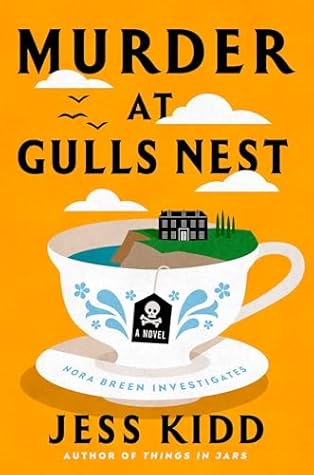
Nora Breen has sprung the coop, run away from her home of the past thirty years and come to Gull’s Nest, a rooming house near the sea. “Gull’s nest is that sort of place, isn’t it? Where the dreamers and schemers wash up.” And indeed, that’s our Nora. “A washed up nun…An abandoned friend. Flotsam and jetsam.”

Murder at Gull’s Nest is the first mystery in a series by one of my favorite novelists, Jess Kidd. I’m grateful to NetGalley and Atria Books for the review copy. This singular story will be available to buy in the U.S. April 8, 2025.

Nora is indeed a former nun; she’s shed her holy orders along with her tunic and scapular; she’s asked Christ for a divorce. Now she’s middle aged, and dressed in whatever castoffs were available when she departed. She has very little money, and is appalled at what inflation has done to prices between the time that she entered the monastery and the present day. Her first order of business now is clear, regardless: she must find her beloved friend Frieda, who left the order, came to live at Gull’s Nest, corresponded faithfully, then apparently dropped off the surface of the earth. If she’s alive, Nora will find her; if not, Nora will find her anyway.

She settles into the rooming house, and as she gets to know the other boarders, we get to know them along with her. The owner is a stickler for rules, and the cook and housekeeper—one person—is a tyrant. The food is dreadful! Nora resolves to float along beneath the radar for a bit, get the lay of the land before she does any obvious snooping about. However, since this is a murder mystery, someone dies while she’s still getting her bearings. And in time honored tradition, she irritates the very bejesus out of the local law man, Inspector Rideout, who is still deciding whether this death is due to murder at all.

“’I am not yet investigating a murder, Miss Breen.’

“’Are we not?’

“’No, I am not.’”

Don’t ask me to give away anything else about what happens here, because I won’t. I will tell you, however, that it crackles. Jess Kidd writes everything well: internal monologue? Check! Dialogue? Check! Denouement? Check, check, check!

Get this book and read it. You won’t be sorry.

The Ballad of Jacquotte Delahaye**-***

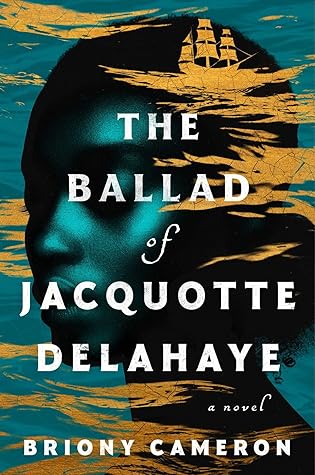
The Ballad of Jacquotte Delahaye marks Briony Cameron’s authorial debut. She is a talented wordsmith, and my thanks go to Atria Books and NetGalley for the invitation to read and review. While I enjoyed several exciting passages—I do adore a good pirate tale—in the end there were issues with credibility that got in my way.

 This story of a pirate woman’s derring do is for sale now.

When I read that Jacquotte Delahaye was a real person and that the book is based on true events, I was all in. However, there are passages that made me raise an eyebrow, and since there didn’t seem to be any notes that would indicate what is true and what is the author’s invention, I took to Google to find out more. This is where I learned that actually, she may have been a real person, or she may be only legend. The stories surrounding her life and exploits are also legend. There’s virtually no verified historical information on this character.

I love good historical fiction, which is where actual, documented facts are given warmth and life by an author that adds dialogue and perhaps fleshes out a few areas where the record is sketchy. Then, if the author is sharp and professional, there will be end notes that explain what is a matter of historical record, and what has been invented. That’s my happy place. Even better is when sources are provided for interested readers. Of course, a writer of any kind of fiction isn’t required to provide footnotes or other documentation, but when they do, it’s the cherry on the sundae, and it makes me love them all the more.

Because this story is not nearly as closely aligned to historical record as the promotional materials would have me believe, I nearly dropped my rating to two stars. I felt, and still feel, that the synopsis provided is misleading. I don’t like feeling as if I’ve been played. However, I realize that the author probably is not in charge of her own promotional blurb, and I can’t see penalizing her for what the publicist has chosen to do.

Do I recommend this story? Not so much. Had it been written in such a skillful way that I felt no need to do research of my own, I might not know that this is pure fiction based on little more than speculation. That’s not the case, though. It doesn’t ring true in a number of places, and that’s partly because it isn’t. However, should the reader decide to pursue it, I would advise that you get this book free or cheap, unless your resources are endless ones. Don’t pay full cover price.

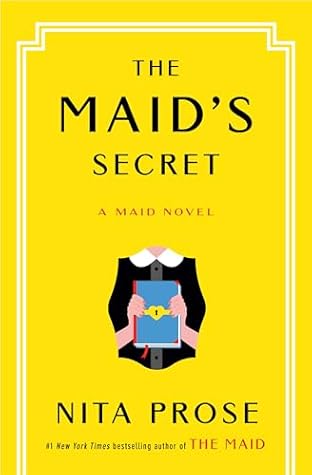
The Maid’s Secret, by Nita Prose****-******

Molly the Maid is back for the third installment of Nita Prose’s excellent and wildly successful series. My thanks go to NetGalley and Random House Ballantine for the review copy. This book will be available to the public April 8, 2025.

As in the first two books, we find Molly employed at The Regency Grand Hotel; she’s been promoted to Head Maid as well as Special Events Manager. She is engaged to chef Juan Manuel, a lovely fellow that helped fill the void in her life when her beloved Gran died. But everything changes when Brown and Beagle, art appraisers famed for their reality television program, come to do a show at The Regency Grand. Along with all of the “polishing to perfection” that is necessary for such a massive event, Molly decides to bring a few of her late grandmother’s trinkets along; you never know, maybe one of them will be worth something.

Oh, it most certainly is!

Once her rare and valuable object becomes public knowledge, Molly’s life changes completely. She no longer has privacy, which she holds dear; strangers are constantly in her face seeking autographs, and the press won’t leave her alone. Meanwhile, we are apprised of the circumstances leading up to this startling discovery. Gran comes to us from beyond the grave—so to speak—in the form of a diary that Molly didn’t know she kept. Chapters in this book alternate between the present day in Molly’s life, and the past, as told in epistolary fashion by Gran.

I wasn’t a big fan of this method, and I’m still a bit ambivalent, which is where the half star off the rating went. It seems like a lazy way to go about telling a story. However, if an author must use this method, it’s hard to imagine it being done better.

Of course things don’t go smoothly following the discovery of the heirloom; if they did, then there would be no novel. But I will leave the conflicts and resolution to the reader to discover.  As for me, I found the series of events, and the ending, believable enough for our purposes, and I enjoyed the story greatly, despite my misgivings about Gran’s storytelling method.

Recommended to those that enjoy the series; this book may be read as a stand-alone, but will be better enjoyed if you can read the first, second, or both earlier books first.

Only Big Bumbum Matters Tomorrow, by Damilare Kuku

When a novel written and set in Nigeria is so successful that it’s translated into English and sold in the U.S., you know it’s probably one hell of a good book, and Only Big Bumbum Matters Tomorrow is clear evidence that this is true. My thanks go to HarperCollins and NetGalley for the review copy; this book is for sale now.

Our protagonist is Teme (TEE-mee), a young woman fresh out of college who is sure of her next course of action: she must develop a perfect body, starting with her backside. She works and saves her money so that she can have her buttocks enhanced surgically. Everybody loves a woman with a big butt, and once hers is augmented, she can marry anybody she wants. It will be a great investment!

This choice, not surprisingly, blows the roof off her family home. All of the women, her mother, auntie, sister, and others are adamant, and they scheme together, and bicker together, about how to prevent her from carrying out what they perceive to be a dangerous and foolish task. In the process, they reveal their own long held secrets, and also? They are hysterically funny!

The reader should know that the best material isn’t dropped in at the beginning, as is the unfortunate trend. Instead, it starts out fairly serious, and then I find myself snickering a little, and then a little more, and by the end, I am howling! There are quite a number of characters, and not recalling all of them won’t interfere with your enjoyment; however, it’s easier to catch up and also identify certain Nigerian terms that are peppered in, most of which are self-explanatory anyway, if you read digitally. However, because I had fallen behind, I checked out the audio version from the library and followed along as I did my morning exercises, and the audio version is brilliant as well. The lilting Nigerian dialect is mesmerizing!

Although it doesn’t seem like it at first, this novel packs a satisfying feminist punch. I highly recommend it to any reader that has eyes, ears, or both. Don’t miss it!

The Great Hippopotamus Hotel, by Alexander McCall Smith*****

The 25th book in the #1 Ladies Detective Agency series is not to be missed. My thanks go to NetGalley and Knopf/Doubleday for the review copy; this book is available to the public now.

When life becomes stressful, what do you do? Some swear by yoga, herbal tea, walking or running, therapy, mindfulness, journaling, or a number of other remedies. Some of us dive into the chocolate; the short-term benefit is mitigated by the long term weight gain, but when we’re upset enough, we don’t care. And for some of us, this series is just what the doctor ordered.

Precious Ramotswe is our detective protagonist, assisted, and occasionally encumbered, by her headstrong but goodhearted colleague, Grace Makutsi, part time apprentice detective, Charlie, and occasionally, by her bestie, Mma Potokwane, who runs the local orphan home.

Our mystery revolves, as the title suggests, around a case of possible sabotage at The Great Hippopotamus Hotel. There’s another thread, too—as there usually is—involving Precious’s husband, Mr. J.L.B Matekoni, owner of the garage and technically, Precious’s landlord.

Those looking for an action packed thriller will always be disappointed here, because that’s not what this series is. Instead, it’s closer to being a Miss Marple-ish cozy mystery. The problem is nearly always solved, not by DNA or murder weapons or questioning baddies until they break, but by an examination of the circumstances and characters of those involved. It is here that Precious is at her finest. In addition, she must tread carefully around the feelings of her staff, primarily that of Grace Makutsi, whose insecurities tend to make her prickly. Grace is a bit threatened by Mma Potokwane, and when Precious explains gently that they will be accompanied by the orphan farm matron on an investigation, Grace says, in a serious case of look-who’s-talking:

“Mma Potokwane—yes, she is observant, but…But Mma, if Mma Potokwane has any faults—and we all have faults Mma, myself included—if she has any faults, one of them is taking over. I am not saying that she is bossy—that is not a word that I would use for Mma Potokwane—I would not say that, Mma, and I am not saying it now. No. But there are some people, I think, who might say that.”

And so, in addition to her detective work, Mma Ramotswe must navigate the small minefields that exist between these two women, both of whom are dear to her.

In some ways, the mystery aspect of these stories is almost superfluous. Every story has to have a problem and a resolution, and so it’s convenient, perhaps, to use a mystery as scaffolding for whatever problem Precious must confront. It’s certainly served Smith well. But the real benefit I see in these series is that the solutions to these problems are always dealt with as gently and as kindly as is possible. Nobody is getting thrown face down on the ground and handcuffed in these stories; every effort is made to turn the problem around while allowing the perpetrator to retain as much dignity as possible. The lyrical prose is so soothing that I love reading these stories at bedtime.

And one more word, for regular readers: the recurring character of Violet, who is the closest we have to a villain, pops up here right away, and I rolled my eyes and said, “Not this again. Smith needs new material.” But the way the character is used this time is different, and if I had a hat, I would tip it in appreciation of the author’s cleverness. He always seems to know when it’s time to break a pattern.

Highly recommended.

Good Dirt, by Charmaine Wilkerson*****

Charmaine Wilkerson is the author of the massively successful Black Cake. Her sophomore effort, Good Dirt, carries some of the same components—an impending marriage, a family heirloom, secrets and betrayals—but is nevertheless a very different story, and it’s an even better one. My thanks go to Random House Ballantine and NetGalley for the invitation to read and review. This book will be available to the public on January 28, 2025.

Our protagonist is Ebby Freeman, which is short for Ebony. She lives with her parents in an affluent neighborhood in New England, but there was a fourth family member, her brother Baz, who was murdered during a home invasion; Ebby witnessed all of it, and has long carried the guilt of survivors. Could her ten year old self have done something to save Baz?

Now Ebby is grown, and plans to be married, but things don’t go as anticipated.

As in her previous novel, Wilkerson packs so many points of view into the story that I eventually stop counting, and although I am skeptical about this choice through much of the book, by the end I have to admit that she has carried it off nicely. Some points of view are urgently necessary to carry the plot forward; others, like that of the intended groom, Henry, are straight-up hilarious in places. Once again, we move not only between points of view, but time periods as well, reaching back into an earlier century, when some of her ancestors were enslaved. These passages aren’t entertaining, but they are necessary to provide clarity and urgency.

Ordinarily, I don’t read stories with wealthy protagonists, and make no mistake, Ebby’s family has a great deal of money; but having the family be African-American, and self-made rather than heirs to massive, often ill gained fortunes helped a great deal. Ultimately it was easy to bond with Ebby. When she experienced pain and rejection, I felt it, too. I carried her around in my head in a way that I usually don’t; over 1,000 reviews are in my rearview mirror, and only the truly special ones take hold of me as this one has.

Highly recommended.

The Briar Club, by Kate Quinn*****

I had never read a novel by Kate Quinn, but my friends on Goodreads raved about it and I was overcome by the fear of missing out. Happily, I was not too late to get a review copy; my thanks go to NetGalley and William Morrow, along with my apologies for lateness. From the get go, I could tell this book was too good to speed read, and so I set it aside for a time when I could sink into it and appreciate it. This fall I was able to get the audio version from the library to help me along; narrator Saskia Maarleveld is outstanding, and those that enjoy hearing their books should strongly consider ordering that format.

Our story takes place just after World War II, and it takes place almost entirely within the confines of Briarwood House, a women’s boarding house owned by the selfish, odious Mrs. Nilsson. The book’s prologue comes to us from the point of view of the house, and for a brief spell I wonder whether the house itself will become the main character. It doesn’t, and that’s probably just as well, because the women that rent its rooms, along with Pete and Lina, Nilsson’s two children, fill the story quite nicely, and all are beautifully developed, some more than others, with Nilsson herself being the only truly static character. In fact, I could argue that even the house’s character is developed somewhat.

I seldom do this, but the prologue is so juicy that I’m going to reprint a considerable chunk of it here, because Quinn’s voice—and okay, the house’s—provide a more convincing incentive to read on, than anything I can offer:

If these walls could talk. Well, they may not be talking, but they are certainly listening. And watching…Now its walls smell of turkey, pumpkin pie, and blood, and the house is shocked down to its foundations. Also, just a little bit thrilled. This is the most excitement Briarwood House has had in decades. Murder. Murder here in the heart of sleepy white picket fence Washington, D.C.! And on Thanksgiving, too. Not that the house is terribly surprised by that; it’s held enough holidays to know that when you throw all that family together and mix with too much rum punch and buried resentment, blood is bound to be shed sometimes…This was a very enthusiastic murder, the house muses. Not one moment’s hesitation from the hand swinging that blade…Briarwood House doesn’t like Mrs. Nilsson. Hasn’t liked her since she first crossed the threshold as a bride, complaining before she’d even shaken the rice out of her hair that the halls were too narrow (My halls! Too narrow!), and still doesn’t like her twenty years down the road. No one else in this kitchen does, either, the house knows perfectly well. It knows something the detective doesn’t. The killer is still very much in this room.

Now that the murder has been mentioned, I must caution you not to identify this story foremost as a murder mystery; it isn’t. The murder doesn’t come till nearly the very end, and the reason that it affects us so deeply is because of the author’s success in making every character here feel tangible and known to us. By the time anyone is enraged enough to swing anything, we know all of these women, or most of them at least, well enough to feel as if they are family. Boarder Grace March is revealed to us more slowly than the other women, but there are reasons for that, and by the end, I may love her best of all. No, this is first and foremost a stellar work of historical fiction.

At the outset, no one knows anyone else. Some are married, waiting for spouses to return from the conflict; some are single; some are professionals. Almost everybody has at least one serious secret. But as they grow to know one another, bonds are established that in some cases are stronger than those of blood relatives.

I won’t go through the plot or describe individual characters; as far as I’m concerned, that would be gilding the lily. Instead, I urge you to get a copy of this outstanding novel in whatever form is your favorite, with a slight nudge toward audio if you’re undecided. Highly recommended!

The Slate, by Matthew FitzSimmons*****

Author Matthew FitzSimmons is a veteran novelist, but he is new to me. I picked up on the buzz generated by his most recent book, a political thriller titled The Slate. What a ride! This is a true thriller, one that gripped me at the outset and didn’t let me go till it was done with me. I’d had surgery and was dealing with a lot of drowsiness from the various medications and anesthesia, but this book didn’t care about any of that. This book—aided and abetted by narrator Mia Barron– made me read it anyway, and I’m glad.

My thanks go to Net Galley and Brilliance Publishing for the review copies. This book is available to the public now.

Agatha Cardiff is retired. She used to be a political mover and shaker, but many years ago, she was roped into doing something she didn’t want to do, and should not have done. Since then, she’s been hiding. A neighbor offers her some bedding plants, and she takes his damn head off in a single bite, because she does not want to get to know him. She doesn’t want to get to know anyone.

To make ends meet, Agatha rents out her basement flat to young Shelby. Shelby is late with her rent, and has done something regrettable in order to rectify the problem. Now, Agatha learns, Shelby is in deep trouble, being held captive on board a ship.  Well, there’s no choice, not really. Agatha has to save the kid, even though it means stepping out of seclusion. And sure enough, all hell breaks loose.

As Agatha emerges from her self-protective exile, we begin to see exactly what she’s capable of. It’s a revelation! Our point of view changes occasionally, but make no mistake, this is Agatha’s story. FitzSimmons is such a badass writer that he even manages to develop this character, something I rarely see in a thriller, because it’s hard to maintain rapid pacing while dealing with backstory and internal monologue. He makes it look effortless, but you try doing that. Go on, give it your best shot.

See?

I often shy away from political thrillers because so many of them have a hugely conservative bent that sets my teeth on edge. The Slate, in contrast, plays it right down the middle, and shouldn’t offend red hats, the woke, or anyone anywhere else on the political spectrum.

Because of the narrator’s skill, I lean toward recommending this as an audio book foremost, but if you are a visual reader, don’t let that stop you, as the print version is also excellent. Highly recommended.

Lula Dean’s Little Library of Banned Books, by Kirsten Miller

Lula Dean is a deeply unhappy woman. Neglected by her children, alone and unappreciated, she strikes on a way to gain the attention she knows that she deserves. She embarks on a crusade to remove books she deems objectionable from local libraries, and she sets a sterling example for her town by erecting a little library on her lawn, a collection of the wholesome material she thinks is most appropriate. Little does she know that one of the town’s youths has snuck out in the dead of night and inserted banned books inside the dust jackets of the books she originally placed there. Her library becomes wildly popular, and Lula hasn’t a clue why.

My thanks go to NetGalley and William Morrow for the review copy. This book is for sale now.

The moment I saw the synopsis for this novel, I knew I had to read it. The First Amendment is a hot button for many people in the U.S., and as a language arts teacher, it’s been at forefront of my mind for most of my adult life. And I think I can safely say that Lula Dean is a soft sell; readers are generally a receptive audience, and so any novel containing the word “book” or “library” in its title should, I would argue, be held to a slightly higher standard. It’s not that hard to preach to the choir.

I love the premise of this story, and I laugh out loud more than once at the beginning. After that, though, things flatten out a bit. There are a lot of characters here, and whereas I have no difficulty keeping them straight, their numbers may have prevented author Kirsten Miller from fully developing them. I feel as if I am reading, for the most part, about cartoon cutouts rather than real people;  had I felt as if the characters were real, I would have been more deeply invested in their outcomes. However, everyone in this thing is either a fine, enlightened character or a despicable, ignorant blowhard. It accurately represents the way many Americans regard those around them, blue versus red, and that is not helpful. Two characters that stand out better than others are side character Beverly Underwood, and the young Elijah. However, even these are not dynamic characters. Nearly everyone here is the same going out as they were coming in.

Those looking for a short, funny novel to toss in their suitcase over the holidays could do worse; they could also do better. The sad thing is that had this been written in a more intentional way, with the literary standards one would hope to see in any novel, it could have been impressive, might even have changed a few hearts. This book isn’t going to do that, and so I see it as an opportunity squandered.

The Love Elixir of Augusta Stern*****

Augusta Stern is about to turn eighty, and she’s being forced into retirement, darn it. Her beloved niece persuades her to leave New York and spend what remain of her golden years in a Florida seniors’ community. From there, a wave of surprising events unfolds, changing Augusta’s life.

My thanks go to NetGalley and St. Martin’s Press for the invitation to read and review. This book is for sale now.

Loigman’s debut novel came in 2016, and as of now, she’s published three more. Every single one is golden. This author writes with warmth and intentionality, and although the first was wonderful, each subsequent one has been better than the last. And so, although I have gone on to read other novels by other authors since I finished this one, this is the one I’m still thinking about.

You see, in 1922, Augusta’s mother became gravely ill. Try though they might, neither the doctors nor her pharmacist father were able to help her, and she died. Augusta, her sister, and her father were all plunged into a dark and terrible place without her.  Great Aunt Esther showed up to run the household, and she brought with her a case full of herbs and tinctures; Esther was an apothecary. Her methods, which were sometimes unconventional, put her at odds with her nephew, but they got results, sometimes where conventional medicine had failed. Soon Augusta was spending her hours after school helping her father in the pharmacy, and sneaking out of bed in the middle of the night to observe Esther devising natural concoctions of her own. Esther declared Augusta to be her heir; she had a loving heart and a healer’s instincts.

Her social life was very limited, absorbed as she was with the family business, but the brightest spot in her day was when Irving Ripken, her father’s delivery boy, came to work. Often, they would talk as they worked; in time, they fell in love. Imagine her horror, then, when he abruptly married someone else and moved to Chicago! Augusta never recovered from the blow, and so she has never married.

Now, imagine her astonishment when sixty years later in Rallentando Springs, Irving shows up at the pool!

Much of what follows is what a reader might expect, but the details and character development take the story to a higher plane, and as we follow it, we also see the events of 1922, and these enable us to understand these characters and what drives them. There’s an unusually clever twist at the end, and it’s one that I absolutely do not see coming.

Ordinarily I would include ways in which the novel fell short or could be improved, but that’s impossible in this case. Loigman has spun magic for us from start to finish, and all I can do is bow in appreciation, and recommend this novel to you.