Category Archives: crime fiction
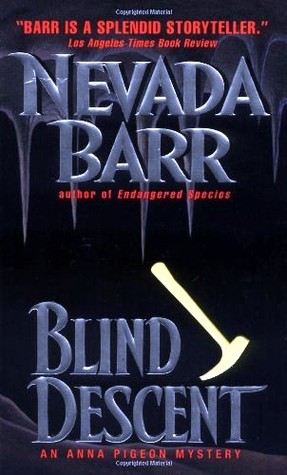
Blind Descent, by Nevada Barr*****
Of all of the riveting tales Barr has spun around her park ranger protagonist, Anna Pigeon, this is, I think, the most compelling (and I have read them all)! For those that want to know, it’s the sixth in a long series, each of which is set in a national park.
Have any issues with claustrophobia? If yours is intense, you may need to give this one a miss. It involves caving and spelunking, including oh my stars crawling in a tiny horizontal tunnel where five extra pounds put on over a last-minute cheesecake just could mean the end of you. Once you’ve gone miles and you can’t go forward, and your light is out…what are you supposed to do, go backwards? It’s not like it’s all one tunnel. There are places you can fall, wrong turns you can take. After all, it was not made to be entertainment, it’s a seriously bad-ass part of Mother Nature that I don’t care to think about too hard.
Now, imagine that you are on such an intense journey, and that you are Anna Pigeon (whose only really detrimental characteristic is a stereotypical view of large people…you know, lazy, poor character, untrustworthy…I said something on Barr’s website once and she responded that this is her character’s perspective, so if you are sensitive about snarky remarks regarding people who have any extra meat on their bones, beware the whole series). Okay, now with that digression aside, imagine you are Anna Pigeon, and because you are a buff, toned ranger with a good reason to do so, you have headed into one of these caving expeditions; you’re in a tight spot; and it is only there that you realize that someone on the expedition would prefer you not make it out again.
Barr’s bias against sizable people aside, her writing is otherwise so impeccably skillful that I have no choice but to give her all 5 stars. Don’t read it right before you go to sleep, unless you are COMPLETELY untroubled by things that go bump in the night!
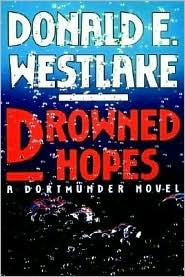
Drowned Hopes, by Donald Westlake *****
A guy gets out of prison, and he goes to get the loot where he buried it. Unfortunately, he’s been gone quite awhile. A dam has been built and the water for a whole town is on top of it now. In order to get to it, he just may have to drown the whole town.
The protagonist is the guy he goes to see about it. Our protagonist, of course, is not a big-time hoodlum with a heart of flint. Westlake doesn’t write that way. No, our guy is callous, certainly; selfish, no doubt. But he does not have anywhere CLOSE to the hard-heartedness required to drown a whole town. And so it devolves upon him to find a way to get the loot, but not kill the town.
Good luck with that.
Funny as hell, but of course, in a slightly dark way, like all of Westlake’s comic capers.
I confess that when a really amazing writer dies, I feel the impulse to review their work to reduce the possibility that it will fade into obscurity. I discovered Westlake’s work about a year after he died. He wrote for fifty years; his Dortmunder series, of which this novel is the seventh, is where most of his funniest stories are found. This title is my favorite among them…and yes. I hunted down every one of them, and when I could not buy them second hand, I asked for them as Christmas and birthday gifts until I had sucked the entire series dry.
I hope you’ll enjoy them as much as I have.
A Swollen Red Sun, by Matthew McBride *****
A shudder went through me as I pressed the five star rating, but it’s true: this is among the very best of its genre. Think of Deliverance; think of The Shawshank Redemption on steroids. No…picture it on crank.
A Swollen Red Sun is set in the middle of the hills and “hollers” in Missouri, a long, long way from a real city, a miserable, impoverished place where some folks’ goal is just to find a nice, normal person to smoke crank with instead of all these crazies. (I am avoiding the direct quotation because I read a galley and the rules don’t allow me to use them, but the figurative language and many other well-turned passages here make it really really tempting.) All told, this horrific account of a small community that has rotted from the inside out will make you think long and hard about whether growing up out in a rural area will somehow keep your kids isolated and protected from all the drugs, crime, and gangs that you know big cities hold.
At least in those cities, there are wholesome choices to be made as well, such as museums, theaters, and video arcades. And at least in those cities, there will be someone to hear you scream.
In my own digital shelves, I labeled this grim but brilliant work as “crime fiction”, but that doesn’t really cut it (oh, if you’ll excuse the expression). It’s more like a horror story minus the supernatural elements. McBride stirs up plenty of horror without needing to summon spirits from the great beyond. His are right here on earth, and they do a fine job of giving the reader a case of the heebie-jeebies all by themselves.
Yet, curiously, this novel has just enough moments of relief, however momentary, to keep it from crossing my “ick” threshold. You know what I mean, right? Once in awhile I start reading a book that is so unrelentingly horrifying, contains deeds so nightmarish that I think, “I don’t want to spend my time with something like this,” and then walk around with a sour stomach for a week over what I have already read. I thought this one might go there, but it didn’t.
I have a friend who likes Patricia Cornwell just fine, but there are certain other writers that she’s told me she’ll take a pass on. When I finish a book by Stephen King, I don’t send it her way, and likewise, both Jan Burke and the non-Sherlock thrillers by Laurie B. King caused her to say, “It’s too much.” And for my friend, this story would also, I guarantee, be too much. Let that be your litmus test.
So my advice for you is this. If you like a fast-moving, original, complex thriller with plenty of skeletons in plenty of closets metaphorically, I promise this hardscrabble tale will hold your attention to the very end. If your nerve-endings are too tender for horror tales, or if you have recently had someone close to you die and you aren’t really over it, you may want to set this title aside, at least for now.
I would be amazed if there are no awards headed this author’s direction. It’s a powerhouse of a story, and there’s really nothing else like it.
A Bad Day for Sorry, by Sophie Littlefield*****
What? Five stars for this, a beach-read type novel? Well yes, because I think it is among the best in its genre. This darkly hilarious tale is really strong. It’s well paced and has enough quirkiness to be endearing without seeming overdone or contrived.
How many women out there have been subjected to domestic abuse? In talking with friends old and new, parents and students, colleagues and neighbors, I am amazed to see how many women go through it. It takes different forms; sometimes it is they who have been abused, and sometimes they learn, to their horror and sometimes guilt (for not having picked up on the cues), it is their children.
Domestic abuse is never funny.
The reason this story works is that it takes the inner vigilante that lurks within the hearts and minds of those who have been abused or love someone who has, and it plays out all sorts of revenge fantasies that in real life just can’t happen. This first in the series was nominated for all sorts of awards, and the competition must have been stiff or it would have won.
You can win, if dark humor appeals to you as it does to me, by getting this well-crafted spin and reading it.
Black Cherry Blues, by James Lee Burke *****
Wow. I can give this book a short review for someone considering reading it, and I want to go more in depth, because this man has a lot going on.
So here’s the short version of this Edgar winning novel: the story line holds together w/o pause, slow spot, or error, but it’s more than that. The development of character is the most engaging of any new-to-me writer I’ve read in a very long time. I was so sick of reading novels about alcoholics, and really, really tired of the hackneyed ruse of ordinary-person-gets-involved-because-he’s-framed and ALSO of ordinary-person-gets-involved-to-save-a-loved-one. Yet Burke made both of these tired old saws brand, spanking new, breathed such amazing new urgency into character, plot, and setting that I could only drop my jaw and say, “WOW.”
I consider this a must-read. Now you can be done, unless you’ve already read it; spoilers below.
__________________________________________________________________________
When I take on a new author–and this guy had been writing for over 20 years before I found him, so I was looking at this novel not only as a new book and writer, but also as someone whose entire series I was considering reading–I need to know a little bit about his outlook on the world before I can really engage. If he spins too far to the right, with Black folks being just born to a life of crime and gay people being sick, sick sinners (for example), I just can’t go there and do that. So I reserve a little of my buy-in until I trust the writer.
You can read on many levels. If you are a pleasure reader and don’t do analysis, and if you are still with me, you can go now. I’m about to delve into issues of race as they come into play in this novel, and I will take my time. Again, there will be spoilers.
That said, I went in wary, and came out very impressed, though still a little bit puzzled. What is WITH the habitual use of the word “Negro”? It may be on the U.S. census, but I don’t know a single African-American who wants to be called by it. When six syllables are too long to sustain, simply “Black” is preferred. My basis for this belief is my many years of teaching in what was considered by some to be a “dangerous” school (oh please) and my own family members. I am pretty pale, but the miracle of blended families has brought us all together. And I looked at the word, and my back went up. WHAT? What’s that about? And because the writer drives home his message subtly and uses that weird, weird term (socially weird, anyway,) I had red flags all over his work until I was three-quarters of the way done.
He compounds the error by referring to “Texans and Negroes”, inferring that no Black person can be Texan…this is uncharacteristically clumsy, or else the guy really has a few issues that he probably doesn’t even realize he has; his writing later sympathizes with a former Panther behind bars who hears that the system works, and says, “That’s right, Motherfucker. And it work for somebody else.”
And still later, he talks about how people who complain about the cost of welfare and paying for free housing for the poorest of the poor have absolutely no idea what it costs the people who grow up in projects to live the way they must, and how very little they actually have.
So the guy is not a racist in the true sense of the word; like a lot of folks who think they have passed all the hurdles, he has one or two left, at least at this stage in his writing.
What he really wants to talk about, though, besides of course building an outstanding suspense thriller, is how the Indians have been treated. And he uses this term, but also directly refers to AIM (the American Indian Movement). This didn’t bother me right up front, the way the word “Negro” did, but I was watching to see where he took it.
Part of the story takes place in Montana. The writer is very familiar with the area; he has two homes, according to his profile, one in New Iberia, Louisiana, and one in Montana. And all through the build-up, as he decides that the death of a man who is a member of the Blackfeet tribe may be the key to his own dilemma, he inquires of various locals as to whether they knew this man, or what happened to him. And again and again, they explain to him, not about the man as an individual or whose well being causes them concern. They tell him about Indians. They tell him about the reservation.
I have sticky notes on all the pages where this occurs, but this review will be long enough without all of them, so here’s the short version: they say something that sounds token, like how sorry they feel about what was done to the Indians…and then, they feel free to say what they really think, which is that Indians drink, they fight, they blow all their money in bars, they don’t show up for work. They’re violent; alcoholic; unreliable. “They’re a deeply fucked up people.”
So, as a new reader, I am still wondering whether the author believes this is true. The way he pops that bubble is artistry, all by itself.
He does this with two people who are also Blackfeet. One is the sister of the victim, with whom he has an affair; the other is the mother of the victim.
The victim’s mother is a wizened old woman out in the dusty fields, cropping away at the dirt and weeds with her hoe, working in what is trying to be a garden. He speaks to her as if she is simple, maybe doesn’t speak very good English. It’s both an act of racism and ageism, but as the narrator, he outs himself. He realizes when she looks him straight in the eye and asks him who he is and what he is after, that he has underestimated her. Then he talks to her like someone who knows something, and she invites him in for a chat.
The victim’s sister is better still. She notes that the Blackfeet Reservation is in the lee of the mountain, and she has to tell HIM what that means (it’s the side away from the wind, on the eastern slope). The US government has its missile silos under the reservation. The government had freely admitted that if the missiles were ever used, every single person on the reservation of the Blackfeet would die. She has quite a bit to say, and none of it is stupid, violent raving or alcohol-induced stupor.
He also does not shrink from talking about the misery experienced by those who live in the kind of poverty to which reservation Indians have been consigned, or issues of addiction. He compares them to Salvadoran refugees whose village has been the site of terrible warfare. Any people who loses a war, he says, is consigned to unspeakable degradation. And he gives us details to support it.
This is all sideline stuff in terms of the story itself, but it was essential to me as a reader. I can’t bury myself in a writer’s story until I feel that his good guys and my good guys are mostly the same people. His tale is one outstanding ride, and the writer, warts and all, meets my standard of what a decent human being looks like.

Red Hook, by Gabriel Cohen *****
I am generally a six-book-at-a-time reader. I have different books in different rooms; books on my e-reader, paperbacks, and hard covers. Red Hook is one of those unusual books, though, that has kept me from my other reading. Once Net Galley gifted me with a free copy, the story picked me up by the front of my shirt and kept me reading, even when the normal demands of daily living beckoned. So you say it was nominated for the Edgar Award? Why am I not surprised?
No, there are no ghosties or hobgoblins or other supernatural things that go bump in the night, but the story packs enough goose pimples in the plot alone to make it an October-worthy read.
The story is police procedural in format, and bounces between two points of view, that of the protagonist, a New York City cop named Jack, and his son Ben, who lives close by, but with whom he has a remote relationship. Jack’s fear of losing control of himself stands in the way of his capacity to develop and maintain close relationships; to say more would be a spoiler.
Son Ben, now (barely) grown and 23, is a documentary film maker, and is interested in producing a documentary on Red Hook, the Brooklyn neighborhood in which his father grew up. Jack, on the other hand, has too many ghosts that await him there, and he avoids the place like the plague. And from there, the story builds to a place that may keep you awake long into the night.
Cohen does masterful work at developing character, plot, and pacing, and setting, while not quite as deft, is still stronger than most writers. This is a must-read for anyone who enjoys police procedurals. I look forward to reading the rest of his work.