The Last Outlaws: the Lives and Legends of Butch Cassidy and the Sundance Kid****, by Thom Hatch


I read this interesting nugget on an e-reader. I found it fascinating, but for some folks it will be considered tmi. It depends how much detail you are up for, and how well you deal with ambiguity.

If you want a real cut-to-the-chase telling, you may do better to look for historical fiction, because the thing about famous outlaws is the whole not-getting-caught part. You can’t leave a broad, wide trail for historians to trace while remaining safely anonymous while the law is looking for you. Consequently, Hatch gives us what is believed to have happened at the end, along with a couple of other remote possibilities, and an outright case of fraud, just to cover the bases.

The story does not start with Butch and Sundance, but with their predecessors. Actually, the writer starts clear back in 1866 in order to set context. 50,000 people in the USA die from Typhus, and before the Latter Day Saints, or Mormons, head west, they first send missionaries to Europe to recruit amongst the mill workers. Hatch does a fine job of painting the setting for us: all those dirt-poor city slickers from England come over, desperate, ragged, and ready for a new start, but being city folk, they ignore the seventeen-pound-per-adult and ten-pound-per-child limit, and instead haul all sorts of stuff with them, so they are trying to shove four hundred or five hundred pounds across the plains and up the mountain sides in handcarts. Well, a lot of them die. Of course they do. There’s no Medic One. But the reader should be prepared to slog through a lot of detail in order to get to the shooting and the robbing. It’s not an action movie, it’s good solid history. Be ready.

The 1969 movie reawakened a certain amount of interest in the public, and so there were historians checking journals and anthropologists checking bone and metal fragments in South American graves. In short, the lives of two interesting thieves somehow inspired the expenditure of all sorts of money.

Hatch wants us to understand that neither of these men, nor the Wild Bunch with whom they often associated, was a Robin Hood sort. Whereas it is true that they avoided robbing poor folk (and where’s the margin in that anyway?) they mostly robbed from the very rich for their own benefit. They focused on the railroads at first, because stage coaches and railroads were, before technology reached in and touched us all to one another, incredibly easy to rob. Unlike most of the Wild Bunch, neither Butch nor Sundance approved of the use of gratuitous violence. They tipped generously and were kind to children. Who can say whether it was heartfelt sentiment motivating them, or good sense? The neighbors are much less likely to point their finger in your direction when the sheriff comes calling if they remember that you helped put up their fence or paid for your drink.

One way or another, I found myself cheering them on as they boarded a ship with the Pinkertons darting around, one step too many behind them. But guys like this don’t settle down and become gentleman ranchers for life. Their whole lives have been adrenaline rushes; they become addicted to being in a perpetual state of emergency.

If you want to know more, you can get the book and read it yourself. Our local library had a digital version available. But roll up your sleeves, and be prepared to dive into an in depth version.,

John Wayne, by Scott Eyman *****

johnwayneWhen I was young, John Wayne was everywhere. His new movies were in theaters, and his old ones were on television. I remember him primarily as the quintessential cowboy—his most oft-played role—and particularly as Rooster Cogburn in True Grit, for which he won the Academy Award. I also remember him as the first big celebrity to announce on television that “I licked the Big C.” And then, oh damn, he died of it anyway…but not for some time. And I read this biography to fill in the gaps, since I actually knew very little.

Thanks go to Net Galley for letting me read it free.

There are two popular assumptions made about Wayne, I think, that this biography does a thorough job of smacking down in the dirt where they belong. The first is that he was playing himself in those movies, a big, dumb galoot of some sort. In fact, he was very bright and well read. A journalist makes the error of talking to down to him, asking if he is familiar with the work of Eugene O’Neil. Wayne says that he has been to college, and yes, he has read O’Neil.

The second popular notion is that he emerged from nowhere as this enormous star, as some indeed did. Wayne did nothing to suppress such tales; in fact, he liked to pretend, our author says, that he was just doing props work and sort of fell into acting. But nothing could be farther from the truth. He wanted to act very much, and he put up with ten years of very hard work, in dust and heat and all kinds of environments, required to expend immense amounts of physical energy and strength (which he fortunately had). Ford, who most often directed him, was nasty and abusive toward most of the actors with whom he worked, including Wayne, who just took it. There was no stunt so dangerous that if his double was not available, he would not do it. But once he was in a position to do so, he went after the scoundrels in the business that underpaid him or cheated him in percentages that he was supposed to receive, but which they held onto for unconscionably long time periods.

His love life was as awful as his work was excellent. He was married three times, and all turned out badly. Like many people, he was married to his work, and the acting talent and magnetism that drew women toward him turned out to be one of the things that later alienated them. Hey, he was always at work!

I have to say I really enjoyed reading this biography, and I am glad someone put in what had to be an exhaustive amount of research to write it. I can’t imagine anyone doing a finer job.

Having said that, I must caution the reader that this is one long book, and it takes a similar attention span. That’s the joy of a well-researched biography: there’s a lot to put in it. It is well paced, with a zillion fascinating anecdotes, several of which I highlighted and then realized that since this is a galley, I can’t quote from them directly. But that’s all right; if you have the attention span to dive in and immerse yourself, it’s better to find those little treats along the way as you do so.

For the serious reader, highly recommended.

Fierce Patriot: The Tangled Lives of William Tecumseh Sherman, by Robert L. O’Connell*****

 fiercepatriot I was able to read this in advance of its publication, thanks to Net Galley. If you can’t find it, I am sure you can pre-order it. And you should!

This is a brilliant analysis of American history’s most controversial, complicated, and I would add, heroic general. In writing it now, rather than waiting till I am finished reading the book, I break one of my own rules; I am an academic, and I pour over prose; sticky note pages (or mark them electronically); make little notes; and only then, when I have thoroughly analyzed every single page, do I set down my review. To do so when I am only 25 percent finished, as I am doing now, means that the book is worth having if you pay the full cover price and read only a quarter of it (though I plan to finish at my happy leisure, and hope you will too); and that I want to promote it badly enough to leap into an early review.

I spent a decade of my life teaching about the American Civil War, and my fascination with it is still not sated. However, because I have read the trilogy by Catton, along with Battle Cry of Freedom, Sears’ tomes on various individual battles, Liddell’s biography of Sherman, Sherman’s own memoirs, and Grant’s as well, I sat down to read O’Connell’s book thinking that perhaps I would find nothing new, but only a rehashing of the information I already have. I could not have been more wrong.

O’Connell takes a fresh new viewpoint, and he looks at Sherman in a more dynamic way than any other writer I have seen to date. He takes him from his beginning career, which was lackluster, he points out, due more to being in the wrong places at the wrong times, consigned to a bureaucratic position during the war with Mexico, and he takes him forward. He starts with the Seminole War, through the Mexican War; and into and through the US Civil War, where he would earn his place in history.

O’Connell manages to synthesize Sherman as a man who hailed from a powerful family, along with the Sherman who suffered from periodic depression (which O’Connell believes to have been similar to that from which Lincoln himself suffered); and does not drop a stitch or miss a beat in threading these important factors and nuances into his role as a key general at a critical time in history. He finds ways to inject Sherman’s character and personality into the narrative without letting it become the story. And most importantly, he notes key instances in which Sherman develops and morphs into the leader he becomes by the end of his career. It is a rare gift to be able to craft a nonfiction narrative into as compelling a story as a well-written novel might be, but O’Connell does it well.

More than anything, the author notes that Sherman was ambitious, but only as a “wing man”. Sherman’s depression took over any time he was placed at the very top of the ladder of authority, and Sherman knew this, and positively begged, again and again, NOT to be given the top job. He had no interest whatsoever in politics; he was a strategist, and though charming enough to run for office (apart from his somewhat understandable hatred of the press, which was quite different then from now), he had no interest in holding office or crafting policy. He was a military man, from the top of his spiky red hair to the soles of his well-worn boots, and he knew it. All he asked was to have one man above him, and at Fort Donelson, he found his perfect match in US Grant.

I began to skip through the book so that I could tell you exactly how O’Connell approaches Sherman’s march through Georgia and to the sea and a dozen other things, but I can’t stand to skim anything this strong. I am going to take my time with it, savor it, and I suggest you do the same. The one other piece of advice I offer the reader is that you spring for a hard copy of this marvelous volume. The maps are important, and utterly unreadable on an e-reader.

There are many books that I recommend to readers only if they can get them cheaply or free. Not so here. This is a real treasure. Buy a good, solid copy that will endure for years. It’s worth it!

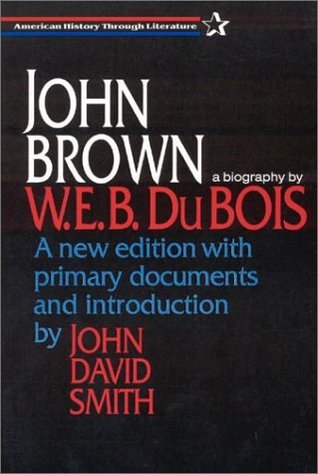
John Brown, by WEB DuBois *****

johnbrownThe class I took in college that featured John Brown as a small figure in American contemporary history dismissed him fairly quickly. He meant well, but was not stable, they said; in the end, he took extreme, hopeless measures that were destined for doom. He remained a hero to Black families (they admitted), South and North alike, as the first Caucasian man who was willing to die for the rights of Black people. Whereas many White folks (those with enough money for a fireplace and a portrait to go over it) featured a family ancestor or a painting of George Washington, Black homes often had a picture of John Brown.

The problem with that education is that no African-American scholars were included in this very central, pivotal part of the prelude to the American Civil War. I doubt anyone would doubt the credentials of this writer, whose urgent and compelling defense of Brown as a selfless but sane man with a perfectly good plan that went wrong due to a couple of the people in key positions of responsibility for the taking of Harper’s Ferry held my face close to the book (it is not the edition pictured; mine is so old, we’ve had it for so long, that the plastic lamination on the paperback has half peeled off, and it is not featured here!). The writer’s words forced me to read it, though I am no longer a student, with a pen in hand to underline and star key passages.

It’s tempting to leave it here, but I think I need to give you a couple of instances that may draw you, if you like history, care about the rights of Black people in the USA–because the oppression that started here is still not over (that’s me speaking; DuBois died in Ghana in 1963), if you are interested in the Civil War or Brown in particular, you have to read this book.

Tidbits that do not spoil, then: Harriet Tubman planned to be there with him. She became seriously ill and was confined to bed; otherwise, she meant to fight alongside him.

White writers have all assumed that his escape route was impossible. They have the WRONG escape route; DuBois explains the actual plan.

The Underground Railroad was run almost entirely by Black people, some of them wealthy, in the Northern US. DuBois points out that free Blacks owned over a million dollars worth of property, free and clear.
It was this same large body of free Blacks who provided the funding for Brown. He would have had more, if he had not become ill, and the loss of momentum removed most of his Canadian backers. Indeed, DuBois states that Brown most likely went to Harper’s Ferry physically ill and “racked with pain”, that he was very gaunt due to illness and poverty, but felt that to wait longer would be to lose his support and those he had gathered (a small group) for the initial attack.

To say might make you feel as if you have little reason to read this book. It is eloquently laid out as only a wordsmith such as DuBois is capable of doing. I am deeply sorry I waited so long to find time for it.

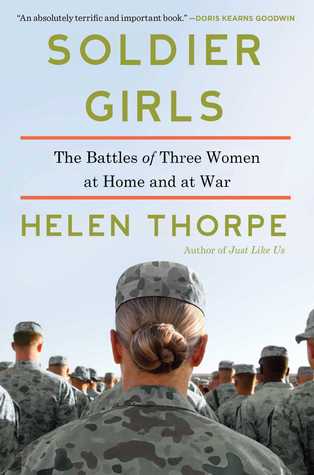
Soldier Girls: the Battles of Three Women at Home and at War, by Helen Thorpe*****

soldiergirlsI was able to read this before its publication date, courtesy of NetGalley.com. Thanks, guys!

I am usually good for half a dozen books at a time, but I have to admit that this one story has dominated my reading hours for the past week or so. I had so many preconceptions (and yes, stereotypes) that I didn’t even realize I’d developed until I read about these brave souls who have gone to Afghanistan and in some cases, Iraq.

What kind of woman leaves the home she knows and signs up for the National Guard? Sometimes (often!) it is someone who needs money quick. Sometimes it’s a woman who is desperate to get out of her current living situation. And once in awhile, it is something done, at first, when one is dead drunk and out of control; the Guard will fix that quickly!

I’ve been a Marxist my whole adult life, and I have no athletic talent or inclination whatsoever. If I loved this story–and I did–then almost everyone will. My past stupefaction with people who signed up for the military and then were somehow surprised when they were sent to go to war is gone. I get it now. And I understand completely what alienation and culture shock awaits someone who has lived under a completely regimented structure in a Third World nation for a year or more, and then comes home to blaring advertisements for things nobody needs and the petty-sounding complaints of those who have always had it soft.

I get it, because I read this book. You should, too.(less)