
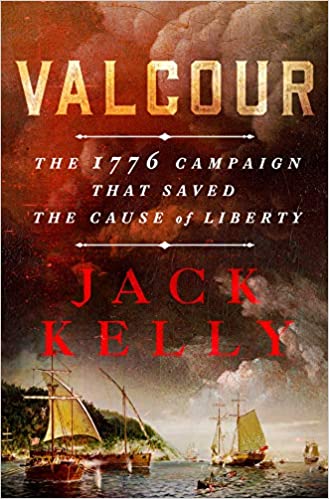
Valcour is the story of an audacious battle at sea during the American Revolution. It took place at the same time as George Washington’s attack at Trenton and was led by General Philip Schuyler, (former British officer) Horatio Gates; and a capable sea captain named Benedict Arnold. It was the name of the latter that drew my attention, given the ignominy with which his name has been associated in U.S. history and culture.
My thanks go to NetGalley and St. Martin’s Press for the invitation to read and review. Perhaps they would have asked someone else had they known I’d be five years late, but I’m reviewing it now.
It’s a brave, almost foolhardy notion for the Colonies to declare independence from Great Britain, which at the time was unquestionably the greatest military power on the planet; but to fight on the water, facing down the British Navy, seems almost like a death wish. The Patriots—as those seeking independence were called—knew the area far better than the British did, but that, and their motivation, were really the only true advantages they had. And to be clear, they didn’t actually win the three-day Battle of Valcour, but sometimes it’s enough to hold one’s own and avoid annihilation, and that’s what they did.
Arnold was a brave man, as well as gifted and at the time, heroic. I had never read anything by Jack Kelly before this, and as the narrative continued to wax enthusiastically about the deeds and ideas of Benedict Arnold, I wondered, for a time, whether this book was something that was commissioned by Arnold’s descendants with the goal of rehabilitating his image. But at the end, I realized that it was not.
Arnold was a brilliant strategist, and he suffered mightily, as did all involved, during the periods of deprivation this campaign brought about. There were times when they had no ammunition; there were other times when they had limited supplies, but no food. Imagine being reduced to eating soap, which back then was made using lard! The weather, the illness—which killed more of them than combat did—and more than a year spent away from their families must have been demoralizing; yet they never surrendered, and ultimately saw independence.
So, why then, at the very end, did Arnold turn around and betray his fellow fighters to the enemy? It’s a small thing, and though the years and circumstances are different, it reminds me of the motivation of the secret source that betrayed the Nixon administration during the Watergate scandal. Both Arnold and Deep Throat were bitter men that were passed over for promotions that they expected, and had every right to expect. On February 19, Congress promoted five servicemen to the rank of major general, which was the highest rank apart from that of George Washington. Washington himself wrote to Arnold and said, “I was surprised when I did not see your name in the list of major generals.” Furthermore, this was no oversight; it was a snub dealt by small minded men playing politics. Rather than be placed subordinate to men that he had previously commanded, Arnold resigned. What else was he supposed to do? But rather than leave it there, he took one step further, and that step was betrayal.
Kelly is a capable writer, and his research passes the sniff test. Because I had delayed for so long, I checked out the audio book from Seattle Bibliocommons to accompany and speed my way through the digital review copy I’d been given. Narrator David Colacci does a fine job.
I recommend this book to those interested in the American Revolution.
 Seattle Book Mama