How to Summon a Fairy Godmother, by Laura J. Mayo*****

“She was Theodosia Balfour. Good things did not happen to her.”

Theo is engaged to be married, despite her wishes; her mother has bartered her to an ancient, badly behaved duke for the prestige of his title and the money she must have to keep the family manse. Beggers can’t be choosers, amirite? Her stepsister and the prince have barred her from their castle due to her own unseemly behaviors, and her sister is about to be wedded to a more desirable man. There’s only one way out of it: Theo needs to find her stepsister’s notes on summoning a fairy godmother. Only magic can possibly get her out of this mess.

My thanks go to Orbit Books, Hachette Audio, and NetGalley for the review copies. This book is for sale now.

Because I am lucky enough to have both the print and audio galleys, I pair this book with my morning regimen on my exercise bike. While my feet are doing the work, my eyes and ears are on a pleasure cruise, listening to the story as read by the talented Josie Charles. At the outset, I’m not sure I’m going to enjoy it. After a handful of quick laughs, the story and voice actor seem to be a little over the top, perhaps trying too hard. However, a number of other reviewers that I respect have really enjoyed this thing, so I keep an open mind, and sure enough—about a third of the way in, I realize that I’m bonded to the protagonist. As I follow the narrative and become accustomed to the writing and narrative styles of the author and performer, the whole thing grows on me, and before long I find myself looking forward to my wretched exercise bike, because Theodosia needs me.

Once the fairy has been summoned, Theo is magicked away to fairy land, and she is provided with a set of tasks she must accomplish in order to be freed from the loathsome old toad to whom she’s betrothed. She is provided with some assistants and supervisors, and it’s a good thing because she needs rescuing now and then. The hardest part, perhaps, is the caveat that as she completes the steps required, she must behave respectfully—at all times!

The chapters are brief and have hilarious titles. A couple of examples: “Chapter 5 Where Theo Should Probably Think of Something Before She Ends Up Married,” “Chapter 11 Where It Becomes Quite Clear Theo Was Never Trained as a Lawyer.”  There’s lots of snarky dialogue, with a tender moment or two tucked in here and there.  There’s a twist at the end that I absolutely did not see coming.

Should you listen to the audio, or read the printed version? There are some American readers that don’t like a British accent, and Ms. Charles’s is a heavy one. Once I’m used to it, I rather like it, but you know what type of reader you are. Follow your usual go-to. If you enjoy an audiobook, this one could make your commute much pleasanter.

Highly recommended to those that enjoy fantasy and/or humor.

Crook Manifesto, by Colson Whitehead*****

The Ray Carney mystery series is among the most exciting new series to emerge during the past decade, and that is hardly surprising, given that it’s written by Colson Whitehead, who has two Pulitzers and a host of other prestigious awards to his credit. The first in the series is Harlem Shuffle, which came out in 2021. Crook Manifesto is his second. I was unable to get the galley this time, but happily, my son bought it for me for Mother’s Day. I mention this because it’s rare that I pursue a book once I’ve been denied the galley. In this case, it was worth it!

Ray Carney, when we met him first, was a man who’d sometimes been known to bend the law in the past, but as a family man, it was important to him to lead a straight, steady life now. Carney owns a furniture store, financed by money his father had socked away before he died. Ray politely refused to deal with the sort of merchandise that, you know, fell off a truck. That had been a big part of his father’s life, but it wasn’t his.

The place is, of course, Harlem, in New York City; the time is the 1970s.

Ray’s dad had lived on the wrong side of the law. Decent, above board jobs were hard for a Black man to come by in Harlem, so when something needed to exchange owners, or a decrepit building needed to be set ablaze, Mike Carney was your guy.

But not Ray.

I seldom read a book printed on paper anymore, so when I do, I put it in the bathroom. No novel that remains in the bathroom from start to finish can have five stars. In the case of Crook Manifesto, it emerged immediately, but after a few chapters, it went back in, and it managed to stay there until an electrifying moment at the 78% mark, when I sat bolt upright and dragged the book over to the bed.

It all starts out with a corrupt white cop who forces Carney to accompany him on a shakedown. There’s the carrot, and there’s the stick. On the one hand, he can give Carney tickets to see the Jackson 5 live in concert; Carney’s daughter has a birthday coming up, and would give a great deal to see that concert. Tickets are impossible to get, but the cop has some. And then there’s the stick; the cop can make Carney’s life very, very difficult. And so Carney has no real choice.

But among all of the wrongdoings occurring in Harlem, there’s an arson that nearly kills a boy, puts him in the hospital. Carney is obsessed with this. It’s over the line, and he wants to find out who did it and make them pay. And in the process, which involves side business and some interesting new characters, he is forced to reckon with exactly how his own father managed to support his family.

And so that whole middle section of the story, which is atmospheric but relatively low key, is the calm before the storm, but oh honey, that storm is coming. Believe it!

I cannot wait for the third book in the Ray Carney series to come out. When it does, I’ll be ready. If you love this genre, you should start with Harlem Shuffle, then advance to Crook Manifesto directly. Highly recommended.

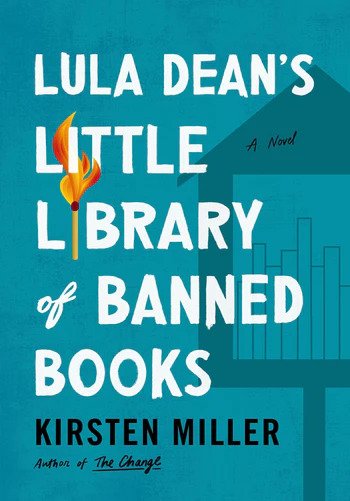
Lula Dean’s Little Library of Banned Books, by Kirsten Miller

Lula Dean is a deeply unhappy woman. Neglected by her children, alone and unappreciated, she strikes on a way to gain the attention she knows that she deserves. She embarks on a crusade to remove books she deems objectionable from local libraries, and she sets a sterling example for her town by erecting a little library on her lawn, a collection of the wholesome material she thinks is most appropriate. Little does she know that one of the town’s youths has snuck out in the dead of night and inserted banned books inside the dust jackets of the books she originally placed there. Her library becomes wildly popular, and Lula hasn’t a clue why.

My thanks go to NetGalley and William Morrow for the review copy. This book is for sale now.

The moment I saw the synopsis for this novel, I knew I had to read it. The First Amendment is a hot button for many people in the U.S., and as a language arts teacher, it’s been at forefront of my mind for most of my adult life. And I think I can safely say that Lula Dean is a soft sell; readers are generally a receptive audience, and so any novel containing the word “book” or “library” in its title should, I would argue, be held to a slightly higher standard. It’s not that hard to preach to the choir.

I love the premise of this story, and I laugh out loud more than once at the beginning. After that, though, things flatten out a bit. There are a lot of characters here, and whereas I have no difficulty keeping them straight, their numbers may have prevented author Kirsten Miller from fully developing them. I feel as if I am reading, for the most part, about cartoon cutouts rather than real people;  had I felt as if the characters were real, I would have been more deeply invested in their outcomes. However, everyone in this thing is either a fine, enlightened character or a despicable, ignorant blowhard. It accurately represents the way many Americans regard those around them, blue versus red, and that is not helpful. Two characters that stand out better than others are side character Beverly Underwood, and the young Elijah. However, even these are not dynamic characters. Nearly everyone here is the same going out as they were coming in.

Those looking for a short, funny novel to toss in their suitcase over the holidays could do worse; they could also do better. The sad thing is that had this been written in a more intentional way, with the literary standards one would hope to see in any novel, it could have been impressive, might even have changed a few hearts. This book isn’t going to do that, and so I see it as an opportunity squandered.

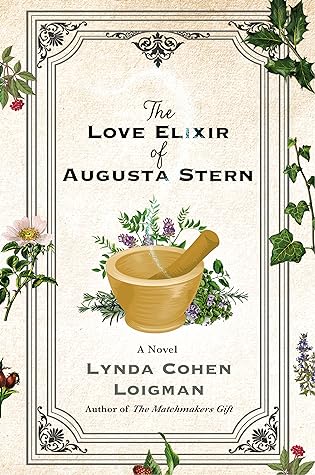
The Love Elixir of Augusta Stern*****

Augusta Stern is about to turn eighty, and she’s being forced into retirement, darn it. Her beloved niece persuades her to leave New York and spend what remain of her golden years in a Florida seniors’ community. From there, a wave of surprising events unfolds, changing Augusta’s life.

My thanks go to NetGalley and St. Martin’s Press for the invitation to read and review. This book is for sale now.

Loigman’s debut novel came in 2016, and as of now, she’s published three more. Every single one is golden. This author writes with warmth and intentionality, and although the first was wonderful, each subsequent one has been better than the last. And so, although I have gone on to read other novels by other authors since I finished this one, this is the one I’m still thinking about.

You see, in 1922, Augusta’s mother became gravely ill. Try though they might, neither the doctors nor her pharmacist father were able to help her, and she died. Augusta, her sister, and her father were all plunged into a dark and terrible place without her.  Great Aunt Esther showed up to run the household, and she brought with her a case full of herbs and tinctures; Esther was an apothecary. Her methods, which were sometimes unconventional, put her at odds with her nephew, but they got results, sometimes where conventional medicine had failed. Soon Augusta was spending her hours after school helping her father in the pharmacy, and sneaking out of bed in the middle of the night to observe Esther devising natural concoctions of her own. Esther declared Augusta to be her heir; she had a loving heart and a healer’s instincts.

Her social life was very limited, absorbed as she was with the family business, but the brightest spot in her day was when Irving Ripken, her father’s delivery boy, came to work. Often, they would talk as they worked; in time, they fell in love. Imagine her horror, then, when he abruptly married someone else and moved to Chicago! Augusta never recovered from the blow, and so she has never married.

Now, imagine her astonishment when sixty years later in Rallentando Springs, Irving shows up at the pool!

Much of what follows is what a reader might expect, but the details and character development take the story to a higher plane, and as we follow it, we also see the events of 1922, and these enable us to understand these characters and what drives them. There’s an unusually clever twist at the end, and it’s one that I absolutely do not see coming.

Ordinarily I would include ways in which the novel fell short or could be improved, but that’s impossible in this case. Loigman has spun magic for us from start to finish, and all I can do is bow in appreciation, and recommend this novel to you.

Identity Unknown, by Patricia Cornwell*****

Patricia Cornwell’s Scarpetta series is among my favorites. Identity Unknown, the 28th in the series, is every bit as riveting as her earlier ones, and I am thrilled to have received a review copy. My thanks go to Grand Central Publishing, NetGalley, and Hachette Audio. This book is for sale now.

First, I have to offer a shout out to January LaVoy, who reads the audio version. I was unsure how I would feel about this one, because I read the first 27 installments with my own eyes, and so I had developed the voices for each character in my head. Would I be thrown by the way they were voiced by a professional? As it happens, no. The protagonist and her ever present sidekick, Pete Marino, who is now her brother-in-law, sound exactly as I had thought they would. Of course, much of this comes down to excellent writing. The voices of her niece, Lucy, who now occupies the top echelons of governmental spookdom, is softer and slightly higher pitched than I had expected, but it fits, and I made the mental transition easily. Kay’s husband, Benton, doesn’t have as deep a voice as I would have thought, but to make his voice that deep would require a second, male reader. All told, LaVoy does a fine job, and I didn’t feel distracted from the story.

I have begun reading the DRC when I am provided the audio, and so from there forward, I switch to the audio, referring occasionally to the DRC to make notes or highlight possible quotations. Once the climax comes, however, the tension gets the better of me, and because I know I can read faster than LaVoy can talk, I switch back to the text.

The premise is that there have been two deaths. The first is an old boyfriend of Kay’s, a man named Sal Giordano. They have remained friends over the years, and she saw him recently when she dropped off a basket of goodies for his birthday. He has been the victim of a death flight, which is new to me but apparently, according to Wiki, is a thing. It involves killing someone by dropping them from a plane.

Holy crap!

Now we get into aspects of the case that make it an even better October read, as well as darkly funny. The prose itself doesn’t appear to be intentionally humorous, and yet I cannot, for the life of me, imagine that Cornwell didn’t snicker a bit as she wrote it. The area where Sal is dropped is inside an abandoned amusement park with a Wizard of Oz theme. It’s been vandalized, and is seriously creepy. The higher ups within the U.S. military are in on the investigation, and so:

“’Let me make sure this is clear,’ General Gunner says to me. ‘He landed on the Yellow Brick Road in the middle of an apple orchard.’

“’Inside the Haunted Forest. Yes.’”

I couldn’t help myself. I squawked out loud!

Soon another corpse is identified, a child belonging to a pair of wealthy, powerful people that are also terrible human beings, and as it happens, horrible parents. The two deaths are connected. The parents throw their weight around and try to manipulate the investigation, but of course, they don’t succeed.

Ultimately it seems that one of the guilty parties is Kay’s nemesis, Carrie Grethen. Carrie was once Lucy’s true love; later, her evil nature became apparent, but nobody can seem to keep her locked up, and she has become Kay’s Moriarty. I mention this here because it is raised early in the story, so I don’t think it can be called a spoiler, but I won’t say more about that.

To the faithful readership, I will also say this. As the book opens, two of Cornwell’s old standbys, ones that I’d be happy to see her retire, appear. First, she has to be driven to the scene in a helicopter, but oh no, there’s a storm coming. I was irritated. Can Kay not go anywhere without there being a storm? Just once? Please? And then something has to be retrieved by diving, which harks back to an earlier book in which she’s attacked with a spear gun. But friends, neither of these turns out to be key to the story, and we’re done with them in a heartbeat, so be patient.

I like to read a few books at a time for variety, but once this one began, it edged out the others—except at bedtime, because when I go to bed, I need to sleep! It’s among her finest work, and I recommend it wholeheartedly to you.

The Message, by Ta-Nehisi Coates****

Ta-Nehisi Coates is an eloquent writer, and I look forward to reading whatever he publishes. My thanks go to NetGalley and Random House for the invitation to read and review. This book is for sale now.

This book is brief, and it consists of four essays. The first and briefest is about returning to Howard University to teach writing. The second details his first trip to Africa, specifically Senegal; it’s surprising that it took him this long, he says, what with being raised in an Afrocentric home, the child of a Panther. But it’s expensive, it’s time consuming, and now, he can finally do it. As I read both of these, I admire the way he crafts an essay, but at the same time, I also feel as if I am not his intended audience; at times I feel almost as if I am listening in on someone else’s conversation. But I remind myself that I am reading this thing at the publisher’s invitation, so I push on, and it’s outstanding material.

The third essay is the one I enjoy the most, particularly because I had just finished reading a harrowing memoir about book banning. Coates attends a South Carolina school board meeting in which his own book, Between the World and Me, is being challenged. He’s invited by a teacher there that wants to continue using his book in her classroom, and he’s amazed at the assertions being made by some of the speakers in attendance, right in the shadow of George Floyd’s murder. And speaking of this, he says

“I understand the impulse to dismiss the import of the summer of 2020, to dismiss the ‘national conversations,’ the raft of TV specials and documentaries, even the protests themselves. Some of us see the lack of policy change and wonder if the movement itself was futile. But policy change is an end point, not an origin…and whereas white supremacy, like any other status quo, can default to the cliched claims and excuses for the world as it is—bad cops are rotten apples, American is guardian of the free world—we have the burden of crafting new language and stories that allow people to imagine that new policies are possible. And now, here in Chapin, some people, not most (it is hardly ever most), had, through the work of Black writers, begun that work of imagining.”

The final essay, which is also the lengthiest, is about his trip to the Middle East. At the outset he mentions his trip to the World Holocaust Remembrance Center, and seeing the vast Book of Names, which catalogs all of the nearly 5 million Jews killed in the Holocaust. But a few pages later he gets to the meat of the matter and decries the way that Israel is treating Hamas. No wait, that’s not the way he words it. He dislikes the treatment of the Palestinians that chose to be ruled by Hamas. Whatever. All I know is that when he states flatly that he isn’t interested in hearing the other side of this conflict, completely ignoring the pogrom that set this entire conflict in motion, he loses me. I skim the rest of the essay in case there’s a surprise for me somewhere in there, but of course, there isn’t. Bandwagons are easily joined, but I would have expected a writer of his caliber to think and write more critically.

So, should you read this book? There’s no denying that Coates is a skillful writer, and the essay regarding censorship is worth reading all by itself. And in that spirit, I won’t say that you shouldn’t read this because I happen to disagree with the last nearly fifty percent of the book; but when you do so, keep your brain engaged and don’t take everything he says at face value.