Hell of a Book, by Jason Mott*****

It really is.

This book is a standout in more ways than one. First the obvious: look at that cover! Then again, how many novels have a nameless protagonist all the way through the book? Get into it deeper, and the distinctions become more complex. The buzz around it is wholly justified. My thanks go to Net Galley and Random House for the review copy. This book is for sale now.

Our author is on an odyssey that takes the form of a book tour, and it lands him, in the end, back where he grew up. He doesn’t tour alone; apart from the various organizers he meets in various locations, he is accompanied by a small Black child he refers to as “The Kid.” Alternately, we also see the story of a young Black boy, a very Black boy, nicknamed “Soot,” who grows up in the American South.

As I read, I am always on the back foot, understanding most of what it being said, yet developing questions as I go. Our author says (often) that he has a condition, and that this is probably why he can see The Kid when others cannot. My notes ask whether his condition is dissociative, and is The Kid just part of himself? Or is The Kid Soot? Are Soot and The Kid both part of the author? Every time I come up with a plausible theory, something else happens to undercut it. Yet one other thing becomes clearer all the way through: to be born an African-American boy in the United States is to be perpetually on the back foot; perpetually having to guess how best to proceed; to perpetually guess at one’s welcome or lack of same, at the quality of one’s relationships with Caucasians, to perpetually guard one’s own safety. And to be very Black—“Nigga, I bet when you get out of the car your daddy’s oil light come on”—is to invite not only the suspicion and hostility of Caucasians, but to draw the enmity of lighter Black people, too.

The synopsis of this story that initially drew me billed it as humor, and in places, it is not only funny, but laugh-out-loud funny. But the further we get in, the darker it becomes.

There are a number of sardonic references to the publishing world; editors, agents, and other promoters have told the author that while it’s fine to write about Black characters, He must not write about being Black:

“The last thing people really want to hear about is being Black. Being Black’s a curse—no offense—and nobody wants to feel cursed when they read something they just finished paying $24.95 for…The future of this country is all about patriotic, unity-inducing language. Post-Racial. Trans-Jim Crow. Epi-Traumatic. Alt-Reparational. Omni-Restitutional. Jingoistic Body-Positive. Sociocultural-Transcendental. Indigenous-Ripostic. Treat of Fort Laramie-Perpendicular. Meta-Exculpatory. Pan-Political. Uber-Intermutual. MOK-Adjacent. Demi-Arcadian Bucolic. Write about love. Love and Disney endings…”

Later, an interviewer asks if the past doesn’t still matter, and the author says, “It does. Not just three-fifths of it, but all of it.”

So, my friend, you can see why this book should be called a love story. Race? Oh, no no no. Fear? Injustice? Police brutality? Of course not. After all, this is a hell of a book!

Highly recommended; one of the year’s finest.
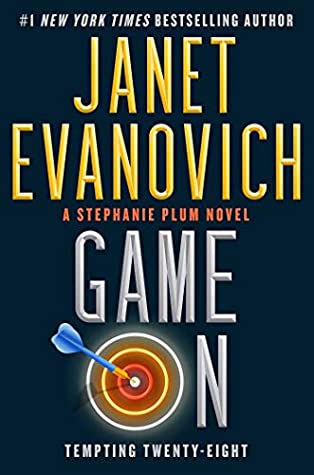
Game On! by Janet Evanovich****-*****

Stephanie Plum has been my constant companion for decades, but she never seems to get any older. We should all be so lucky!

My thanks go to Net Galley and Atria Books for the invitation to read and review. This book is for sale now.

Stephanie is a bounty hunter, working for her cousin Vinnie’s bail bond service. She tracks down no-shows, takes them to have their hearings rescheduled, and collects a commission. Her mother wishes fervently that she would get a normal job such as a bank teller, or just go ahead and marry long-time boyfriend Officer Joe Morelli, and keep house and raise kiddies. But Stephanie is long on independence, and she’s short on marketable skills, and so this is what she does. And we readers are well aware that she wouldn’t be half this hilarious as a housewife, so we cheer her on.

In an interview, author Evanovich said she had lit on the idea of a bounty hunter protagonist because the writer doesn’t need a background in legal matters the way that she would if she used a cop, detective, or lawyer. The primary skill required of a bail bonds enforcer is lying, and she felt she had a good grasp of that one.

You gotta love it.

There have been a few wobbles in the series, and a moment (long ago) when I thought perhaps it was played out. But like her intrepid protagonist, the author rallied and came back stronger than ever.

Can you read this book if you haven’t read any of the others in the series? Yes. Yes, you surely can; but you are most likely going to want to go back for the rest once you do so.

There are a few things that strike me as I read this one. I suddenly find myself wondering why Stephanie doesn’t seem to have women friends. She’s lived in Trenton—in the Burg—her entire life, so shouldn’t she have a few lifelong pals? But by the end of the story, I realized that her work buds are her go-to girls. Lula gets into a scrape and leaves what little she has to Stephanie (but of course, Lula pulls through. I don’t feel like this is a spoiler; since when would a riotously funny writer like Evanovich off a main character?) Connie is a distant relative, but she’s also a friend.

I also find myself, like other reviewers, wondering about the sanitized language and decreasing vocabulary levels. We’ve been drifting in this direction for awhile. At the start of the series, profanity was used by the people and in the situations where you’d expect to find it. The overall language level was accessible to anybody that finished eighth grade. Over the last several episodes, however, it’s been drifting downward. Now, apart from one “damn”, I found nothing, although the euphemisms are stellar (“What the fork,” “What the Hellman’s Mayonnaise,” “Son of a bagel.”)  And the overall vocabulary level is now down to about fifth grade. If it goes any lower (see the author’s other series,) I may not be interested anymore, but as it stands, it’s fast, it’s snappy, and I’m in.

The usual elements—escorting Grandma Mazur to viewings at the mortuary; exploding cars; men surprising Stephanie when they let themselves into her locked apartment; dinner with Stephanie’s parents; a geeky witness, or victim, or possibly even an offender, that Stephanie takes under her wing; and the red-hot Joe Morelli are all present and accounted for. Stephanie’s mother has been drinking heavily every time Stephanie gets into a dangerous scrape, and Evanovich has been toying with some character development in her direction. I hope she follows through.

The tension of Stephanie trying to decide between Morelli and the mysterious Ranger is over, for now, at least, and it was getting old, so I applaud this development. She knows that Ranger will never marry her, and there’s a lot he’ll never tell her. She knows Morelli. They grew up together, and they understand one another. Marriage, maybe not yet; but Joe is the one. She’s tempted by others in this installment, but for once, she behaves herself. Good.

Whereas this series isn’t the magnificent literary accomplishment attained by some mystery Grand Masters, and it doesn’t try to be, I rate it as five stars in the humor genre. It made me laugh out loud on page two, and though I read quite a lot of books each year, those that have made me howl this year can be counted on one hand. It’s a more valuable characteristic than some might guess, especially during these tense times.

Highly recommended to those that need a good laugh.

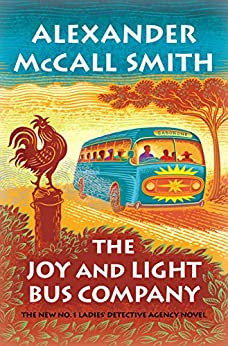
The Joy and Light Bus Company, by Alexander McCall Smith*****

“Connections with others were what made life bearable…We all need reassurance, she thought. We all need people to tell us that everything is going to be all right, even when it is not, and that we should not worry, even when we clearly need to be concerned about something. We are only human, after all, and that is why reassurance is so important to us. That is undoubtedly well known.”

I am not generally fond of cozy mysteries, yet I love this series hard. I told a friend—who works as a therapist—that the #1 Ladies Detective books are the cheapest therapy on the planet, and she agreed.

My great thanks go to Edelweiss and Penguin Random House for the review copy. This charming tale will be for sale November 16, 2021.

As is usual, we have two equally important story lines woven into a single narrative. The detective story has to do with a client—a most unpleasant fellow, but a client, nonetheless—that has come to the agency looking for help with his father’s will. His father is still alive, but not entirely himself anymore, and is planning to leave his valuable home to his nurse. Mma Ramotswe and Mma Makutsi are enlisted to dig up information about this woman, and to see if anything can be done to reverse his father’s decision. The second storyline concerns Mma Ramotswe’s husband, Mr. J.L.B. Matekoni, who has decided to invest in a dubious-sounding scheme to turn secondhand buses into a bus service. Mma Ramotswe is horrified, because in order to invest the necessary sum, it will be necessary to take out a bank loan, using the building that houses the businesses—Matekoni’s auto repair, and Ramotswe’s detective agency—as collateral. There’s also a smaller thread involving human trafficking of small children locally, and as usual, it is dealt with tidily and in a most entertaining fashion.

The book begins with Mma Ramotswe wondering what makes men happy. This is a tricky way to start a book, given the current social climate especially. Many readers, women in particular, are sensitive to having a male author write about a female character’s fervent longing to make her husband happy. The internal monologue could use some tightening up here, and that’s unusual for this writer. However, this passage is near the beginning, and once it’s done, the rest of the book more than makes up for it.

What is the alchemy that makes this series so successful? Certainly at the start, there was the novelty. It’s unusual for an English-language series to be set in Botswana, or at least, it was when this one began. But it takes a lot more than that to sustain a series over so many years.

For me, the gentle humor goes a long way. I also appreciate the depth of respect for working people that shines out of every book in this series. Mma Potokwane, who runs the orphan farm and is Mma Ramotswe’s closest friend, reflects on the squabble over the old man’s will. “Rich people are always forgetting that they are only rich because of the work of others. They do not dig their money out of the ground, you know, Mma.”

Also? There are a lot of us out here that are also “traditionally sized,” and we love seeing lovable, successful characters that look, to some extent, like ourselves.

There’s the notion that people are inherently good—try finding that in your average noir detective story—and also, the idea that ordinary people can and should intervene to the best of their ability when they see wrongdoing. “Sometimes those people simply did not see what others could see; sometimes their hands were tied; sometimes they felt threatened. And all of that meant that there were times when it was left to people like them, a private detective and the matron of an orphan farm, to do what had to be done.”

This story, however, is singular in that both Mma Ramotswe and Mma Makutsi manage their husbands through deception. Grace Makutsi reveals that she gets her husband, Phuti, to take his vitamins by stirring them into his breakfast tea without telling him. Precious Ramotswe, when unable to persuade Matekoni not to apply for the bank loan, sneaks around behind his back, looking for a way to kill the deal without his knowing it. Neither of these things leads to marital disaster, yet I find myself wondering whether these things may come back on them in a future installment.

The fact that I find myself feeling concerned about the marriages of two women that are fictional, fictional, fictional says a great deal about Smith’s capacity to develop characters with depth and breadth.

I can talk about this series, and these characters, and this book all day. I’ve already come close to it. But the best way for you to appreciate it is to get this book. It comes out in a week, so I suggest you order a copy now. Highly recommended.

Voices from the Pandemic, by Eli Saslow****

Eli Saslow is the journalist that wrote Rising Out of Hatred, the story of former White Supremacist Derek Black, in 2018. When I was offered the chance to read and review his new book, Voices from the Pandemic, I jumped on it, because I like this author a lot. Once I had it, I avoided it like the plague (pardon the reference) for a couple months, wondering just what I had been thinking, to sign on for something like this. In the end, I am glad to have read it.

My thanks go to Doubleday and Net Galley for the review copy.

Saslow tells us in the introduction that he expected to become depressed, perhaps numbed, by all of these interviews, but ultimately was galvanized by “their empathy, their insight, their candor and emotional courage.” Fair enough, but an awful lot of these stories are gut-wrenching. For whatever reason, he chooses to start with some of the most horrific ones, but as we work our way into the book, there are several that are not about the excruciating, grim death of a loved one, but are interesting for different reasons. There are stories of essential workers, of coroners, and medical professionals. One that has stayed with me is that of a middle aged man, ex-military, who is finally compelled, when everyone in the household loses their livelihoods, to visit a food bank. He gets there two hours before it opens to be on the safe side, and discovers that there’s already a huge, hours-long line.

My favorite story is that of Bruce MacGillis, a wily old man that barricades himself in his room in his nursing home, lets nobody in, throws open his windows in subfreezing weather, and stuffs towels underneath the doorway to keep out other people’s germs. He ends up being one of two residents that are spared, out of eighty-nine residents. (My notes say, “Hell yeah!”) On December 28, he lets a nurse come in to administer his vaccine. I hope that man lives to be a hundred.

There are some stories by vaccine deniers, mask avoiders, included here, but if you are among them, you probably won’t enjoy this book. It leans heavily toward science, and away from conspiracy theories.

After I’d procrastinated reading this thing, I checked out the audio version at Seattle Bibliocommons to give myself a leg up. I thought it might be easier to hear these stories while I was also engaged in some other task, so I fired it up while I was slicing bell peppers and marinating meat. If anything, it was worse that way. Well—to be fair—worse, and also better. There’s a separate reader for each story, and the hard ones are read with such searing emotion that it makes them all the worse. The saving grace is that each person’s story is concisely told, so there was only one time that I hit the stop button and fast-forwarded to the next one. At the outset, I only listened for a few minutes at a go, and then turned to listen to another book, something light and fictional, to restore my mood. By the second half, I no longer needed to do that.

The book only covers the 2020 portion of the pandemic, but I’m not sure it would sound much different had he waited to include the whole horrible thing. (It will be over someday…won’t it?) Recommended, for those that can do this.

The Family, by Naomi Krupitsky****-*****

4.5 stars, rounded upward.

The cover grabbed me first, two women in vintage sweaters—no faces even—and the title written in Godfather font. Oh, heck yes. I need to read this thing. The author is a newbie about whom I know nothing, so I know it may be a recipe for disappointment. I’ve taken review copies this way in the past, and have regretted it, because of course, the cover doesn’t speak to the author’s ability. But old school mobster books are fun, and they’re thin on the ground these days, so I hold my breath as I take a chance…and hit the jackpot!

This is one of the year’s best works of historical fiction, and you should get it and read it. My thanks go to Net Galley and Putnam for the review copy. This book is for sale now.

Antonia and Sofia grow up together; their fathers are both mobsters, and their houses share a wall. Not only are they thrown together for Family events from early childhood forward, but their peers ostracize them in elementary school, their family’s reputations having preceded them, so for several years, they are each other’s only option. But it’s enough.

Our story starts in 1928, and it ends in 1948. We follow the girls through childhood, adolescence, and into their early adult years. At the outset, their fathers are best friends, until Carlos, Antonia’s daddy, starts skimming, covertly building a nest egg in the hope of making a new start far away with his little family, doing an honest job, and leaving the Family behind.  His theft is, of course, detected, and he disappears; Joey, Sofia’s father, is promoted, and told to take care of Carlos’s widow and daughter. Thus, we have a clear, concrete reminder, right up front, that this is an ugly, violent business. The author’s note says she wants to demonstrate the strange way that violence and love can coexist, and she does that and more.

Those readers seeking a mob story full of chasing and shooting and scheming will do well to look elsewhere. We do find these things, of course, primarily in the second half, but the story’s focus is entirely on Sofia and Antonia. Whereas setting is important—and done nicely—the narrative’s fortune rises or sinks on character development, and Krupitsky does it right. These women become so real to me that toward the end, when some ominous foreshadowing suggests that devastating events are around the corner, I put the book down, stop reading it or anything else for half a day, and brood. I complain to my spouse. I complain to my daughter. And then, knowing that it’s publication day and I have an obligation, I return to face the music and finish the book. (And no. I’m not telling.)

My only concern, in the end, is a smallish smattering of revisionism that occurs during the last twenty percent of the novel. Knowing what gender roles and expectations are like in that time and place, I have to say that, while I can see one intrepid, independent female character stepping out of the mold, having multiple women do it to the degree I see it here is a reach.

Nevertheless, this is a badass book by a badass new talent, and Naomi Krupitsky proves that she is a force to be reckoned with. Get this book! Read it now.