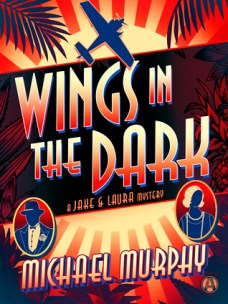
 Michael Murphy’s Jake and Laura series is both engaging and interesting, the best blend of historical fiction and detective fiction I’ve seen in a long time. Until I got halfway through, it was headed for the land of five stars, and I am not sure how objectively I’ve been able to review it since that point. But I went with my gut, and ultimately, when it comes to fiction, that’s what every reader uses to judge a book. Thank you to Random House, Net Galley, and the author for permitting me a sneak peek; this title will be available to the public August 31.
Jake Donovan, our intrepid detective-turned-novelist, is working on his latest Blackie Doyle novel, but he takes a break from work to honeymoon with his bride, the famous actress Laura Wilson. He has sworn off detective work at her insistence, and has decided he likes being a novelist better, anyway. Fate intervenes, however, when Laura’s good friend, Amelia Earhart, finds a man dead near her plane.
It’s shaping up to be a really great story. At this point, I am noticing the level of historical detail, and thinking of this as potentially great classroom material. A number of public schools teach language arts and history in a block simply titled “Literacy”, and since so many young folks have reading skills that aren’t up to snuff, sometimes the best way to teach history is by partnering it with historical fiction. The book is clean enough that no one is going to race to the nearest school board meeting to complain; no explicit sex. The possibility is exciting, for teenagers and perhaps also for the author and publisher. There are some wonderful, positive depictions of women, who were active in non-traditional roles during this time period. What a great book for teens as well as adults!
It was then that I ran into the “J” word. Here, once I got past the slapped-out-of-nowhere feeling that racist terms generally evoke, I asked myself whether the historical circumstances of the novel merited the inclusion of this term in place of the correct term, “Japanese”. I also reminded myself that the rest of the book might be free of the term, and I could just push past it, as sometimes one must, and return to an appreciation of the story’s period flavor and nicely woven plot.
The problem here is that the word kept popping up in nonessential places, as if it were a bit of window dressing, and it was accompanied by some rather nasty language about that group. And again, it was a word used commonly during the time period by Caucasians and some others. For that matter, so was a lot of racially and ethnically derogatory language; even in the early 1960’s, I can recall hearing casual conversations peppered with anti-Black, anti-Jew, anti-Italian terms when nobody was angry; it was just the way some white folks talked without even thinking. But most writers today would not choose to evoke that part of history in their writing. The harm outweighs the usefulness. In Wings in the Dark, the only place that it might have been contextually useful is when General Patton enters and leaves again, spewing his trademark xenophobic profanity behind him. But neither Patton nor his profanity is really key to the story line, either.
I think about what I like to read; here on the west coast of the USA, most cities have a fairly hefty number of Asians and Pacific Islanders, and this was true of the district in which I taught history and literature until my recent retirement. I could never put this in their hands. What a terrible thing to do to them. And it’s a shame, because they would have enjoyed reading about Amelia Earhart. In fact, there is a magnet school dedicated to aviation and partnered with Boeing. Less the anti-Japanese slurs, they might have made great use of this book; with it, I could see students looking down and away; I could see parents coming to school or to board meetings looking for an explanation.
Apart from the term—which hit me harder than it will most Caucasian readers—this is a strong piece of fiction. The pacing, dialogue, and character development are all strong. There are red herrings that I nibbled on and was fooled by, and the ending is about right; at least I think it is. Again, I struggled with objectivity. But I think without the four places that hit my ouch-button, I would have enjoyed the second half of this novel as thoroughly as I enjoyed the first half.


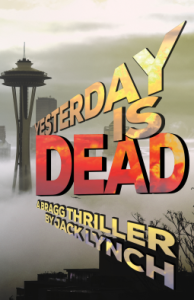 Peter Bragg is a San Francisco private eye. He is originally from Seattle, but he left all that behind: the rain, the grey skies, the depression…and Lorna, his ex-wife. Now a case brings him back. He isn’t eager to make the trip, but an old friend is in a spot and needs his help. And for the reader, it is a trip indeed, since the story is set in the 1980’s, when it was originally published. This established mystery series is now available digitally, and I was lucky enough to jump on Net Galley’s offer to read it free. My thanks go to them, and to Brash Books, for the DRC. What a fun romp!


 Seattle Book Mama