
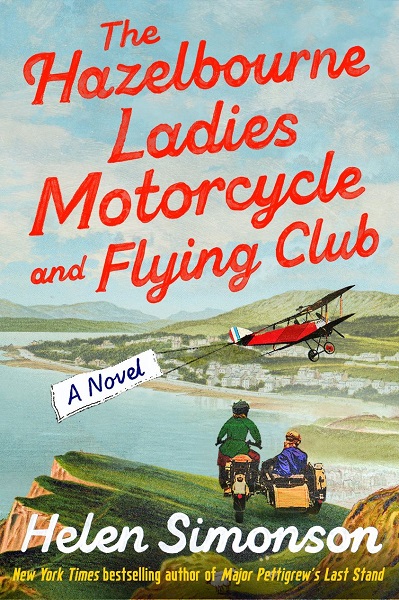
The Hazelbourne Ladies Motorcycle and Flying Club, by Helen Simonson*****

Helen Simonson is the author of the bestselling novel, Major Pettigrew’s Last Stand. With her new release, The Hazelbourne Ladies Motorcycle and Flying Club, she is once more in her element, creating believable characters and using them to skewer the pervasive racism and class snobbery of Britain, and also, in a smaller way, that of the U.S.  With outstanding word smithery and an unflagging pace, this historical novel should be number one on your summer reading list.
My thanks go to NetGalley and Random House for the review copy. This book is for sale now.

The year is 1919; the place is England. Constance Haverhill has been ousted from her job running an estate; the Great War has ended, and now the women that have been gainfully employed and done a fine job are unceremoniously ejected so that their jobs may go to the men that have returned from the conflict. For the time being, she has a position as a traveling companion to a family friend who’s recuperating at the seashore; once this situation ends, she has no idea where she’ll go or what she’ll do.

Out of nowhere comes Poppy, a daring young woman from a wealthy family. Poppy wears trousers and drives a motorcycle; she befriends Constance and sweeps her into her motorcycle club. Things become even more interesting when Poppy purchases a used biplane to bring home to her brother Harris, a handsome but severely depressed young man who’s lost a leg in the war. At one point he laments, “They look at me as if my brain has gone missing along with the leg. Or rather they refuse to look at me at all.”

Poppy is utterly fearless, challenging local authority and promoting women’s rights. She doesn’t care about the opinions of others; her eye is set on the horizon. And she can do that, because she has a soft nest in which to land. At the same time, Constance is always aware of the stark class division that prevents her from behaving as Poppy does.

“Respectability was the currency in which Constance knew she just trade for the foreseeable future. She…did not have Poppy’s wealth and position from which to defend herself against notoriety.”

There are a number of amusing side characters whose less progressive attitudes contrast with Poppy’s. The two women—also very wealthy—on the adjoining estate sniff at her exploits and declare them to be unladylike. The class division is also highlighted when Constance is offered a position with the hotel where she and Mrs. Fox, the family friend she accompanies, are staying. However, she is told that once she accepts the offer, she can no longer be a guest at the hotel, nor may she use the restaurant, which is a frequent gathering place of Constance’s new friends. No hobnobbing with the clientele will be tolerated; she must use the back door. Constance reflects to herself that wherever she goes, her friend Poppy will use the front door.

Britain’s racist attitudes toward people of color is also featured here, but in a way that does not hijack the plot. There’s an Indian guest of the hotel that is snubbed left and right; at one point, an American visitor attempts to have him excluded from the social events to which he’s been invited. This is resolved in a deeply satisfying manner, as is the issue of taboo friendships formed by Mrs. Fox.

If I could change one thing, it would be to add a bit more nuance. The bad characters are oh so bad; and while the good characters make the occasional mistake, we never doubt their complete goodness. However, this is a minor bone to pick, and overall this is a delightful book.

Highly recommended.
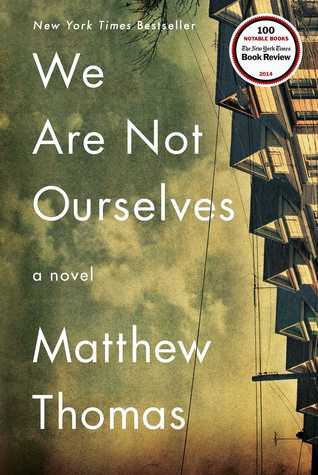
We Are Not Ourselves, by Matthew Thomas *****

WearenotourselvesA haunting, epic story that stays with the reader long after the final page has been turned; Thomas has created a masterpiece. Thank you once and once again to Net Galley and Simon and Schuster for the ARC.

When I saw that some goodreads reviewers had marked this book at three stars, at first I wanted to grab those people, shake them by the shoulders and ask, “What is wrong with you?”

But eventually, I came to understand, or at least I believe I do, what it was that bothered them. Our protagonist is not always a lovable one. She’s deeply flawed and hard to bond with. Those who equate a lovable character with a well written book may indeed be disappointed, not only by this story, but by many of the Great Books.

As for me, I am impressed. My measure of extraordinary literature is that I am still thinking of, or even wishing I could have a conversation with the main characters after I have finished reading. I’ve moved on to other books, and yet this one remains with me. Aw, geez; poor Ed. We didn’t know. And what’s up with Connell, anyway? It speaks to me on a deeply personal level as I find myself comparing my own family and relationships with the Leary family. Given that I am a reader who absorbs a dozen books a month and sometimes more, this says a great deal.

Our protagonist is Eileen, who grows up in an Irish immigrant family that cuts across the typical large, boisterous, poor-yet-loving stereotype of the New York Irish. Instead she is the only child in a chilly, quiet apartment. Relationships are often strange and distant despite the fact that her parents love each other and her. The second bedroom is taken, for most of her childhood, by a tenant. Her father is a genial man, well loved among the Irish workingmen’s community, a union man and a hard drinker. Her mother is lonely, hardworking, and bitter until she also takes to drink; yet her parents don’t drink together, but apart. The only fun time is when relatives from Ireland come across the ocean and spill over into her family’s wee apartment as their final pit stop before finding a place of their own.

Eileen grows up knowing that she wants more.

As her hormones work their alchemy and her body grows and changes, she becomes disarmingly beautiful, and she understands that marriage may be her ticket to better things. Once she finishes college and becomes a nurse, she wants to marry a man of great capability and ambition. She believes she has found him when she meets Ed, a brilliant young scientist with a promising career ahead of him. Between the two of them, they ought to be able to bring in the money needed to live the good life. By the time children come, he should have climbed far and high enough that she can stop working and be happily domestic in a magnificent home. It is the dream of the 1950’s, though she wants something a bit finer than a suburban house with a picket fence.

Eileen’s grasping nature and her harsh behavior, at times, toward Ed and their son are off-putting. When their only child brings home a test marked 95%, her husband exudes praise while she asks what happened to the other five percent. I cringe. At times she seems to understand that she is showing no more warmth than her own mother did, yet the habits are ingrained. She does not reach out for the hug, does not easily part with praise. And as it becomes clear that her goals and Ed’s are not really the same, the marriage begins to founder.

The harder she pushes, the more irritated I grow with her. It’s like watching a relative who is bent on self ruin; I want to talk her out of this. I want to hit the “escape” key for her. I want her to be more empathetic, more flexible. But the one thing I absolutely don’t want to do is put the book down.

Then the unthinkable happens, not at all what I expected though, and everything that has gone before takes on new meaning. As events unfold, Eileen must change also.

To say more would be to spoil the read, and you should read it. Happily, this is one book that works just fine on a digital device, and I am grateful to the publisher and Net Galley for letting me read it that way. But if you are a reader who needs the tangible object in your hands, I will tell you that this is worth investing in. All you need is an attachment to excellent literature.

Absolutely brilliant. I look forward to seeing more of Matthew Thomas’s work in the future!