The All-Girl Filling Station’s Last Reunion, by Fannie Flagg *****

Big, big fun! I recently read this wonderful new work by the famous and always hilarious Fannie Flagg. One of Flagg’s hallmarks is that she spins over-the-top characters so real you can almost see them, but then she sneaks in subtle metaphors and other devices so clever that for me, it takes awhile to sink in.

As she did in Fried Green Tomatoes (a personal favorite), she morphs back and forth between the present and the bygone era of World War II, homing in on the WASPs–women who served as pilots for the armed services, ferrying planes from one part of the country to another so that all military male pilots could do other things.

The story starts in the present with the key protagonist, Sookie, who is informed one day by mail that she is adopted. Given that she is already having a few anxiety issues, this is the last thing she needs. As women go, she feels like a failure; she is a little finch, and does not stand a chance of fulfilling the thunderous expectations of her adoptive mother, who was a Blue Jay from the get-go. When the bomb drops on Sookie, she realizes that she has been reading the wrong horoscope all this time! Her mother has made such a fuss about family bloodlines and heredity, and it turns out that her long-gone ancestors are “total strangers”! She is about ready to come unstuck.

I won’t spoil the rest of it for you. In a completely entertaining manner, Flagg drives home the inequity dealt women pilots during this time period, who received no veteran status, medical benefits, or pension for their service to the country. The 39 who died on the job had no death benefits, either. I salute Flagg (oh, sorry, bad pun!) for putting her literary muscle behind a feminist cause at a time when many sneer at feminism as a thing of the past.

One minor detail that I mention for those who are Japanese-American, Japanese, or close to someone who is: because Pearl Harbor is mentioned here, vintage (but nevertheless painful) use of the “J” slur is used here. It is contextual, and it passes by quickly, but just as many folks blanch at reading Twain’s fiction for the “n” word, so do those who are stung by the “J” word (myself among them) need to know it’s coming. It just helps to be prepared. It isn’t done in a mean-spirited way, and I am glad I read it. But sometimes it helps if you can brace yourself.

The plot is well-paced and is less complex than Fried Green Tomatoes, which hosted a variety of settings that required the reader to carefully scan the heading on the first page of a given chapter in order to be properly oriented. This is more of a quick back-and-forth. It was my fun, light reading at bed time. My only real regret is that it’s over.

Get a copy right away if you love Fannie Flagg as I do!

The Promise, by Ann Weisgarber *****

thepromiseย  Romance is not my genre, generally speaking. But for every generalization, there is an exception, and Ann Weisgarber’s The Promise is an exceptional novel. Set primarily in Galveston, Texas in 1900, it’s beautifully voiced. Other reviewers mentioned Willa Cather, and I could see some of that. My first thought was the similarity in tone to Helen Hooven Santmeyer’s epic And Ladies of the Club, one of my favorites.

Right about now I am required to tell you that I received this luscious hardcover novel absolutely free via the Goodreads.com first reads program. I hate doing that, because it implies that this is the source of my high rating and compliments. But if you check my first reads record (and I recently changed my privacy settings so that anyone can do that), you will see that I don’t routinely give high ratings or praise. If the cover letter asks me to write a review “if you like what you read here”, then I only review the book if my review will be a good one. If I am asked to review it no matter what, then that’s what I do. One of my ratings (over which the local newspaper here raved) was two stars, and another was so badly edited that I left the stars blank and documented the fact that the book needed extensive editing before it should be sold.

This touching story of a woman who is “ruined” and forced to leave town and marry down (an old expression and my own, not the writer’s) touched me in a way I can’t entirely understand. I generally carry a strong working class bias, and yet the first person story of this formerly pampered musician, a member of the intelligentsia during a time when such a thing was a rare luxury for women, really grabbed me from the start. Maybe it’s because it was so easy to imagine being that person. A different time period, a different set of rules, and hey…who knows?

The characters were all so tangible, so vivid, that I felt I could step into the pages and have a conversation with them. This is really strong writing.

So even if you aren’t one for romances generally, you might give this a try. The awards mentioned in the author’s blurb were what led me to take the chance. It’s what, back in the day, would have been called a three-hanky–story, because by the time you were finished sobbing, you’d have gone through three handkerchiefs. For you? Keep a box of facial tissues at the ready, and settle down by the fire, because once you’re more than halfway in, you’ll be there for the duration.(

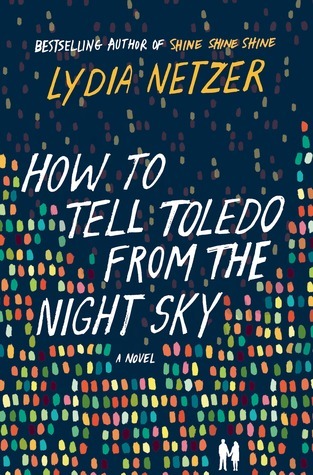
How to Tell Toledo from the Night Sky, by Lydia Netzer *****

  Imagine a complete collection of the Great Books. Add in all those that have won Pulitzers and the National Book. Do you see room for one more? If not, you’ll need to grab the title you never really thought belonged in this collection and toss it. Now, go ahead and slide this title in there, because it is where How to Tell Toledo from the Night Sky belongs.

The story is about a pair of astronomers who were meant for one another on a whole lot of levels, but if, like me, astronomy bores you, this wonderful, quirky romance won’t. It contains a number of story elements that don’t usually appeal to me; the presence of a very unscientific sort of clairvoyance is one that usually causes me to close my book abruptly. This time, the story had me from hello, and it was going to take a lot more than that to turn me away. In the end, I didn’t want to.

I received my copy electronically via Net Galley in exchange for a review. I’ve read and written about dozens of free books either there or via the Goodreads first reads program, and I have never suggested that any other book was worthy of a place among the timeless classics by which we define ourselves as a society and pass down to our children. I’ve read some really good books, but I haven’t read one this great in years.

The suggestion that ancient Babylon was once where Toledo is seems a bit cheeky in some ways; typically American to assume it must be here somewhere. Those who hail from other countries won’t find it nearly so disturbing, I imagine, as will New Yorkers. But for our story’s purpose, the setting shouldn’t be anywhere except Toledo.

Irene, the protagonist, returns to Toledo from her position in the south to take a prestigious position. She also arrives in time to deal with her dead mother’s remains and clean out the house.
From there, nothing takes the trajectory that Irene has anticipated. A warm story that manages to be sentimental yet never maudlin, it pulled me in and I had to stay with Irene once I hit the halfway mark. I never thought once about character development, plot plausibility, pacing, transitions, or anything else. And once I was done, all I could think of was who else I should buy it for.

Don’t miss it.