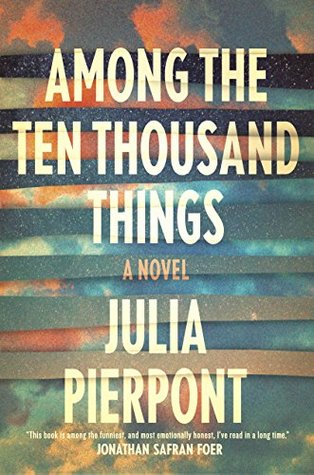
Among the Ten Thousand Things, by Julia Pierpont *****

amongthetenthousandJack is an artist living in New York City. Sometimes he sleeps in the apartment where he lives with his family. Sometimes he sleeps in his studio, when his work is really going strong. Just as sometimes he sleeps with his wife, whereas sometimes, he sleeps with whoever. This story is about the fallout that occurs when one of the random women he has taken up with, then discarded comes back with a vengeance, and though she intends to punish Jack through his wife, instead she ends up punishing him and his wife through their children, who are the unhappy recipients of the series of randy e-mails the woman he’s just jettisoned prints up and delivers to his building. My god, my god. And before I go farther, let me say thank you to Net Galley and Random House for allowing me a sneak peek. This book will be published next month.

Jack and his latest-fling have been prolific writers, it seems. It takes a large, somewhat weighty box to hold all the hideous missives that have passed between the two of them. And though it’s a rotten thing he’s done to his wife Deb, it slips out early on that she has married him only after dating him while he was married to someone else. Hey, what goes around, comes around.

Unfortunately, Jack is sufficiently garrulous enough with his recent conquest that he shares his children’s names with her, and when eleven year old Kay accepts the box to take upstairs, she is thinking that it is nearly her birthday, and perhaps what is inside is a gift that she can’t wait two weeks to know about. And then one of the papers on top of the pile has her name on it. It isn’t underlined, nor in bold or colored ink, but one’s name tends to jump out at one. And so the steamy sex talk she is way too young to see in any context whatsoever is accompanied by the sentence, “I know about Kay.”

It’s almost enough to permanently traumatize a kid. Well, maybe we can forget that “almost”.

The events are so horrible that any sensible reader would turn away rather than face what comes next, but Pierpont has a fresh, immediate writing style that pulls one in, almost to the extent that we care about those kids as if they were our own. We keep reading because we have to know what happens to them.

Several times I grew angry enough with Jack that I found myself senselessly typing angry retorts into my kindle comments. Nobody sees that stuff but me, but typing seemed better than waking my spouse to inveigh against this self-absorbed asshole, this swine who has the nerve at first to blame Kay for reading mail not meant for her eyes. Oh please!

And when Deb equivocates, I want to smack her, too. Sure, I know I said that what goes around comes around, but once you have children, the whole equation is altered, and you have to act immediately on their behalf. She feels a little sorry for Jack at first, at the alienation his children display toward him, and I just want to shake her. Don’t feel bad for him, the pig! Feel bad for your kids! Hello?

The kids are really what the book is all about, what makes it worth reading. They aren’t little big-eyed Holly Hobbie dolls, but both innocent and insolent, naughty and adorable, disturbed, devastated, and resilient as well. They flounder; they struggle. And when the story ends, the spell isn’t really broken until one accepts that they are fictional, because believe me, the whole thing feels so very real.

Pierpont is a damn good writer. She will be a force to be reckoned with in the literary world, a writer to watch. I can’t wait to read whatever is next!
As for you, you should get this novel when it comes out July 7. Maybe you should even reserve yourself a copy. What a fascinating book, by a strong new author.

The Sunlit Night, by Rebecca Dinerstein *****

thesunlitnightWhen was the last time I read something this poignant? No, it’s more than poignant. This novel is a real powerhouse, and my heartfelt thanks go to Net Galley and Bloomsbury, USA for letting me read it as a DRC. It affected me to the extent that I needed to let it steep in my mind for a few days after I read it, before I could review it. That’s always a good sign.

You see, Yasha has grown up without his mother, at least for most of his life. He, his father, and his mother all received much sought-after plane tickets to the USA from Russia. Not all were scheduled to depart at the same time, and not all of them did. And so Yasha and his father have lived above the bakery, and now and again they phone to see when Mama might be coming. It isn’t like she is dead or in jail. She just hasn’t come. She puts them off; she makes excuses. So Yasha helps his father run the bakery, rising early every day and jetting home from school promptly when the bell dismisses him. Season follows season,and year follows year;the loss grows deeper and stronger, as does his bond with his father, a flour-speckled, graying eccentric with the world’s kindest heart. His father is his life, and the place where his mother once was is a constant void. “No mother. No mother. No mother.” Unless you are made of brick or cement, you have to feel his pain.

I think the narrative that alternates here, that of Frances, who is destined to meet Yasha, is supposed to be equal in force, but to me she is an also-ran. The book is really about Yasha, and I am fine with that. Frances also hails from a family that is coming unstuck; her parents have given her and her sister notice that they need to get out of the tiny Manhattan apartment in which they grew up, because they are going to separate.

At the same time, Frances’s boyfriend, the man she loves so much that she has turned down a prestigious art fellowship in order to follow him to the ends of the earth, dumps her. Doesn’t even stay with her till she boards; he just leaves her there all by herself, hurt and stunned. He’s gone.

Yasha and Frances will meet at the top of the world, or the nearest possible place. It’s in Norway, not far from where the Sami hunt reindeer. In the summer, the sun never goes down.

Generally I am not a reader of romances. I am perhaps too cynical; I hear the violins starting up and slam the book shut. No schmaltz for me, thank you kindly. But once in awhile an amazing story comes along. Think of The Thornbirds; think of The Prince of Tides. The Sunlit Night is such a story, an exceptional story for which rules were meant to be broken.

It comes out in June, and you just have to read it. Don’t let yourself be left out.

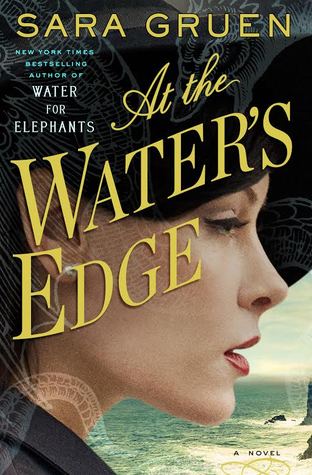
At the Water’s Edge, by Sara Gruen *****

bythewatersedgeBy the author of Water for Elephants comes a gripping tale of cowardice,deception, love, and heroism. My great thanks go to Net Galley and Random House for the DRC. It was a quick read and a great deal of fun.

The setting: World War II, primarily on a remote Scottish island. The story: three spoiled, wealthy, entitled brats misbehave publicly and are sent away by their chagrined parents. Since their allowance has been cut and they have to get gone anyway, they decide it might be just the thing to track down the Loch Ness Monster; not only will it be heaps of fun, but Father will be so pleased. He always wanted proof it existed! And what war? When one is wealthy enough, one cannot possibly be in danger! Just haul out the cash and start bribing others. Nothing to it, really!

Now we’re cooking. We’re on a remote Scottish island after endless seasickness aboard a ship that is constantly fired upon by u-boats. We have a crumbling castle; a Scottish warrior; a fainting damsel; a fiendish conspiracy; several working class heroes of both genders; a love story; and of course, there’s the loch! Get your gum boots ready; it’s soggy out there. Toss in a dash of magical realism, and we’re all set.

Gruen does a wonderful job developing Maddie Hyde, our protagonist, who receives more than one wake-up call whilst she is marooned on this island in the middle of a war that is now real and present. The treatment of husband Ellis and pal Hank is perfect; the writer is subtle, but not so subtle that we miss what’s happening. Angus is such a magnificent character that I found myself wondering what actor ought to play him when the movie comes out.

So I absolutely forbid you to regard this book as Water for Sea Monsters! No, no, no.

Gruen’s wonderful nugget will be released at the end of March 2015, just in time for spring break. If you’re going to be somewhere warm, it’s the perfect beach read. If you’ll be at home or in a cozy cabin watching the rain pound down, it’s the perfect curl-up-by-the-fire book.

Your reviewer isn’t usually fond of love stories, but for Sara Gruen, an exception will always be made. A must-read!

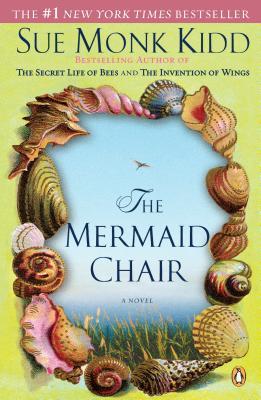
The Mermaid Chair, by Sue Monk Kidd *****

themermaidchairJessie Sullivan has a twenty-year itch. She’s stifled, confined, and irritated by her husband, Hugh, a psychiatrist whose professional knowledge makes him automatically correct in any difference of opinion. When the phone call comes telling them that her mother has deliberately chopped off her own index finger, Hugh tells Jessie to go, and once gone, she finds herself unwilling to return home.

Jessie tells Hugh she has to take care of her mother, but the truth is that she has to take care of herself. And the other truth is that she has fallen madly, deeply in love with a monk who lives at the friary next door. And it’s mutual.

Beneath the surface of her romance, old family business percolates, heats, expands. And something is about to blow.

Merely telling you the outline of the plot fails to convey the magnitude of this writer’s magic. If you have read anything else by Sue Monk Kidd, you have at least an idea of what she’s capable of. A few writers are capable of speaking to the reader as if there is no other reader; the whole thing has been written for you, and you alone. It’s deep, and it’s personal.

In my retirement years I have been devouring books the way I once did bags of chips. Sometimes a few months later I look back at the list of books I have read, and have to get online and remind myself what some of them were even about.

Yet there are others that strike a chord so deep and true that years, decades may go by and I’ll still remember them almost as if I had just read them. And this is one of those; I know it already. I actually stopped breathing a few times, I was so struck by her prose.

It’s possible that this may appeal most to middle aged women and those who are older, since that is the gender and stage of life of the protagonist. Yet in some ways such labeling is unfair, because women often read and are spellbound by novels whose chief protagonist is male, so it seems as if the reverse should be true sometimes. All I know for sure is that it really worked for me.

My copy came from the local library, but if I had paid full jacket price for this little treasure, it would have been worth every penny.

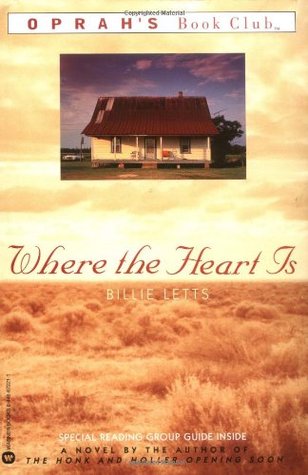
Where the Heart Is, by Billie Lett ****

wheretheheartis  I recently read and enjoyed another title by this author. A quick internet search brought me to this title, which the same search told me had made Oprah’s book club. I rarely watch daytime television and have never seen that show, but I know that books she recommends are often titles I like as well. Such was the case here.

Just imagine it: seventeen years old, basketball-belly pregnant, and riding in a car so beat-up that when you nod off, your shoes fall off your feet and through the rusted-out spot in the floor of the car. There they go! And what could be worse than that?

Then the man of your dreams, who to be fair doesn’t seem all that engaged in your relationship, drops you off at Walmart to get some house shoes, and floors it as soon as you enter the store. There he goes, too.

This story is fascinating because it forces us to examine the difference between innocence and ignorance, between the trusting nature that being a trustworthy person sometimes engenders, versus straight-up stupidity.

Novalee Nation is innocent and maybe a little bit ignorant, but when given the chance to improve her own knowledge base, she does it with enthusiasm. She isn’t stupid; she suddenly realizes, as she enters the Walmart, that Roger would not have given her a ten dollar bill when she only asked for five, if he hadn’t planned to dump her there. She runs back out to the parking lot, but she’s too late. All she has now is Walmart.

Once in awhile the fringe characters in this affable tale are a tad overdrawn (all those bandaids; really?), but most of them–Sister Husband, Forney, Moses Whitecotton, and others, not to mention our protagonist– are so palpable that I found myself inventing other scenarios for them as if they were actual people. That’s always a good sign.

So get your copy–I got mine at the Seattle Public Library–and hunker down in your favorite reading spot. This is engaging fiction from a writer I’ll be following in years to come.

One of Ours, by Willa Cather *****

OneofoursI always seem to love Willa Cather’s writing. Just imagining the country as it was a hundred years ago or more is time-travel of the imagination, and Cather can help a person get started, with her meticulous research and careful, thought-provoking shaping of the protagonist and other characters as well. I feel that the cover description provided on this site is a spoiler, since it takes the reader at least halfway through the book; if you haven’t read it yet and like strong historical fiction, save the goodies as a surprise.

I don’t have any publishers to thank here. I bought this novel on my annual pilgrimage to Powell’s City of Books in Portland, Oregon, where I grew up. Once I’d read the first chapter, I wondered why I hadn’t read it before. It’s not as if I’ve ever been too busy for books.

Claude is a wonderful protagonist; he is flawed, and I find myself wanting to go up to him, as if he were before me, and tell him he needs to stand up for himself. And I want to yell, “Don’t DO it! Don’t marry her!” But he is at Cather’s mercy, and she shows us what love and beauty look like, but poor Claude also sees some real heartbreak. As a mother of grown sons, I identified somewhat with his mother, even though she is not a main character.

Darling Jim, by Christian Moerk****

The writer makes his English novel writing debut with this book, which I snatched off a sidewalk cart for two bucks. Wow! It is, as he explains in the back pages of the book, like a Russian doll: a story, within a story, within a story, within a story, 4 plots nested inside of one another.

Some writers just start writing and see what comes out, then edit just a little. (Stephen King, a personal favorite of mine, comes to mind). But this writer begins with a 75 page outline with snippets of dialogue, all planned out carefully, before he commences writing. Truly remarkable. On top of it all, it was originally written in English, although the writer is Danish, and the story set in Ireland. (The Danish publication came out first, but the English draft was submitted first; the writer did the Danish translation himself).

If you like memoirs; ghost/werewolf/vampire stories (or at least an implication);or if you have a soft spot for the outlying regions of Ireland, where a latte is available but legends and superstitions sometimes still hold sway, find a copy of this book in whatever language you like (just about) and snuggle before the fire. Eat first, and have something to drink with you; you’ll be awhile.

Tipperary, by Frank Delaney *****

Aside

review “The most eloquent man in the world”? It’s entirely possible.

This hyper-literate narrative inside a narrative inside a narrative unfolds as a simple tale at first, then becomes more complex as this deft tale-spinner pulls the scope out one notch at a time.

In addition, we are provided with a passionate re-telling of the atrocities visited on the Irish by the Anglo and Irish-Anglo ruling class. Delaney puts such genuine feeling into the narrative of the republican movement as it progressed in the early 20th century that I am surprised the writer doesn’t find himself on the do-not-fly list. His honesty and appreciation of the struggle is refreshing, at times surprisingly witty, and disarming.

At the story’s beginning, I really do not care much for Charles O’Brien and his stalker-like behavior toward April Burke. No means no. What’s WITH this guy?

But then later, the narrator (who is a character within the story) says more or less the same thing, and in due time, I find myself warming toward this awkward but well-meaning fellow. And as the narrator’s camera zooms out and encompasses so much more, I read more closely.

Occasionally I made the error of trying to read it AFTER I took the sleeping pills, and found I had to go back the next time and reread. It is not a story for the short attention span or one who wishes to multitask; it is absorbing, and requires one’s entire focus. But I found it rewarding enough to devote the necessary time and attention, and even found myself doing web-crawls to see how much of one or another historical detail was true, and how much was fictional or unknown.

In the end, my book was jammed full of sticky notes, and I felt as if I had traveled over oceans and centuries. An eloquent story, indeed!

Between, Georgia by Joshilyn Jackson *****

Jackson’s folksy, humorous love story is more complex than it appears at first glimpse; its entertainment value is instantly obvious. She has taken the town of Between, Georgia, which exists midway twixt Athens and Atlanta, and used it to create a fictional haven for a plethora of characters drawn so deftly that they all but materialize in front of the reader.

Nonny, our protagonist, is between many things. In fact, the deeper one looks at this supposedly light romance, the more “betweens” there are in the story, in setting, in plot, and above all, in character. The teacher in me wants to assign an essay question about it. You are excused from the essay, but you ought to read the book, even if, like me, you generally pass on romances. And for goodness sake, pay attention!

In some ways, this is a story that could have been set in just about any Between in just about any English-speaking setting as long as it was in a small town (and anyone who sniffs at the story as failing to accurately represent Georgia and Georgians completely misses the fact that this is not really a story about Georgia at all). How many of us have dealt with the question of nature versus nurture? How many of us have alcoholics, anxious individuals who are prone to harming themselves, yet keeping “four baby steps” out of the psych ward, neat freaks, slobs, and feuding relatives in our lives? Are you nodding yet? And how many of us have a small person in the family we suspect is being raised by the wrong relative? Then there are those of us who are between relationships, and the world that exists between the hearing and the deaf, the blind and those whose visual acuity is dandy. I am only scratching the surface here. There is so much of life jammed into this one work of fiction that it leaves me breathless.

It is the commonness and humanity in this tale that ultimately makes it so empathetic and readable, but the writing is brilliant. The prose are so fresh and original that they make me question several of the five star ratings I have given to other writers.

Jackson has written a real gem. Sometimes I conclude my reviews by saying that a book is worth reading if you can get it free or cheap. Not this story, not this time. Open a window and order it, or get in the car and go get it. You have to read this book. Whether for depth of literary analysis or pure fuzzy joy, you’ll be richer for doing so!

The All-Girl Filling Station’s Last Reunion, by Fannie Flagg *****

Big, big fun! I recently read this wonderful new work by the famous and always hilarious Fannie Flagg. One of Flagg’s hallmarks is that she spins over-the-top characters so real you can almost see them, but then she sneaks in subtle metaphors and other devices so clever that for me, it takes awhile to sink in.

As she did in Fried Green Tomatoes (a personal favorite), she morphs back and forth between the present and the bygone era of World War II, homing in on the WASPs–women who served as pilots for the armed services, ferrying planes from one part of the country to another so that all military male pilots could do other things.

The story starts in the present with the key protagonist, Sookie, who is informed one day by mail that she is adopted. Given that she is already having a few anxiety issues, this is the last thing she needs. As women go, she feels like a failure; she is a little finch, and does not stand a chance of fulfilling the thunderous expectations of her adoptive mother, who was a Blue Jay from the get-go. When the bomb drops on Sookie, she realizes that she has been reading the wrong horoscope all this time! Her mother has made such a fuss about family bloodlines and heredity, and it turns out that her long-gone ancestors are “total strangers”! She is about ready to come unstuck.

I won’t spoil the rest of it for you. In a completely entertaining manner, Flagg drives home the inequity dealt women pilots during this time period, who received no veteran status, medical benefits, or pension for their service to the country. The 39 who died on the job had no death benefits, either. I salute Flagg (oh, sorry, bad pun!) for putting her literary muscle behind a feminist cause at a time when many sneer at feminism as a thing of the past.

One minor detail that I mention for those who are Japanese-American, Japanese, or close to someone who is: because Pearl Harbor is mentioned here, vintage (but nevertheless painful) use of the “J” slur is used here. It is contextual, and it passes by quickly, but just as many folks blanch at reading Twain’s fiction for the “n” word, so do those who are stung by the “J” word (myself among them) need to know it’s coming. It just helps to be prepared. It isn’t done in a mean-spirited way, and I am glad I read it. But sometimes it helps if you can brace yourself.

The plot is well-paced and is less complex than Fried Green Tomatoes, which hosted a variety of settings that required the reader to carefully scan the heading on the first page of a given chapter in order to be properly oriented. This is more of a quick back-and-forth. It was my fun, light reading at bed time. My only real regret is that it’s over.

Get a copy right away if you love Fannie Flagg as I do!