
Trouble in Queenstown, by Delia Pitt***-****

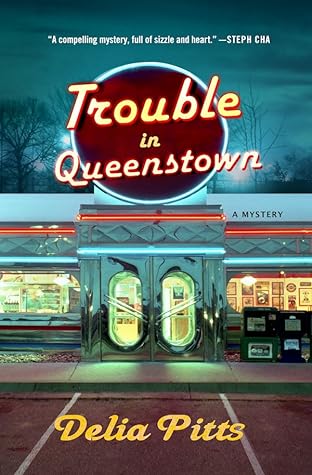
Delia Pitts has been writing mysteries for quite some time, but she is new to me. In Trouble in Queenstown, she introduces hardboiled sleuth Evander Myrick. Myrick’s friends call her Vandy, and that helps to distinguish her from her elderly father for whom she is named; he’s in a memory care unit.
My thanks go to NetGalley, Macmillan Audio, and St. Martin’s Press for the review copies. This book is for sale now.

At first glance, I thought that this detective fiction was set in New Zealand. Queenstown, right? But in this case, the locale is Queenstown, New Jersey. The story opens with Vandy cleaning up a mess in her office just as Leo Hannah storms in and wants to see Evander Myrick. He assumes Myrick will be a Caucasian male, and that Myrick herself is a member of the cleaning staff.

Oops.

Hannah comes to hire Vandy in the wake of his wife’s murder. He knows exactly who did it, he tells her, and he wants her to prove it, starting with some surveillance. Vandy isn’t sure she should take this job, but she has to pay top dollar to keep her daddy in the best facility, so she reluctantly signs on. As the story progresses, there are numerous twists and turns, and the violence escalates. By the story’s end, three different people have tried to hire her for exactly the same case!

The thing I appreciate here is the way Pitts addresses cop racism. So many detective novels require the reader to suspend belief, to assume that every cop is fearlessly dedicated to finding out the unvarnished truth and arresting the perpetrator of the crime, regardless of race, ethnicity, or sexual orientation. But as Vandy conducts her investigation, Pitts keeps it real. At one point the detective speaks with a salon stylist that worked on Ivy’s hair, and he tells her that Ivy was afraid of someone at home. Vandy asks if he contacted the police.

“’The police?’ He jerked his neck, pursing his lips as if I’d farted. ‘Girl, you think the cops came here?’ He sniffed. ‘You don’t look like a fool. Maybe I read you wrong.’”

Sadly, the second half of the book doesn’t impress me as much as the first half does. I have a short list of tropes that I never want to see again in a mystery novel, and she trips a few, including my most hated one. I won’t go into details because it’s too far into the story, and I don’t want to spoil anything, but when it appears, I sit back, disengage from the text, and roll my eyes. Ohhh buh-ruther. As I continue reading, I can see who the murderer is well in advance, and the climax itself is a bit over the top, though without the tropes, I mightn’t have noticed this last issue.

In addition to the digital review copy, I have the audio. The reader does a fine job.

The more mysteries a person reads, the staler tropes become. I am perhaps more sensitive than most readers, having logged over a thousand novels in this genre. Readers that have not read many mysteries are less likely to be aware of, and therefore bothered by overused elements, and so this book may please you much more than it did me. But for hardened, crochety old readers such as myself, I recommend getting this book free or cheap, if you choose to read it. Newer readers may enjoy it enough to justify the sticker price.

Harlem Shuffle, by Colson Whitehead*****

Ray Carney has a foot in both worlds, and he isn’t given to thinking too deeply about that. As the son of a badass criminal, he considers that he has turned out quite respectably; yet, when Cousin Freddie occasionally brings a consignment piece of jewelry to his store, he doesn’t ask many questions about its history. Thus begins a slow, steady slide, from being a mostly-straight retailer, to a mostly-crooked fence. But oh, what a glorious story it makes!

My thanks go to Doubleday and Net Galley for the invitation to read and review. You can buy this book now.

The first time I read Colson Whitehead was when The Underground Railroad was published five years ago. It was unquestionably a work of genius, but it was also a fair amount of work to read. Then The Nickel Boys came out, and when I finally found a copy, it was well written yet so harsh, and at a difficult time for me personally, that I thanked my lucky stars that it wasn’t a review copy, and I gave myself permission to abandon it. So thus far, my admiration for this author has been tempered by the awareness that I would need to roll up my sleeves, or to brace myself, or both.

Harlem Shuffle contains none of that. It’s told in linear fashion, beginning in the late 1950s and ending in the late 1960s. The writing is first rate, as one might anticipate, but it’s also an unmitigated pleasure to read.

Our protagonist, Carney, has married up. His beautiful wife Elizabeth comes from a family with lighter skin, higher social position, and a good deal more money. Elizabeth loves him, but she has expectations. As his young family grows to include a son and daughter, the pressure increases. But let’s not kid ourselves; this isn’t just about Carney supporting his family:

“If he got a thrill out of transforming these ill-gotten goods into legit merchandise, a zap-charge in his blood like he’d plugged into a socket, he was in control of it and not the other way around. Dizzying and powerful as it was. Everyone had secret corners and alleys that no one else saw…The thing inside him that gave a yell or tug or shout now and again was not the same thing his father had. The sickness drawing every moment into its service…Carney had a bent to his personality, how could he not, growing up with a father like that. You had to know your limits as a man and master them…His intent was bent but he was mostly straight, deep down.”

Freddie comes to Carney with a plan: he and his confederates intend to rob the Hotel Theresa, which is the pride of Harlem, the place to stay for Negro patrons of breeding and taste. It was almost sacrilege; and yet, it would also be a fantastic take. Would Ray Carney put out some feelers to find out who could move the sorts of valuable baubles that might be found in the hotel safe? Ray tells him of course not. No no no no no. A thousand times no! And then, he commences doing exactly that.

There are several aspects of this tale that make it exceptional. Whitehead resists the amateurish urge to fall back on pop culture of the period, instead imparting the culture and the pressures of the time more subtly. Racism against Negroes (the acceptable term of the time) by Caucasians; racism by light-skinned Negroes against darker ones, such as Carney; cop violence against all of them; the difficulty faced by Harlem merchants that want to carry first-class products but must first persuade snooty Caucasian company representatives; protection rackets endemic to Harlem, run by Negro criminals as well as cops, so that envelopes had to be passed to multiple representatives every month; and a plethora of other obstacles, stewed into the plot seamlessly, never resembling a manifesto. There’s Whitehead’s matchless ability to craft his characters, introducing each with a sketch so resonant that I had to reread them before moving on; highlight them; then go back and read them a third time after I’d finished the book. My favorite secondary character is Pepper, an older thug so terrifying that even the cops wince when they’re near him. And then there are brief shifts in point of view, and again, my favorite of these is Pepper’s.

Carney isn’t a brilliant decision maker, but he is an underdog, and he’s a survivor as well, and both of these things make me cheer him on. I haven’t had so much fun in a long damn time. When events escalate, Carney finds himself rolling a corpse into a fine carpet, and I can only hope that he chose a relatively cheap rug, because otherwise, what a waste! Those that love the genre mustn’t miss this book, filled with everything anyone could ever want in a noir-style crime novel. Do it, do it, do it!

The Big Book of Female Detectives*****

TheBigBookofFemaleDWell now, that was a meal. Penzler does nothing halfway, and this meaty collection of 74 stories took me awhile to move through. I read most, but not all, and I’ll get to that in a minute. First, though, thanks go to Net Galley and Doubleday for the review copy. This book is for sale now.

The collection begins with Mrs. Paschal, published in 1864, who must find “the cleverest thieves in Christendom,” and it concludes with a piece by Joyce Carol Oates. The stories are broken down into sections, beginning with The Victorians and Edwardians, followed by Before World War I, The Pulp Era, The Golden Age, Mid-Century, and The Modern Era, and concluded with Bad Girls. Says Penzler in his introduction:

“Seeing the Evolution of the female detective’s style as it gathers strength and credibility through the decades is educational, but that is not the purpose of this book, or not the primary one, anyway. The writers whose work fills these pages are the best of their time, and their stories are among the high points of detective fiction that may be read with no greater agenda than the pure joy that derives from distinguished fiction.”

And so the reader must absorb the hallmarks of the time period, and that means the earliest entries carry a certain number of stereotypes, primarily about the nature of women, but in the end, the detective is successful nevertheless. And it’s fun to see historical details written in present tense long ago, and so we know it’s getting to be late out when the lamplighters come out to start the gas lights in the hallways of the manse, for example. It’s also interesting to read authors that were the runaway sensations of their day, the ones that sold the most and wrote the most and were on the tongues of every mystery reader—and yet now they are completely obscure. We can never tell who will stand the test of time until it happens.

And now a confession. The first time I set out to read this tome, I read the entries in the first two sections and decided I would skip the portion devoted to pulp, which isn’t my personal favorite, and I would skip forward to read an entry by one of my favorite present-day mystery writers, and then go back again to cover the sections that come after the pulp section. That was my plan. I’m telling you this because the mistake I made here could happen to you, too, so here it is.

What I did was I skipped to the last section and began flipping through it, and then I was pissed, because I thought the best female detective writers of today had been left out, and in a huff, I abandoned the rest of the book and picked up something else. It wasn’t until I sat down to write a halfhearted review, in which I would explain what I read and what I skipped and why, that I reread the promotional teaser and realized I must have missed something. I went back to the galley, moved back to the second-to-last section that is clearly labeled “Modern”, and there they all were, and it is the longest, most inclusive section in the collection. That changed everything. So reader, if you go for this book, bear in mind that the sections are not completely linear. The “Bad Girls” section at the end, which didn’t do much for me but you may like it, is made up of stories about women criminals from a variety of different time periods. The most recent time period, the one bearing selections by Marcia Muller, Sara Paretsky, the late and beloved Sue Grafton, Nevada Barr, and a host of others, is second-to-last.

Once I realized my error, of course I returned to read the rest of the book.

The one sorrowful note here is that those of us that love these modern female detectives enough to have bought other anthologies, for example those brought to us by the Paretsky group, “Sisters in Crime,” will run across selections we have already read. I have seen both the Grafton and Paretsky stories already, although the piece by Barr, “Beneath the Lilacs,” is new to me. However, I see authors I haven’t read and will happily watch for now. The end of the mid-century section features “Mom Sings an Aria,” and although it veers a wee bit toward stereotypes, I can’t say I mind too much, because this writer makes me laugh out loud. James Yaffe is on my list now. “Blood Types”, by Julie Smith is likewise pithy, and “Miss Gibson,” by Linda Barnes also cracks me up. And I don’t know why I am still surprised by this. After reading so many anthologies, you’d think I’d realize that the greatest charms are had by finding brand new-to-me authors, but since it’s a good surprise every time, I may allow myself not to absorb the lesson; this way I can still be pleasantly surprised over and over again.

If you buy a holiday gift for a mystery lover, I recommend you get this book. If you try to buy something by your loved one’s favorite author, you may run up against it as I did: they’ve already read it. (And you probably hate returning things as much as I do.) But what are the chances she has this anthology? It’s over a thousand pages of detective fiction, and last I saw, it’s on sale for less than twenty bucks. There, that’s one gift chosen for you, and it’s not even November yet. You’re welcome.