
The Old Fire, by Elisa Shua Dusapin***

Elisa Shua Dusapin is the author of The Old Fire. My thanks go to NetGalley and Simon and Schuster for the invitation to read and review. This book is for sale now.

The promotional materials describe this brief work of literary fiction as the author’s “most personal and moving novel yet.” If that is truly the case, I don’t think I want to read her earlier work. It’s not a terrible novel necessarily, but given the hype, I am a little surprised. Someone else praised it as “subtle,” and I can vouch for its subtlety; but for me, it is a story in which I keep waiting for something to happen, and in the end, I’m still waiting.

In broad contours, it is a story in which our protagonist, Agathe, must return to the tiny hamlet in France in which she was raised following the death of her father. Her sister Vera is still there, but they haven’t seen one another in a long time. Her mother is alive, but the parents split up when she and Vera were children, and they don’t see her. She and Vera must deal with the estate, hence the title.

As Agathe returns to the house where she was raised, there are all sorts of issues hovering in the background. She is pregnant, deciding what to do about it; her sister Vera, who is mute due to some physical but unexplained cause, resents her for moving to New York when they were both still fairly young; Agathe has a partner back in New York that wants a commitment, but she holds him at arm’s length. She used to have a crush on a neighbor in their French village; does she still?

As the book ends, none of these things is addressed much. Agathe and Vera sort through their father’s effects and make decisions, not always agreeing; there’s a great deal of inner monologue; and when Agathe leaves to return to New York, nothing much has changed or been decided about anything. And I am left with questions and more questions. What’s with Vera’s mutism? Why don’t they and their mother talk? Agathe comes to France, and not even a phone call…? What does Agathe even think of the man back in New York that’s waiting for her?

I’m inclined to recommend this book to insomniacs as a sure cure, but it’s probably not that simple. I note that it was a huge hit in France, and has been translated into dozens of languages, yet most English-speaking readers seem as underwhelmed as I am, and so I have a hunch that my lack of enthusiasm may be cultural. But I can only report my own impressions, and my impressions say that this book is a snooze fest.
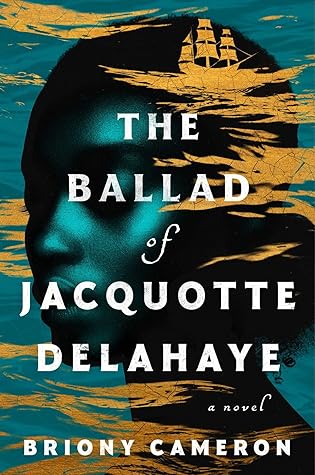
The Ballad of Jacquotte Delahaye**-***

The Ballad of Jacquotte Delahaye marks Briony Cameron’s authorial debut. She is a talented wordsmith, and my thanks go to Atria Books and NetGalley for the invitation to read and review. While I enjoyed several exciting passages—I do adore a good pirate tale—in the end there were issues with credibility that got in my way.

 This story of a pirate woman’s derring do is for sale now.

When I read that Jacquotte Delahaye was a real person and that the book is based on true events, I was all in. However, there are passages that made me raise an eyebrow, and since there didn’t seem to be any notes that would indicate what is true and what is the author’s invention, I took to Google to find out more. This is where I learned that actually, she may have been a real person, or she may be only legend. The stories surrounding her life and exploits are also legend. There’s virtually no verified historical information on this character.

I love good historical fiction, which is where actual, documented facts are given warmth and life by an author that adds dialogue and perhaps fleshes out a few areas where the record is sketchy. Then, if the author is sharp and professional, there will be end notes that explain what is a matter of historical record, and what has been invented. That’s my happy place. Even better is when sources are provided for interested readers. Of course, a writer of any kind of fiction isn’t required to provide footnotes or other documentation, but when they do, it’s the cherry on the sundae, and it makes me love them all the more.

Because this story is not nearly as closely aligned to historical record as the promotional materials would have me believe, I nearly dropped my rating to two stars. I felt, and still feel, that the synopsis provided is misleading. I don’t like feeling as if I’ve been played. However, I realize that the author probably is not in charge of her own promotional blurb, and I can’t see penalizing her for what the publicist has chosen to do.

Do I recommend this story? Not so much. Had it been written in such a skillful way that I felt no need to do research of my own, I might not know that this is pure fiction based on little more than speculation. That’s not the case, though. It doesn’t ring true in a number of places, and that’s partly because it isn’t. However, should the reader decide to pursue it, I would advise that you get this book free or cheap, unless your resources are endless ones. Don’t pay full cover price.

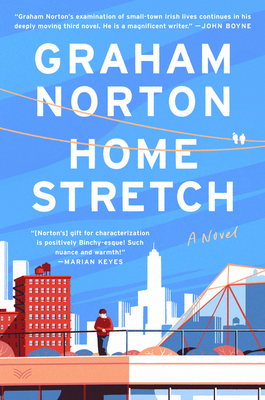
Home Stretch, by Graham Norton***-****

3.5 stars, rounded down.

Home Stretch is Graham Norton’s third novel, and because I absolutely loved his first, Holding, and his second, A Keeper, I expected great things from this one. It’s not a bad book, but it didn’t delight me the way the first two did.

My thanks go to Net Galley and HarperVia for the review copy. This book is for sale now.

We start with a tragic accident, and our protagonist, Connor, is unhurt, but three of his friends are killed, and Connor is blamed by everyone, including his family. It’s a small town, so trying to keep his head up and avoid people that dislike him is impossible.

His family feels the same, and so he is abruptly packed off to Liverpool, and from there to bigger and in many ways, better places. And in many ways this is a favorable development, as he is no longer forced to hide his sexuality; and yet, it’s a tough thing to live a life that’s separate from your family, one that you know would horrify them.

The story is set in the 1980s, the era of the AIDS epidemic. This reviewer lost friends to it during that time; a lot of people did. Norton does a serviceable job with setting, and with character too; and yet, this book lacks the spark of his earlier two novels. The pacing is not as brisk, and the surprising bursts of humor that made me laugh out loud never materialized here. At times it felt like work to read it, and I wonder if he found as much joy in writing it.

I still believe in Norton as a novelist; everybody has a “meh” moment now and then. I look forward to seeing what he writes next.