Murder in an English Garden, by Carlene O’Connor***-****

Murder in an Irish Garden is the eleventh in the Irish Village mystery series by Carlene O’Connor, but I haven’t read any of the earlier books. My thanks go to Kensington Books, RB Media, and NetGalley for the review copies; this book is for sale now.

I was drawn to this book because it features three of my interests: mysteries, Ireland, and gardening. On the downside, it’s definitely a cozy mystery, and I am generally not a fan of cozies, except for the ones that have a bit of an edge, the sort that make true cozy readers complain. I mention the latter because for me, this felt too sedate; on the other hand, true cozy fans may find it is just about right for them.

The premise is that the annual gardening contest, which features a significant cash prize and a great deal of prestige, is about to take place. The village’s most serious gardeners have spent considerable time, effort, and money preparing their gardens for the event, but then one of the displays turns out to have a corpse inside it; the body is that of an entrant who isn’t from the village, an outsider who’s using the competition as a stepping stone to get her admitted to another contest that has a massive cash prize. Cassidy Ryan, the outsider, has been murdered. Village cops Siobhan and Macdara, who are a married couple, are tasked with solving the crime.

As the story opens, we find the two cops—called garda—in a marital dispute, and our protagonist, Siobhan, has an internal monologue that switches back and forth between murder and her pique at Macdara. I felt the latter was overdone, but I also wonder if I had read some of the earlier books, whether I would be more invested in their romance. Of course, they eventually resolve their dispute, and they crack the case.

I was lucky enough to have access to both the digital and audio versions. This proved to be even more helpful than usual, as I was able to hear the story through the delightful Irish brogue of reader Caroline Lennon, and at the same time, I learned the pronunciation of a few common Irish names that I’d only seen in print until now. Between these things and the fact that the narrative is linear and lends itself to the audio format so beautifully, I recommend that interested readers select either the audio alone, or a combination of both. I read multiple books at a time, and because it is easily followed, it’s the story I have chosen to hear while driving.

The characters felt poorly developed to me, with external qualities—this gardener loves goats, that gardener is formal and rather picky—serving as the only development that I found. I would have liked to see some dynamics, and some agreeable qualities for the deceased included. There was almost nothing about gardening, which would have been fine, had there been character development, but alas.  For this reason, I rate the digital version 3 stars, but for the reasons mentioned earlier, the audio version is elevated to 4 stars.

Carl Perkins, the King of Rockabilly, by Jeff Apter*****

“’I had only three childhood idols,’ John [Lennon] would tell a friend. ‘Elvis, Carl Perkins, and Jerry Lee Lewis.’ Paul McCartney would go one step further: ‘If there were no Carl Perkins,’ he’d state, ‘there would be no Beatles.’”

When I saw this book, I felt a slight buzzing at the back of my mind. Huh. Carl Perkins. Have I heard of him? Sounds familiar, but…? And then I read the synopsis, which said that he wrote Blue Suede Shoes, and was the first one to perform it. I went to my streaming service and typed it in; since he wasn’t the one to have made the song iconic, I figured his rendition of it would sound lame. But no! No, it didn’t. So now I knew that I had to read this biography.

My thanks go to NetGalley and Kensington Books for the review copy. This book will be available tomorrow, November 26, 2024.

Perkins was born in 1932,  grew up the son of a Tennessee sharecropper, and starting at age 6, he worked in the cotton fields with his family all day, “from can to can’t.” Had he not, he and his family might have starved. This was a time when no governmental safety net existed, nor did child labor laws. The man who would become his closest friend, John Cash—who would perform and record as Johnny—lived in nearly identical circumstances across the Mississippi River in Arkansas. The only good aspect of this grueling life was the singing. His family sang with the other field laborers, who were mostly African American, and while still a child talked his father into purchasing a guitar.

Perkins was 21 years old when he went to Memphis, where Sam Phillips, founder of Sun Records, had advertised that he would record anyone, anywhere, any time. He had some original music that Phillips liked; not long afterward, he and his wife, Valda, heard his record on the radio. Perkins said, “Valda, she dropped the baby, and I like to fainted.”

Phillips had three other promising musicians signed, and they got to know one another well, sometimes performing together. The other men were Johnny Cash, Elvis Presley, and Jerry Lee Lewis. The first two became Carl’s lifelong friends; Lewis was unpredictable, sometimes violent, and Perkins avoided him when he could. But on one occasion, when the four were together, Lewis complained that the three men with guitars could move around, whereas he was stuck at his piano. Perkins asked him whether he could play standing up, and suggested he “make a fuss” while he did it, advice which altered and improved Lewis’s career.

Perkins’s hit original song, “Blue Suede Shoes,” sold millions, and Perkins was on his way; but just as his momentum was growing, he and his brothers were in a serious car wreck and hospitalized. Once Perkins was able to play again, he felt that loyalty demanded he wait for his brothers—his bandmates—to heal. By the time they could play again, Elvis had also recorded the song, and his career was catapulted into the stratosphere. For a while it appeared that Perkins’s career was finished, but soon help came from an unlikely source: The Beatles wanted to meet him. They wanted to record his songs. They looked up to him as a mentor, and became his lifelong friends.

Reading about Perkins, I am amazed at his capacity to remain grounded and retain the values with which he was raised. Some men would have resented Elvis, but Perkins was delighted for him—and enjoyed the royalties when Presley recorded and performed Perkins’s music. How many men, raised in such horrifying poverty, would place family loyalty over fame and fortune? How many could be so reasonable? Perkins later said that when he saw Elvis perform, he could see why the man was rising so quickly. Elvis was immaculately turned out, and the girls went crazy for him. Perkins wasn’t much to look at, and he knew it, and he would never flirt with his audience, because “I was a married man.” And indeed, he remained faithful to Valda for all the decades of their lives together, and he counted himself lucky to have her. Meanwhile, the royalties from the Beatles, Elvis, and others enabled him to buy a modest but much loved house for himself, Valda, and their growing family, and later he would be able to do the same for his parents. And as it happened, his career as a performer was not dead, only sleeping.

I have read many musicians’ biographies and memoirs, and all of them had greater name recognition than Perkins; but from what I can see, Perkins was the most decent person among them. This is not to detract from others, but seriously…what a nice guy!

Meanwhile, author Jeff Apter writes in an intimate, conversational way that makes this book surprisingly hard to put down, and his research is beyond reproach. Highly recommended.

Mastering the Art of French Cooking, by Colleen Cambridge****

This charming cozy mystery, set in Paris during the postwar years, had me at hello. Tabitha is an American expat, and her best friend, Julia Child, is teaching her how to cook. But one evening, during one of the Childs’s many soirees, a woman is murdered…and the knife in question came from Julia’s kitchen!  To make matters even worse, the victim was carrying a card with Tabitha’s name and address on it when she was found. For some young women, this would be a wakeup call, and the morning would see them on the next available plane to Detroit; but Tabitha is made of sterner and more curious stuff, and so she begins snooping.  

My thanks go to Net Galley and Kensington Books for the review copy; this book is for sale now.

To cope with the horror of the previous night’s events, Julia is roasting a ham.  “I just had to take my mind off everything. Can you even believe it, Tabs? Someone murdered a woman in this building—with my knife! That means they had to have been in my kitchen! This kitchen!”

Like many an amateur sleuth in other mysteries, Tabitha begins poking around. Sometimes she has smart ideas, and at other times she is breathtakingly dense, but there is never a time that I am thinking about the author rather than the protagonist, and that means that I believe the character. There are some familiar tropes and the occasional cliche: “She knew too much!” But it never becomes a problem, possibly because this is a novel that doesn’t take itself too seriously. Now and then the author breaks down the fifth wall, or nearly so. For example, Tabitha tells us that she knows what to do because she has read plenty of Nancy Drew mysteries.

The solution to this whodunit is fairly transparent, and I am able to predict the solution, along with the conclusion of the additional thread of incipient romance early in the book, but the whole thing is so adorable that I never become annoyed. “Just like an Agatha Christie novel—all the questions answered at the end, and the villain is caught, and everyone else is happy.”

Because I had fallen behind, I supplemented my review copy with the audio version, obtained from Seattle Bibliocommons, and narrator Polly Lee does a brilliant imitation of Julia Child! In fact, all of the passages involving Julia are brilliant, and that is my favorite aspect of this story.

Sometimes an author manages to step on multiple pet peeves of mine, and yet I emerge pleasantly entertained anyway, and that’s what has happened here. This is light reading, but it isn’t insipid. I look forward to reading the next in this lovely new series. Recommended to cozy readers.

Hypnosis is for Hacks, by Tamara Berry****

Eleanor Wilde is a sham medium, a fraud who’s used her dramatic talents and the trust of her clients to bilk them. But lately things have changed; she has received intelligence from the great beyond, specifically from her deceased sister. As a businesswoman that now resides in a small town in the UK and doesn’t want her neighbors to hate her, she’s shifted most of her business to herbal cures and such. As it happens, this doesn’t keep all hell from busting loose.

My thanks go to Kensington Books and Net Galley for the review copy. This book is for sale now.

Eleanor–you may call her Ellie—is the protagonist in a satirical cozy mystery series, and this is the fourth. I read and reviewed the first two, but somehow missed out on the third. The first two took place in a tiny village where the ruling family lives in an honest-to-goodness castle. She went there, in the first in the series, to conduct a bogus séance, but instead fell in love with Nicholas, heir to the estate. Now the castle is in need of serious repairs. It’s summer, and the castle is hot enough to be uninhabitable, and so Ellie accompanies the elderly Vivian, matriarch of the castle, to the seaside. Her brother Liam, who is visiting, joins them. And once there, all sorts of things go wrong. We have a menacing, possessed doll that reappears in or near Ellie’s room, no matter what she does to destroy it, and a sinister figure from Ellie’s checkered past shows up as well. And of course, of course, of course, Ellie witnesses a murder shortly after arriving, but nobody will believe her.

I came away of two minds about this particular installment. The thing I’ve appreciated most about this series is that Berry’s writing is hilarious, and whenever an obvious plot device is utilized, it’s done in such an over-the-top manner that we can imagine the author winking and guffawing. Nothing here is to be taken seriously. In the past there’s been very little character development, and I was okay with that, because I wasn’t looking for great literature; I was looking for a laugh.

Here I find some changes. There’s less humor, although two particular bits, one involving lobsters and another involving, per the title, hypnosis, made me snicker. But I also find more character development. Realistically speaking, a series can’t last long if there’s no character development, and so I’m pleased to see Berry adding a bit of depth, but at the same time, what I really want is to laugh out loud. We live in tense times, and there’s a growing body of evidence that we live longer if we laugh. A silly, escapist novel that lets us forget current events entirely for a brief while, forget our own troubles, whatever they may be, and sit back and howl at what our clever author has cooked up, is worth more than many can imagine.

Nonetheless, this story is better by far than most of what’s out there within the humor genre, and I recommend it to you. Now…where’s that cat?

Potions Are for Pushovers, by Tamara Berry*****

I loved Berry’s first Eleanor Wilde mystery, Seances Are for Suckers, and so I looked forward to this one. Ellie, our protagonist, makes a living as a sham medium and pusher of herbal potions. She arrived in this tiny English town in the last book, hired by the wealthy Nicholas Hartford to scam his family, but they fell in love and so she stayed here. Business is on hold, however, until the murder of the local battle ax has been solved; until Ellie can sell her potions again, she can’t make a living, and the heat is on.

My thanks go to Net Galley and Kensington Books for the review copy. This book is for sale now.

The glory of satire is that the most tired, trite elements of a mystery can be trotted out and placed on full display, the more overdone the better. Add into it an overflowing supply of snark, swift pacing, a hint of confusion and the very teensiest, briefest moment of sentimentality and the result is, well, magical.

At the same time that Sarah is murdered, pets begin to disappear. A grisly surprise is left in Ellie’s herb garden, and her cat Beast, a menace if ever there was one, is nowhere to be seen. Cats, pigs…what’s next?  Her sometimes-friend the local constable is irritated that Ellie doesn’t pass along the finer details of what she learns, but she points out to him that witches and law enforcement have a problematic history. Crackle crackle, she says. Burn burn.

The best new element is Lenore, a pesky but gifted adolescent that wants to job shadow Ellie. Together with partner Rachel, she embarks upon local werewolf research, and this thread makes me guffaw out loud multiple times. (At one point Lenore decides she’d rather be called Lenny because it sounds more like a gumshoe; my reading notes suggest that Rachel should then become Squiggy. Boomers will understand this reference if nobody else does.)

My affection for Ellie increases when she eats an entire chocolate cake. I’d been watching that cake since she received it, waiting for the typical cozy plot point to play out. Most authors would either have Ellie serve or gift the cake to another recipient, or have it smashed in some sort of hilarious accident before she got a single bite. Berry, however, is not your typical cozy mystery writer. It’s the slightly edgy bits that make this series so successful.

The series is written for adults, but teachers and parents looking for engaging reading for their own gifted adolescent should be fine here. There are no torrid sex scenes, no use of vivid profanity.

Sadly, my own review copy disappeared with no trace from my kindle, so I can’t access juicy quotes; happily. I did use the Goodreads update system, which provided me with the particulars listed above.

There are few authors that can make me laugh out loud every single time I read their work, and that alone makes this writer more valuable to me than most. I await the next Eleanor Wilde book with gleeful anticipation, and whether you have read the first book in this series or not, I recommend this one to you wholeheartedly.

Clover Blue, by Eldonna Edwards*****

Edwards is the author of This I Know, and here, once again, she creates a powerful story based on a youthful yearning for identity. My thanks go to the author and her publicist for the printed galley, and to Kensington and Net Galley for the digital copy.  It will be available May 28, 2019.

Our setting is a small commune in California in the early 1970s. Our protagonist, Clover Blue, sleeps in a tree house with some of the other commune members. There’s no running water or electricity, but we don’t miss what we don’t have, and California has a mild climate. Though decisions are made collectively, with younger and older residents each having a vote, Goji is the spiritual leader of the group. In place of formal education, young commune members study with him. Blue can read as well as other children his age, and he knows more about nature than most would because it’s part of his everyday experience. He doesn’t remember living anywhere else; his life is happy, and his bonds with his communal family are strong ones.

But everyone wants to know their origins, and Blue is no different. As puberty approaches, he begins to ask questions. He gains the sense that older members know things they won’t tell him, and it heightens his desire to find out. Goji promises him that he will be told when he turns twelve, but his twelfth birthday comes and goes, and still Goji evades his queries.

And so the story darkens just a bit as Blue undertakes research on his own. He has a hunch as to who his biological parents might be, and despite the communal culture that regards every older person as the mother or father of every younger person, he wants the particulars and is determined to get them. The things he learns are unsettling and produce further questions.

A large part of the problem the communal elders face is that the State of California does not recognize the commune, and the living conditions and educational process used there are not legally viable. Because of these things, Goji discourages interaction with the outside world, and sometimes essential services—such as medical care—are given short shrift because of the risks they pose. Instead, naturopathic remedies are used, often to good result.

Edwards builds resonant characters, and I believe Blue, the sometimes-mysterious Goji, and Harmony, the member of the commune that is closest to Blue. There is enough ambiguity within each of them to prevent them from becoming caricatures; everyone holds various qualities within them, none being wholly benign or malevolent. The way that we judge these characters isn’t built upon their ability to do everything well, but in how they deal with their mistakes when they make them. In addition, some writers of historical fiction—which technically this isn’t, but it has that vibe—fall into the trap of establishing time and place through the cheap shortcut of pop cultural references and well known historical events. Edwards doesn’t do that, but she does use the speech of the time period so effectively that at times, I feel transported back to my own adolescence. There are aspects of the period I’d forgotten entirely that surprise and delight me; if there are errors, I don’t see them.

Ultimately, the story takes a turn that harks back (somewhat) to George Orwell’s classic, Animal Farm, in that while everyone at the commune is said to be equal, some are “more equal than others.” Cracks in the foundation of their once-idyllic lives form, and we see who has strength of character, and who is lacking.

If I could change anything, I would make the ending less rushed, and I’d also urge the author to be less afraid of letting the ugly parts play themselves out as they most likely would in real life. In this novel and her last, it seems like the tragic aspects that occur near or at the climax are a hot stove, and we have to move away from them quickly. I’d like to see Edwards let the stove burn a little more.

 I do recommend this book to you. In fact, it may be a five star read, but it’s almost impossible to evaluate it without comparing it to what the author wrote earlier, and this made the five star standard difficult to achieve here. Those that love historical fiction should get it and read it.

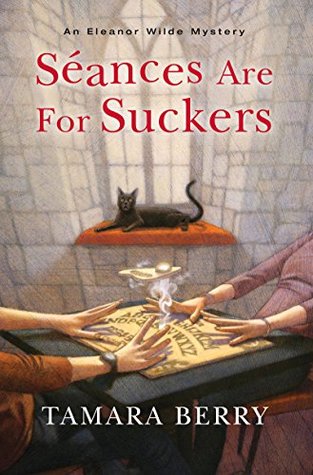
Seances Are For Suckers, by Tamara Berry****-*****

SeancesareforTamara Berry is the queen of snarky humor, and now that I have read the first installment of the Eleanor Wilde series, I am primed and ready for those that follow it. Big thanks go to Net Galley and Kensington Books for the review copy; this book is for sale now.

Ellie narrates her own story in the first person. She explains that she makes her living through fraud, scamming those that want to talk to their dead relatives and solve their Earthly problems via séances. A referral brings her a wealthy Brit that wants a fake medium to vanquish the ghost his mother believes is haunting their mansion. Expenses paid, she flies out to join him and is delighted to find that he lives in an actual castle. His mother, however, hates houseguests and discourages them with miserably small, terrible meals and bad accommodations. As preparations are made for the séance, guests exchange furtively obtained and hoarded snacks in order to avoid starvation.

Nicholas is a hunk; he and Ellie are both drawn toward each other and repelled in classic fashion, and there’s a lot of crackling banter that keeps me snickering. Other well drawn characters include Nicholas’s mother, his sister and her teenage daughter, and a couple of other men, one of whom works for the family. When she comments to the reader, “Bless the sturdy and simple folk of this world,” I nearly fall off my chair. The narrative and dialogue are wonderfully paced and hugely amusing. The solution to the mystery is both partially obvious and wildly contrived, but since this is satire, that makes it even better. In fact, there’s more than one tired old saw that works its way into this story, but it’s with a side-eye wink every time, and I love it.

As the narrative unspools, a corpse is found and then lost, threats and warnings heighten the suspense, and we wonder along with Ellie which of these guests and family members are truly as they seem, and which might be a killer.

The scene leading into the séance is so hilarious that I nearly wake the mister with my cackling.

The only aspect I find unappealing here is the somewhat saccharine story having to do with Ellie’s dying sister. Ellie’s dishonest vocation is, she tells us, necessary so that she can pay for her catatonic sister’s nursing care, and while squeamish cozy readers may find it comforting, I am more than ready to dispatch sis to the great beyond and just let Ellie be Ellie anyway. Happily, this doesn’t hold the story back, particularly since most of the sister’s part of this tale is told at the start and is out of the way by the time we are rolling.

I can’t wait to see where life—and the wakeful dead—will take Ellie next. Highly recommended for mystery lovers ready to be entertained.