
This American Woman, by Zarna Garg*****

Zarna Garg is an immigrant, born and raised in India. She was rich, except for when she was poor; more on that in a minute. Ultimately, she came here for the same reason many people do: she had to make a break for it.

My thanks go to Random House and NetGalley for the invitation to read and review. This book is available to the public now.

Garg works now as a stand up comic, but she has done many things, and worn many hats. First, of course, she was a runaway bride, more or less, bailing from India before her very wealthy father could marry her off as part of a business arrangement.

“If I hadn’t done that, right now I would be a Mumbai grandma in an arranged marriage to a much older, boring industrialist. I would be draped in brocade silk saris, but I would have a giant padlock on my big mouth.”

Garg’s immigration—fast and sneaky, which was the only possible way–was made easier by her older sister, who was already living in Ohio. Since then, Garg has finished law school and passed the bar, married another Indian immigrant, had three children, and done a number of other impressive things, but it was her own daughter that asked her mother whether she’d ever considered a career in comedy. It takes someone that’s mentally tough to succeed in that realm, but the streets of Mumbai, where she’d lived hand-to-mouth for two years as a runaway teen following her mother’s death, prepared her well, so she was ready for the gritty world she was entering. She explains,   

            “…I had played a show at a club on the Upper East Side and a cockroach fell on my head. The night before that, as I walked to the stage I had to step over a communal puddle of throw up from a bachelorette part who refused to leave. They just kept throwing up and laughing. So far my comedy career had been physically revolting—but it was still my dream! Now here I was in my very first New York City green room that smelled like air…I walked out on stage. Two thousand white ladies politely applauded. Oh my god. What was I doing? Would this audience even understand my humor? For them India is incense and chanting. Were they ready for a foul-mouthed real-life Indian auntie who hated meditation? “

I wondered, after watching some of Garg’s stand up work online, whether the book would be a duplication of her routine, more or less; it’s happened with other comic authors. But although there’s a small smattering of shared content, the memoir is mostly unique, and I never had the sense that I’d already seen this before.

Garg is funny enough that I’ve let her speak for herself here. Anyone that needs to laugh hard, and that enjoys reading about the disorientation and culture shock experienced by those new to America should read this book. Highly recommended!  
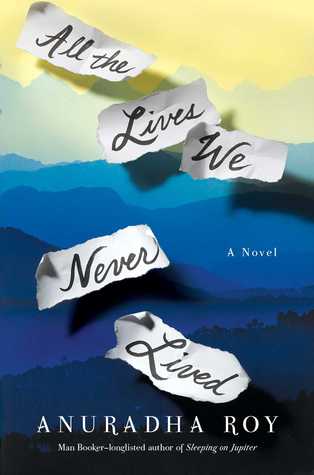
All the Lives We Never Lived, by Anuradha Roy***

I had not read Roy’s work before, but when I saw this galley—with an arresting cover and the promise of a Man Booker nominated author—I jumped on it.  Thanks go to Net Galley and Atria Books for the review copy. It’s for sale now.

I’m months late with my review, and the cause of my tardiness is my ambivalence about this book and my confusion as to why it fizzled for me. It starts out well, and at the outset I love Gayatri, the nonconformist mother of Myshkin, our other main character. Every stereotype ever built about Indian women is utterly crushed as she screams with joy while riding downhill on her bicycle. Her sari is torn, her hair is a mess…and her husband adores her.

The story is set just prior to World War II as well as the Indian quest for independence. But as India struggles to break free of the British Empire, Gay struggles to break free of her marriage.

Myshkin is extremely close to his mother, and when we meet him he is elderly, retired from working as the town’s landscape director and gardener, and living alone in greatly reduced circumstances compared to the ones in which he grew up. His whole life has been nothing but sorrow and loss since his mother abandoned him. We see in her letters to friends and in his own inner monologue that she had intended to take him with her, but the timing was right down to the wire. She told him not to be late coming home from school because something important was happening; but then his teacher was unhappy with the class and kept them all after school, and faced with the choice to fish or cut bait, Gay left without her little boy.

Usually when I don’t like a book, I also know exactly why I don’t like it. This time I had to mull it over. On the one hand, I heartily dislike the mother here; I’m a diehard feminist, but child abandonment is child abandonment. However, a flawed or even villainous protagonist shouldn’t be a deal breaker. Think of Hannibal Lector! Think of The Talented Mr. Ripley! And of course we also know that for Gay to leave her marriage was a dicey proposition during this time period when an Indian woman was legally little more than chattel. Nevertheless, I resent this character, who is portrayed as flawed and yet heroic. Why doesn’t she keep Myshkin home from school, have him feign illness or hide somewhere, rather than set up this failure? Her love for him is supposedly tremendous, and yet she chooses to leave without him; when she becomes a famous painter and openings exist to find and reclaim her son, she has endless excuses.

In addition to my frustration with the character, I also see pacing problems. Rather than experiencing the powerful range of feelings that the book’s teaser promises, after I was twenty-five percent of the way in, I was mostly just weary, depressed, and watching the page numbers crawl by.

Is it over yet?

Another reviewer suggested that although there is a long, slow part during the book’s first half, once we get to a certain point—which he identified, but I have forgotten where it was—the whole thing would gel and make it worthwhile. And so I soldiered on, reached his benchmark and then past it for a few pages more, just in case. But no.

Having forced myself along this far, I resolved to skip to the last 25% so that I would be able to write a fair review. Sometimes the way a book ends can completely change how I feel about it. But I found that so much change had occurred in the portion I had skipped that I couldn’t regain the thread, so with a heavy sigh I flipped back to where I’d been and saw it through. But the ending is worse than the middle, with Gay’s entire narrative attached to it in the form of detailed letters to a third party, the friend that helped her sneak out of India. 

I once met someone that had added onto his home in a do-it-yourself way that had nothing to do with building codes, and the floors sloped precariously, the style of the addition resembling a hillbilly patchwork job more than a suburban home. And that’s what the end of this book is like. It’s as if a deadline was nearing and the writer tacked something on quickly to get it done in time.

How did something that started so well turn into such a mess? It’s perplexing. All I know is that when I was done with it, I felt as though spring had arrived, and there was an added bounce to my step, not because the book made me feel that way, but because the book was over, and I would never have to read it again.

All this said, the initial character sketch of Gayatri is wonderful. I could see using a cutting from it in a creative writing class. But get it free or cheap unless your pockets are deep; I cannot recommend the book as a whole.