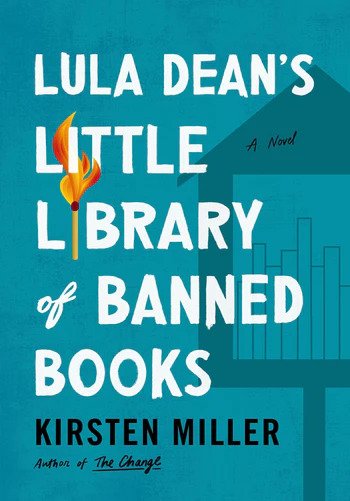
Lula Dean’s Little Library of Banned Books, by Kirsten Miller

Lula Dean is a deeply unhappy woman. Neglected by her children, alone and unappreciated, she strikes on a way to gain the attention she knows that she deserves. She embarks on a crusade to remove books she deems objectionable from local libraries, and she sets a sterling example for her town by erecting a little library on her lawn, a collection of the wholesome material she thinks is most appropriate. Little does she know that one of the town’s youths has snuck out in the dead of night and inserted banned books inside the dust jackets of the books she originally placed there. Her library becomes wildly popular, and Lula hasn’t a clue why.

My thanks go to NetGalley and William Morrow for the review copy. This book is for sale now.

The moment I saw the synopsis for this novel, I knew I had to read it. The First Amendment is a hot button for many people in the U.S., and as a language arts teacher, it’s been at forefront of my mind for most of my adult life. And I think I can safely say that Lula Dean is a soft sell; readers are generally a receptive audience, and so any novel containing the word “book” or “library” in its title should, I would argue, be held to a slightly higher standard. It’s not that hard to preach to the choir.

I love the premise of this story, and I laugh out loud more than once at the beginning. After that, though, things flatten out a bit. There are a lot of characters here, and whereas I have no difficulty keeping them straight, their numbers may have prevented author Kirsten Miller from fully developing them. I feel as if I am reading, for the most part, about cartoon cutouts rather than real people;  had I felt as if the characters were real, I would have been more deeply invested in their outcomes. However, everyone in this thing is either a fine, enlightened character or a despicable, ignorant blowhard. It accurately represents the way many Americans regard those around them, blue versus red, and that is not helpful. Two characters that stand out better than others are side character Beverly Underwood, and the young Elijah. However, even these are not dynamic characters. Nearly everyone here is the same going out as they were coming in.

Those looking for a short, funny novel to toss in their suitcase over the holidays could do worse; they could also do better. The sad thing is that had this been written in a more intentional way, with the literary standards one would hope to see in any novel, it could have been impressive, might even have changed a few hearts. This book isn’t going to do that, and so I see it as an opportunity squandered.

Margo’s Got Money Troubles, by Rufi Thorpe****

Margo’s Got Money Troubles, by Rufi Thorpe, is a bold, inventive, and very funny novel about a young woman cut adrift in a difficult, expensive world. My thanks go to NetGalley and William Morrow for the invitation to read and review. This book is for sale now.

Margo is the daughter of a Hooters waitress and a former pro wrestler, an absentee father with a family of his own; her mother had been his woman on the side. Consequently, Margo has always understood that she would have to hit the ground running when she grew up, and so she’s enrolled in a junior college. When the brief affair with her English professor leaves her pregnant, she has nobody reliable to advise her. The women she confides in urge her to terminate the pregnancy, and of course, the professor does, too; yet Margo likes the idea of becoming a mother, and it’s her fetus. Nobody can make her do anything. She decides to keep it.

Her mother is about to marry a man with money and conservative values, and she sees Margo as a loose cannon that just might upset the whole ship, so she tells her to terminate or be cut off.

Wow, Mom. Really?

Margo’s roommates hadn’t agreed to share an apartment with a baby. They need to sleep! They have to get up early!

Early on, I’m rolling my eyes. Part of me is thinking that Margo is about as dumb as they come; part of me is wondering why no author in this entire world is writing—or, more likely, why no major publishing house is publishing—novels in which a young woman chooses to have an abortion and take back her body and her life. But I’m overthinking, because soon, Margo—who after all, is just young, naïve, and rudderless—admits her error. She loves her little boy, but she had no idea he would be so expensive, or that motherhood would be so difficult. She tells her father, who re-enters her life as her mother steps away,

 “’I shouldn’t have had him,’ as though some rip cord had been pulled inside her. ‘I know that, okay? Everyone told me it would ruin my life and it did. They were right, and I was stupid, and I didn’t get it. Okay? But now I’m here.’ And her father, who strangely enough becomes the most reliable adult in her life, says, ‘Yes. Now we’re here.’”

Later, Margo will comment that nothing can make a person pro-choice like having a baby.

Margo has been waiting tables, but she can’t find child care, and when she brings the baby to work, she’s fired. And the truth is, she doesn’t like leaving her baby. Then one day, while looking at her naked self in a full length mirror, she observes that she has huge boobs for the first time in her life. Men would pay to see this. She opens an account on OnlyFans.

And so this controversial choice becomes the crux of the story. Some friends reject her, and her mother has really had it with her now. But there are a lot of meaty conversations that are thought provoking, and so, even though this old lady schoolteacher reviewer is mighty uncomfortable reading about an online sex worker’s film process, there are related questions that cannot be ignored. For example, Jinx—her father—advises her against it, saying that she shouldn’t get mixed up with these kinds of girls, and she asks him, “What are ‘those kinds of girls’?” And it’s true. A man can send his dick pix out into the world any number of times and places, and whereas many will consider these gross, or obscene, which they are, how many people will condemn the guy’s entire character, his moral fiber, for having done it? So the double standard is screaming to be recognized.

Margo goes through a lot of grief, defending custody of her son when the skeevy professor resurfaces, as well as having to deal with housing crises and other problems. But the central issue lurking in the shadows is that of a young mother choosing sex work as a career.

I have to tell you quite frankly that I was way out of my comfort zone through much of this book. I am probably not part of its target audience, despite the fact that I was approached to cover it. Partway in, I considered not finishing it, but the quality of the writing is so strong that I kept going, and I’m glad I did.

The story is told from a third person omnipotent perspective, but it shifts in a surprising and funny way, and that’s all I will say about that, lest I ruin it. I wonder from time to time if we have an unreliable narrator, but this is more than that. This unusual point of view a brave choice, and I think she carries it off well.

There are a lot of worthwhile discussions that can spring from this novel; it’s fertile territory, if you’ll pardon the expression, for book clubs. It’s also being adapted for Apple TV. I recommend this book for any feminist that likes to laugh, and isn’t afraid to think outside the box.

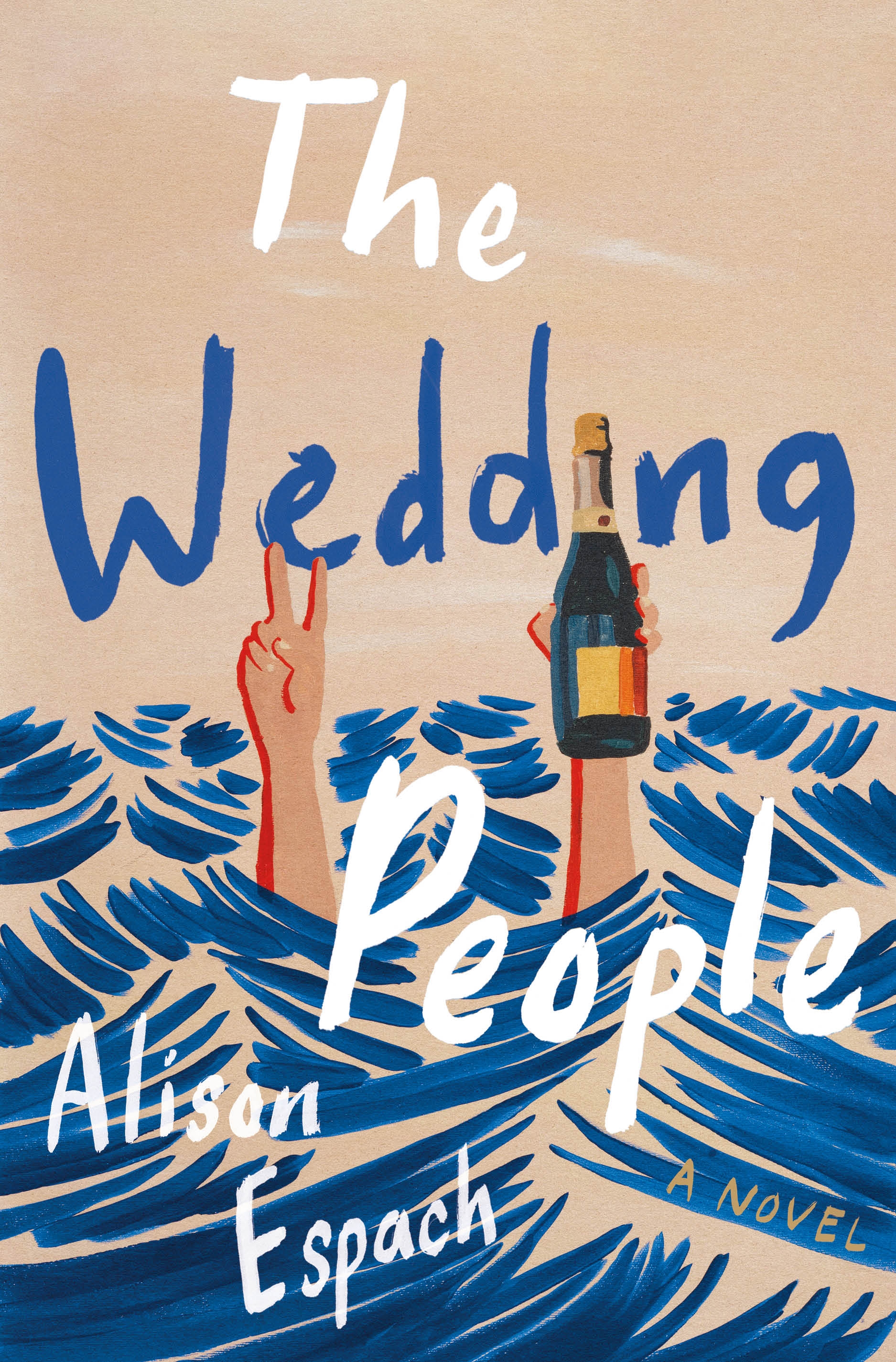
The Wedding People, by Alison Espach*****

It’s a good sign when I finish reading a book, and I’m smiling. Alison Espach’s new novel, The Wedding People, not only left me smiling at the end; it made me laugh out loud almost from the get-go, and it will do the same for you.

My thanks go to NetGalley, Henry Holt, and Macmillan Audio for the review copies. This book is for sale now.

I’m not usually fond of romances, but a friend mentioned the premise of this one, and I couldn’t resist. In a nutshell:  Phoebe, the protagonist, worn down by the pandemic and devastated when her husband leaves her, heads off to the posh hotel where they’d intended to spend their vacation. She takes no luggage or even her phone, because she plans to kill herself once she’s inside that lovely place.

Upon arrival, it’s clear that a mistake has been made. The entire hotel has been reserved for a wedding. But Phoebe’s room hasn’t been double booked, and so she is allowed, with apologies, to proceed to her room. However, the bride—wealthy, entitled, Bridezilla—learns of Phoebe’s presence, goes to her room, and orders her to leave. As they argue, Phoebe discloses her reason for coming, and assures her that she’ll be gone—so to speak—by the time the wedding takes place. But Lila, our bride, is having none of it. How dare Phoebe spoil her wedding! Absolutely not. She isn’t going to have guests gathering just as a corpse is being wheeled out to the morgue, right through the lobby! Phoebe must change her plans.

I won’t share any further developments, but I will tell you this: Espach can write.

Long ago, I decided that five star reviews should not be reserved for the rare gem bound to become a timeless classic. I give five stars to any novel that makes me unusually happy, and that represents the best being published within its genre. This book is one of those.

Helen Laser is the voice actor narrating the audio version, and she makes it even funnier. If you are strictly a visual reader, that’s fine, but if you like both formats, go with the audio this time, or use the audio and print versions together, which is what I did.

Highly recommended to those that enjoy a good romance, a good laugh, or both.

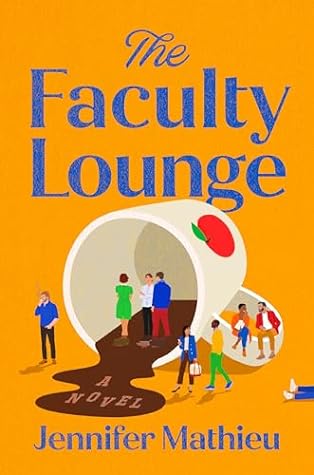
The Faculty Lounge, by Jennifer Mathieu****-*****

“You really had to hand it to Mr. Lehrer. While dying at work is never ideal, he had the decency to do it during his off period. And not only that, but at the start of it, too, giving the clerks in the main office plenty of time to find someone else to cover Ms. DeLaRosa’s Spanish II classes, even as they scrambled to figure out who should be telephoned when an eighty-two-year-old substitute teacher lies down on a ratty couch in a high school faculty lounge and dies. “

Jennifer Mathieu’s new novel, The Faculty Lounge, has been described as love letter to teachers. Though it is darkly funny in a number of places, the description isn’t wrong. By the ten percent mark, I had cackled out loud twice, it was so strangely accurate.

My thanks go to Penguin Group Dutton and NetGalley for the review copy. This book is for sale now.

Our school is Baldwin High, a Texas school with a solid reputation. After the stage is set, with poor Mr. Lehrer breathing his last breaths during his planning period, and another teacher being cranky when the paramedics make her leave before her photocopies are done so that they can work on him, the story is organized with a single chapter per character. Obviously there are a lot more people on Baldwin’s staff, but this method works quite nicely, and since the characters interact, the chapters that come later in the book are richer, because there’s more backstory to help us understand them.

The youngest teachers have grown up with the knowledge that they might be shot to death at school; first they grew aware of this when they were students, and now, as teachers, the danger is still there. While older staff members tend to be rattled by a lockdown, younger ones see it as almost routine. Take attendance, salute the flag, and whoops, there it is. Herd any students outside of your door into the room, then lock it. Everyone on the floor. Pull your window blinds. Wait till it’s over.

I appreciated every character in this book, and I was sorry when it ended.

There are crises at Baldwin, just as there always seem to be fires to put out in real schools; there are high maintenance parents with absurd complaints, as well as idiotic district directives. Bureaucrats! Toward the end, a veteran teacher explains to a newer one that some days, “the best you can do is show up and hang on.” So true! Your reviewer is retired from the profession, and I can recall a wise older teacher saying to me privately during difficult periods, “I’m here. And I’m dressed.”

The whole thing seems so familiar.

How much will this resonate to readers that aren’t educators? I have no idea, but I know that the in-jokes, the sense of the familiar, can’t be as strong. For a general readership, I’d say this is a four star read. Possibly this is true as well for those that have always taught early childhood, because many of the parameters are different. But for those of us that have taught middle and high school, particularly for those that are veterans, this is a solid five star read.

Cheerfully recommended to all, and highly recommended to veteran secondary teachers.

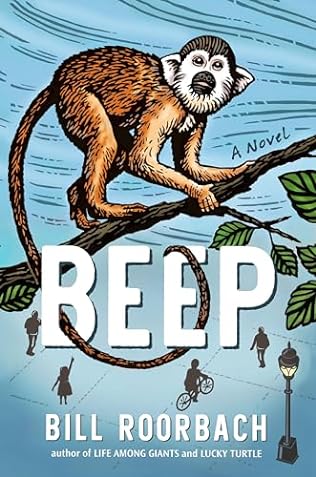
Beep, by Bill Roorbach****

Beep is squirrel monkey, born and raised in the rain forest of Costa Rica. He’s not a baby anymore, and his old uncles have informed him that all the females are spoken for, and he must travel to a new area to mate and propagate. It’s tricky business, though, because human encroachment has separated the forests from one another, so Beep cannot get to the next forest without going through areas developed by humans. Beep’s odyssey takes him much farther than anyone imagined, and in the end, he finds fame and satisfaction.

My thanks go to NetGalley and Algonquin for the invitation to read and review. This book is for sale today.

Much of the book is devoted to the relationship that Beep develops with a human child named Inga. While traveling through neighborhoods, a bit lost and unsure where the next forest might be, he spots her eating some delicious fruits in her backyard, so he introduces himself in order to get lunch. Inga’s mother comes out and meets him also, and this passage provides an idea of the story’s character:

“’Squirrel monkey,” the mother said warmly, ‘Ooooh. They aren’t usually solo. Oooh, ooh. Keep your eyes peeled, there will be more.’

“Ugh, eyes peeled? ‘I’d like some fruit,’ I said clearly.

“’Oh, how charming,’ said the mother. ‘Hoo-hoo, monkey.’ She’d wiped most of yesterday’s blood from her lips, but at the edges of the enormous mouth some remained (probably she’d caught and eaten a bird). Also, part of her outer wrappings had come loose and her poor chest looked more distended than ever, wrapped in a bright banner of some kind. Somemonkey once said they look like us, but come on: they do not.”

But this is not Inga’s permanent home; she is on vacation. When her family returns to New York, which Beep calls Nyork, she smuggles him in with her carry-on items and it is in New York City that he meets fame after surviving several harrowing situations.

For the most part, I find this novel charming. There’s no need to concern ourselves about the credibility of the overall story line, because after all, we’ve begun with a monkey providing the narrative, so it’s clear that we just need to roll with it. It is funny in places, a bit dark in others, and then—as with the above quote—sometimes it’s darkly funny. Some of the reviews I’ve read take issue with the ending, but I’m good with it. My sole dissatisfaction, and unfortunately it’s one of my pet peeves, is Roorbach’s failure to develop Inga appropriately in keeping with her age. There’s a scene at the airport when she starts to cry because her stuffed animals are being taken away to be scanned by security, and another soon afterward where she is walking her doll buggy in Central Park, so I’m figuring she’s maybe six years old; but subsequent scenes make her seem much older, and finally we’re told that she’s eleven years old. It doesn’t take years of study to know that an eleven year old girl doesn’t wail about her stuffed animals or take her dolls for a walk in the park. Get real.

Happily, as the story unfolds from there, Inga settles into being a real eleven year old, and my irritability ebbs so that I can enjoy the rest of the book.

All told, this is a delightful read. Because of its dark characteristics, which I will not provide because they’d be spoilers, this is not a book to read to your little ones, but if you have a young Goth in your home who is able to read alternate spellings and dialects, then this book would likely be that kid’s happy place. The overall message is a worthy one, although Roorbach is probably not going to change hearts and minds about the environment, since those in favor of unchecked development in the face of environmental devastation and disaster aren’t going to buy this book. All told though, it’s a fine read for those that are ready for something a bit different and that can handle dark humor.

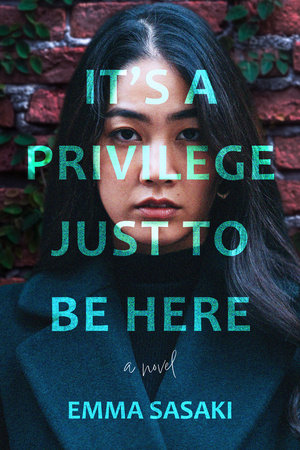
It’s a Privilege Just to Be Here, by Emma Sasaki****

Emma Sasaki makes her fictional debut with the darkly amusing story of a mother and daughter caught up in a scandal at a prestigious private school. My thanks go to NetGalley and Dreamscape Media for the audio galley. This book is for sale now.

Wesley Friends School is the prep school to which presidents and other high placed politicos send their teens, a place where they are nurtured as completely as any hot house flower, and then sent onward, hopefully to an ivy league college. Aki Hiyashi-Brown abandons her PhD and accepts a teaching job there in order for her daughter, Meg, to be able to attend; otherwise the tuition would be impossibly expensive. The school is overwhelmingly Caucasian, and so perhaps it’s unsurprising that Aki finds her face prominently displayed on all of the promotional materials the school disseminates, along with those of the few other teachers of color.

That’s all fine and good until the day when the fence outside is vandalized by spray paint reading, “Make Wesley white again.” Aki is ready to do what she’s been taught from the cradle: keep her head down, do her job, and not say anything. But Meg and her classmates have no intention of remaining silent. Before she knows it, Aki finds she has been assigned to be the head of the Racial Equity Task Force, a token job on a token committee that has more to do with appearances than with any actual desire for change.

She is given a script to follow and told not to offer up any of her own observations or opinions.

Soon, things spiral beyond the control of Wesley’s administration, and Aki is caught between doing what her bosses want her to do, and supporting her daughter and students in their quest for genuine change.

This book, which the author notes is based on her own experience, has me at hello. Though I am not a wealthy or connected individual, I did send my child to a private school for a few years, one which was very white, and which used my half-Japanese daughter’s face on its pamphlets a lot. I can’t not read this book, and whenever I have earbuds in, this is what I listen to. I find it well paced and engaging, setting just the right tone without over-moralizing or becoming strident. There are some great side characters as well; I like Aki’s husband and mother particularly, and appreciate the bond between Aki’s half-Japanese daughter and her Issei (first generation) grandmother.

However, my own husband is also Issei, and I asked him to listen to the reader during one of the many passages in which the grandma speaks to Aki in Japanese. “Is this reader’s Japanese as good as I suspect?” I asked, somewhat proud of my first year Japanese skills. He listened to two lines, laughed, and shook his head.

For this, I really do have to knock one star off my original five star rating. Perhaps if I had a digital review copy I could have rated that version higher, but I have what I have, and it’s problematic. Nevertheless, I appreciate this novel and the message it delivers, and I greatly look forward to reading whatever Sasaki publishes next.

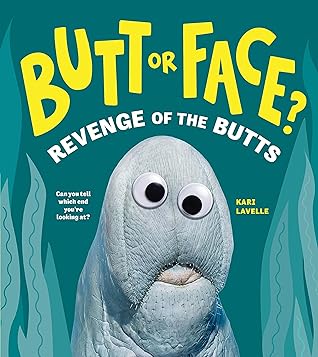
Butt or Face? Volume 2, by Kari Lavelle****

This engaging little science book for early readers is a gem. My thanks go to Net Galley and Sourcebooks Landmark for the review copy. This book will be available to the public April 2, 2024.

The title is the content in a nutshell. One page has a large, sometimes whole page photograph, but we don’t know what animal it belongs to, or what end we’re looking at. These are cleverly chosen and stumped me about half the time. When I set it down, my spouse picked it up, began leafing through it, and I heard him say, “What? You’re kidding!”

There is no real story here. You open the book, and you leap right in. Picture, then the solution, right down the line. Whereas I like a bit of scaffolding and accompanying narrative myself, I also know that there are children that will prefer this book exactly the way that it’s written. Children in early elementary school that are in the stage of development in which they find potty jokes gut-bustingly funny will absolutely adore it.

I was previously unfamiliar with Lavelle’s work, and hadn’t seen the first in the series, but after perusing this one, I knew my grandsons had to have it, and since this one won’t be out till spring, I bought the first volume of Butt or Face for the second grader’s Christmas gift. That’s a strong endorsement.

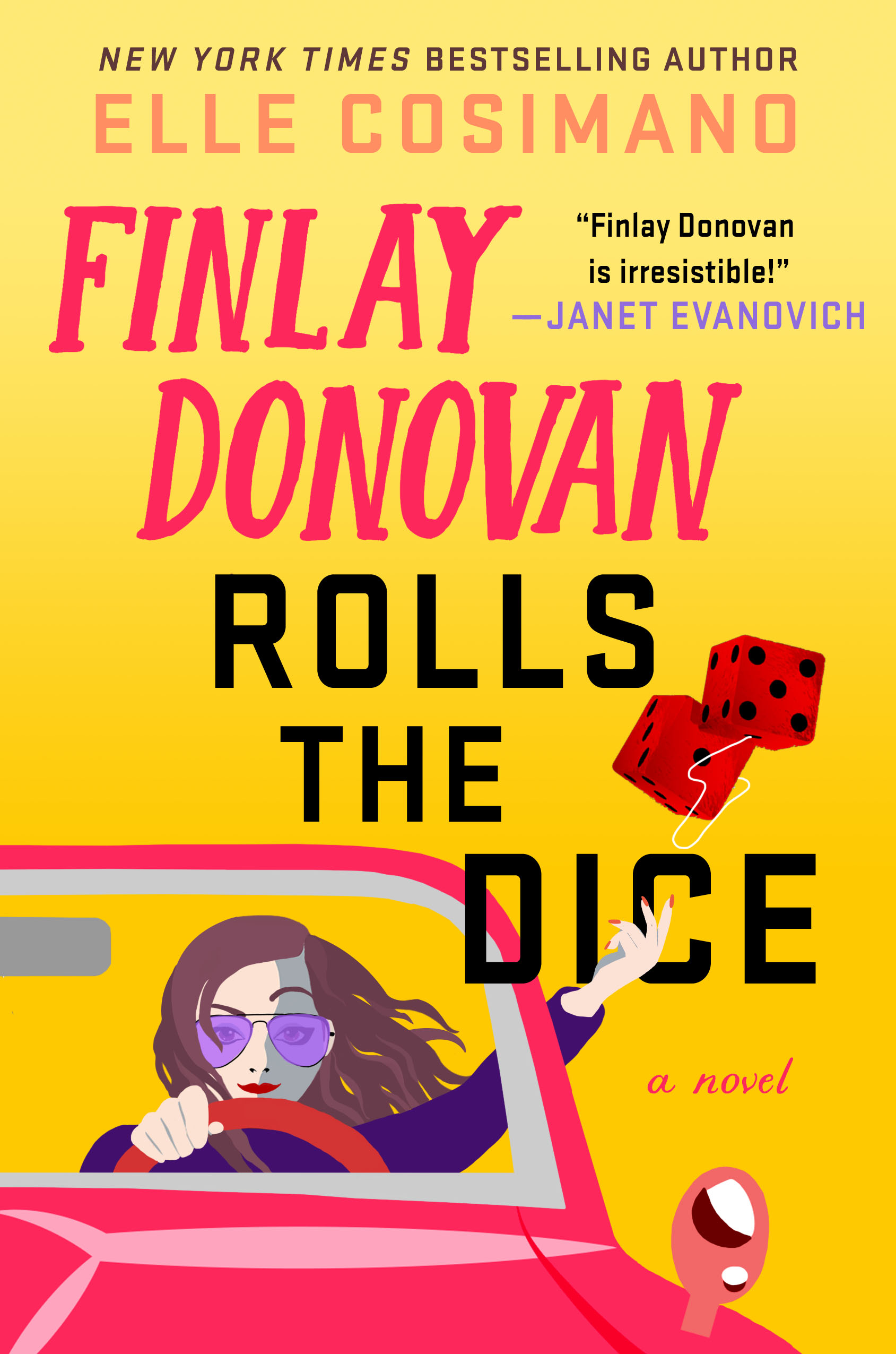
Finlay Donovan Rolls the Dice, by Elle Cosimano*****

“I’m telling you, Finlay, this book is good. This whole SERIES is good. The plots may be a little far-fetched, but these characters are so real! It’s like they just jump off the page!

Finlay Donovan Rolls the Dice is the fourth in the raucously entertaining series by Elle Cosimano. My thanks go to the Minotaur and St. Martin’s Press Influencer Program and NetGalley for the review copy. It will be available to the public Tuesday, March 5, 2024.

At the end of the previous book, Javi, Finn’s nanny Vero’s boyfriend, was abducted by mobsters that wanted to collect a gambling debt incurred by Vero. In this one, the two women plan to travel to Atlantic City to rescue him, with the cover story of needing time to unwind. However, things snowball, and before you know it, almost all the people they hold dear—and a few people that they don’t—are headed there, too. What follows is a riotous adventure with a lot of moving pieces. I love it.

More than any other, this installment has been controversial among reviewers. In the series debut, Finlay is an innocent, entirely law abiding single mother strapped with bills, work, and child care issues. She’s in the midst of a contentious divorce and her soon-to-be ex is an attorney, which makes Finlay’s efforts an uphill battle. She’s easy to relate to, and when, through no fault of her own, she finds herself with a corpse in her car, it seems entirely believable.

With the second and third books in the series, Finn, accompanied by the more street smart Vero, find themselves in deeper trouble. Just as they mop up one mess, another arises, until there’s a sort of house-that-Jack-built tower of problems that see both women in increasingly tenuous circumstances. They break the law once as a life or death matter, but then cannot safely come clean, so they do their best to put it behind them, but someone or something comes along to threaten the modest safety and security they’ve begun to enjoy. Bodies and crimes pile up, and now, with the fourth installment, the author can’t reasonably convince the reader that whatever happens next is purely an oopsie. Instead, she has to draw on other possibilities. Personally, I like it.

Finn and Vero are chasing down the underworld figures that they believe have abducted Javi, and there’s considerable risk involved. A couple of times I literally draw in my breath at the risks they take. Add to this the need to fabricate excuses to tell the myriad members of the retinue that have descended on Atlantic City with them, and it’s an ambitious undertaking.

In this circumstance, I no longer require realism. The whole thing takes on the flavor of a comic caper, what with the clown car full of women, including Finn’s mother; Finn’s ex-husband, who is in charge of the children; and various others (I am being deliberately vague here) that descend on them once they arrive. To put it another way, if Stephanie Plum and John Dortmunder—or if you prefer, Bernie Rhodenbarr—had a baby, she might be Finlay Donovan.  

If you need a good laugh, this book is for you; however, with this series, you really should begin with the first in the series, Finlay Donovan is Killing It. With just four in the series (and the audio is outstanding, too,) this will be a quick and hilarious adventure. What are you waiting for? Jump on in.

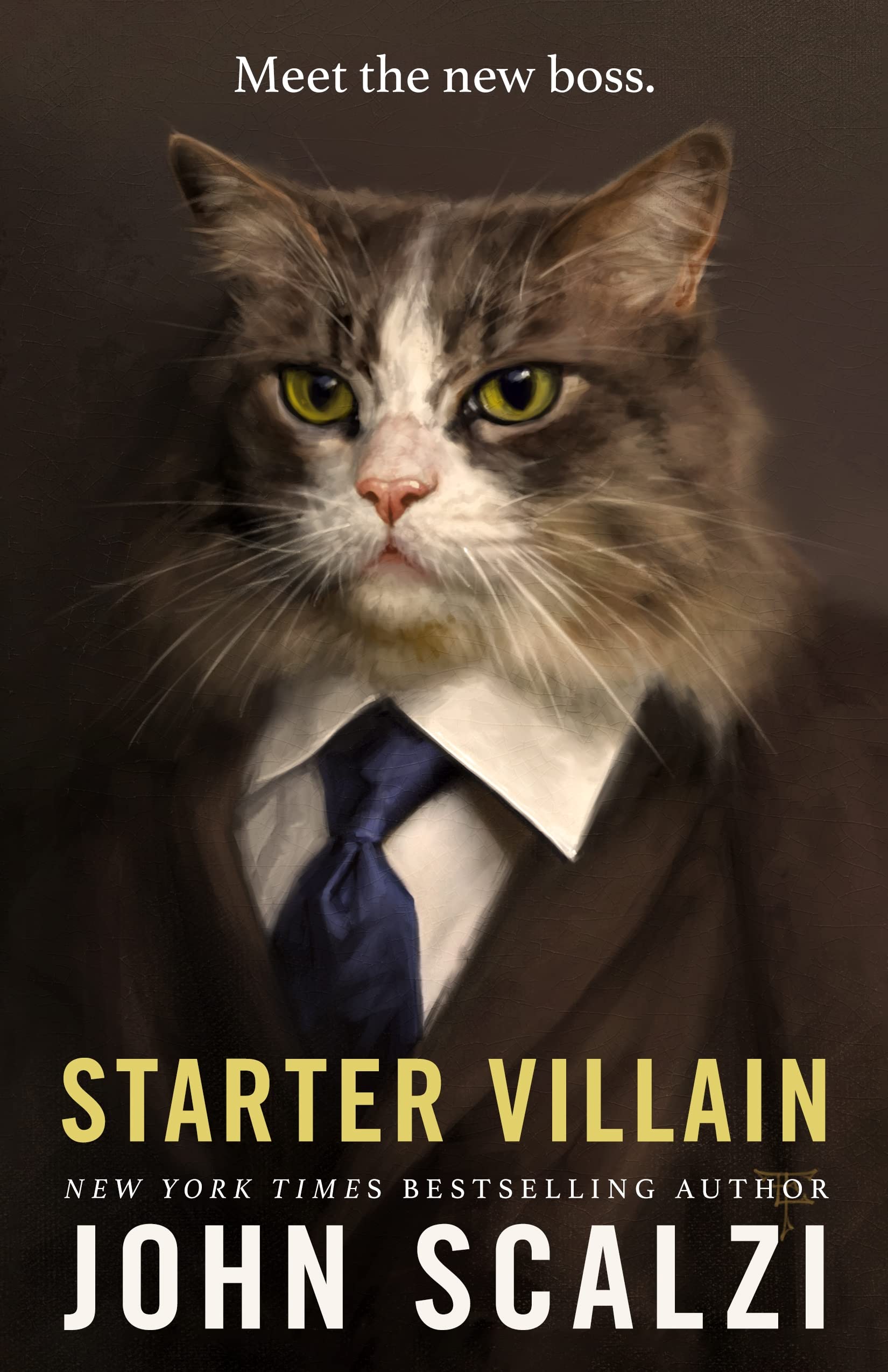
Starter Villain, by John Scalzi****

I’m not going to write a full review for this one; my spouse got it for me for Christmas, so I don’t owe anyone anything. I will tell you, though, that it’s just what I needed, funny, warm, and of course, not even close to realistic. After all, it’s fantasy. The level of unreality is well crafted and consistent within the narrative, and it’s hugely inventive. This is my first John Scalzi novel, and I will read him again in a heartbeat.

North Woods, by Daniel Mason*****

By now the word is out about this genre-bending novel. North Woods, by Daniel Mason, is nothing short of brilliant. My thanks go to NetGalley and Random House for the invitation to read and review; this book is available to the public now.

This book is all about the setting; there are some terrific characters, but don’t get too attached to any of them, because for the most part, they come and then leave. Rather, our story is about a cabin in the woods of upstate New York, and the acreage surrounding it, and how its use changes over the years.

We commence before the American Revolution, and so in the beginning, the narrative has the style of a very old diary, with antiquated spelling and language. This section is the reason I am so dreadfully late reading and reviewing this book. Honestly, the first fifteen percent or so is as dull as watching paint dry. I would begin reading it, but then my eyes would glaze over and I knew I had some other things to read by authors I knew and loved, and so I would switch books. But my Goodreads friends were raving about this book in unusually large numbers. Nobody didn’t like it. And so I summoned my self-discipline and went to it in a determined fashion, fortified by the audio version, which I received from Seattle Bibliocommons. This was very helpful. And once I got past that dry beginning, I began to understand why other readers were raving about it.

The first characters that are noteworthy are twin daughters named Alice and Mary, who are left to run the apple orchards on their own when their father goes off to war. He is a Loyalist, determined to save New England for his king. He doesn’t survive the war, which is just as well, because the locals hate him; he chose the wrong side to fight for. Neither daughter marries, and the property eventually goes to someone else.

The chain of owners is varied and, in many regards, absolutely hilarious. We see one new owner after another explore the house and the grounds, and of course, none of them has a full picture of the previous owner. I love the fact that I know more about this place than its most recent purchaser, and the assumptions that they make range from the merely incorrect to the disastrous. I cannot say too much more, although I particularly enjoy the character of George, whose phlegmatic, unattractive qualities are rendered uproarious in the audio version, and also the medium, a complete charlatan who’s horrified when she inadvertently awakens some actual supernatural beings. I would love to say more, but that would ruin it for you, and that would be a crime because surprise is an important part of the book’s success.

There is a formidable cast of actors that take on the reading for the audio book, and for those readers that are on the fence between audio and print, I recommend the audio version; better still, use both together.

After reading this one clever, memorable book, I will be watching to see what Daniel Mason writes next, because whatever it is, you know it will be good.

Highly recommended to those that enjoy historical fiction, literary fiction, humor, and horror.