The Sleeper, by Robert Janes***

thesleeperThe Sleeper is an espionage thriller set just before Britain enters World War II. David Ashby is living in Germany with his family, but international tensions become so compelling that a British citizen is unable to live there safely anymore. Splitting from his German wife, he grabs their seven year old daughter and goes back to the UK with her. The German government is determined to retrieve the child, and the struggle over little Karen is the basis of the story. Thank you to Net Galley and Open Road Integrated Media for the DRC, which I received in exchange for an honest review.

This one is tough to review, because it has so much going for it, and yet other aspects hold it back. Foremost among the latter is the premise; would Hitler really send this much firepower after one kid locked in a domestic dispute? Youth were a big part of his recruitment campaign, yet it’s hard to conceive of all this time, money, and attention being lavished on the retrieval of one solitary child—and at that, a girl, who by Nazi definition is bound for motherhood, church, and her kitchen. But once we just leap in and let ourselves believe either that this could be true, or that there may be a secondary reason as yet to be revealed to us for Hitler’s diligence, it’s an enjoyable read.

Janes is painstaking in his attention to historical detail. The culture, the more formal reference to others, with the salutation of Miss, Mrs., or Mr. (or their equivalents in other languages) rather than the common use of first names used in Western nations today resonates, along with technology and a host of other historical minutiae. His attention to all aspects of setting is equally outstanding. He weaves a complex, hyper-literate plot that at times is compelling, but the story would be better served if he were to streamline it a little, because there are a lot of side details that lend nothing to the story. For example, whether Ashby has a gay relationship has no bearing on the main story or its outcome. In fact, there is way too much of who is sleeping with whom; I can see why his ex-wife would be motivated partially by jealousy, but the reader is treated to the romantic or sexual inclinations of just about every woman in the village, and it’s distracting rather than useful, and it gets in the way of stronger character development. I also found many of the transitions ragged, sometimes startling, but this may very well only be true of the galley; sometimes the DRC doesn’t include little dividing marks that will be in the final copy to cue the reader of a change of scene; thus I didn’t include this issue in my rating.

About halfway through , the style of writing changes, becomes less fluent and takes on some odd quirks that made me flip to the author page to see whether the writer was perhaps not a native English speaker and the book translated from another tongue. However, since he credits two others with helping him with the brief bits of dialogue in German and French, that doesn’t seem likely. There is one particularly distracting feature of the grammar that I tried to ignore, but after awhile found myself highlighting its frequency to see whether it was really occurring as often as I believed. The specifics of this I will send to the publisher, in the hope that perhaps it can be mitigated by the time it comes out. With this distraction removed, the book would be 3.5 stars, maybe even 4.

The climactic scene in the mine tunnels is absolutely riveting, and the stilted language and grammatical quirks that occur roughly from the 50% to 80% portions are nowhere to be found during this critical part of the book. It is largely Janes’s outstanding word-smithery with regard to setting that makes the climax so palpable and taut.

Should you invest in this novel? I guess that depends on your fondness for WWII fiction, and how deep your pockets are. There are other novels in the same vein that I recommend more highly, but it’s such a large field, and you could certainly do worse.

This title becomes available for purchase December 15, 2015.

An Undisturbed Peace: A Novel, by Mary Glickman**

anundisturbedpeaceThe blurb for this novel reads, “A Jewish immigrant, a Cherokee woman, and a black slave find love, friendship, and redemption in the midst of the tragedy of the Trail of Tears”. I thought it sounded interesting, and it might have been, but really, not so much. Just as a truly great writer can take the dullest of topics and make it shiny and fascinating, so may an interesting concept leave the reader squirming and thinking of other things she might want to do or read, if the narrative doesn’t flow well. And although I usually have tremendous sympathy for writers, since I write a little now and then, I just couldn’t find any redemptive quality in Glickman’s novel. It feels as if someone has gone to a lot trouble to research the topic, and the whole story is going to be strung together around that research, come what may. In other words, instead of assisting the writer with the story, the story appears to be there as a forum to present research. And so thank you, just the same Net Galley, and thank you also, Open Road Integrated Media, but I can’t recommend this book to anyone. And if I felt this way after slogging through a galley I received free of charge, how might I have felt if I had paid for it?

The story starts out with sex, which rather startled me, and it didn’t seem to fit the rest of the story in overall tone, but hey, they say sex sells, so maybe the editors wanted her to open the story with sex. Fine, fine. I got through the first chapter and set the book aside so I could start fresh once my irritation had ebbed.

But the start of the story is only the start of the book’s problems. The figurative language is often trite—“buxom beauties”, and a Cherokee whose face is—what else?—“chiseled”. Description should drive the story forward, but it doesn’t happen here. There are huge stretches of nothing but narrative, and then impossibly long monologues in other places. There is an occasional interesting description of setting, but it comes undone as soon as we go back, as we must, to characters and plot.

It’s kind of a mess.

I found myself wondering whether the author might not find greater success in writing narrative nonfiction, where she could focus on her information, but spin it out in the format of a story, but I just didn’t see anything here that showed promise.

Could be this will be the next National Book or Pulitzer winner and I will have been the one that said the book was hopeless; stranger things have happened. But I have to call them as I see them, and although no doubt a lot of worthwhile research has been conducted, the story itself fails to flow. It feels cobbled together, forced, and contrived. If I felt a little editing here and there would be useful, I’d say so, but it’s pretty much the same from start to merciful end.

Not this time.

The Invention of Wings, by Sue Monk Kidd*****

theinventionofwingsTwo of today’s hottest political topics have to do with equality. As we follow and sometimes participate in the Black Lives Matter movement, along with the fight to keep Planned Parenthood funded and maintain a woman’s right to own her body and say what happens to it, this elegantly crafted work of historical fiction could not, strangely enough, be more timely. The Invention of Wings is a fictional biography of Sarah and Angelina Grimke, abolitionists and feminists, the first to make screaming headlines by speaking out publicly decades before women would see the right to vote, and decades before the first shots of the American Civil War were fired. As is essential in dealing with the rights of then-enslaved African-Americans in the south, Kidd adds an additional character, a slave named Hetty, written alternately with the Sarah’s story. I say it is essential to do so; this is because it is wrong to write about the marginalization and subjugation of an entire people, and then not include a representative of that group into the plot. As usual, Kidd doesn’t disappoint.

Much as I love historical fiction, one thing that makes me a little crazy is wondering where the research ends and fiction commences. In her afterword, the author lets us know specifically what is true and what isn’t. She even gives us a brief bibliography to pursue if we feel moved to do so; the only other historical fiction writer I know of that does this is Laurence Yep, my hands-down favorite YA author. Thus, Kidd places herself in outstanding company.

The Grimke sisters were born into the elite planter class, a tiny minority among Caucasians in the South, and in the very belly of the beast: Charleston, South Carolina. Partially because of the tremendous brutality meted out to the plantation’s slaves right before her tiny eyes there at home, Sarah Grimke grew up opposed to slavery. As a much older sister, she had a formative role helping her mother raise Angelina, who also became a fierce, uncompromising abolitionist.

It is one thing to take up a cause that is small but in which one has a support base. For the Grimkes, there was nothing. Eventually both had to move north for their own safety. And although, as a history major and a feminist of the 1970’s I had read about the Grimke sisters many times, it is within the well-crafted, deeply thoughtful, well researched pages of this novel that they first came to life for me.

Hetty, the slave depicted within these pages, actually existed, but the story Kidd writes for her is entirely fictional. The real Hetty died before Sarah was grown. Still, her character felt as real to me, and was easily as well developed as either of the Grimke sisters. Hetty is not passive, not waiting to be “set” free. She understands that the only freedom she is likely to receive will be what she can do for herself. A nice touch Kidd adds is in making Hetty one of the children of Denmark Vesey, the free African-American that attempted to organize and lead a slave revolt.

Everything here is carefully constructed and absorbing. Kidd has long demonstrated formidable talent in constructing well developed characters and vivid settings; the difference here (as opposed to The Secret Life of Bees and The Mermaid’s Chair, the two others of hers I have read) is the research involved. As with everything else, she blends fact and detail into a well spun tale.

I should add here that the literacy level required to deal with this text is higher than most. Don’t toss it out there for your average middle schooler to read, because it will prove too difficult. Because of the way she builds her story, brick by brick, the pace doesn’t really pick up until about halfway into the book. This isn’t a rip-roaring page turner; it’s a series of quiet nights by the fire, or curled up on your favorite window seat, or by the side of your bed. Give it the time it deserves.
Though I got my copy from the Seattle Public Library, I consider this title worth the cover price. Highly recommended.

The Longest Night: A Novel, by Andria Williams***-****

thelongestnightanovelIn her debut novel, Andria Williams gives a fictionalized account of a meltdown that occurred (in real life also) in Idaho Falls, Idaho. The narrative is intimate, the characters palpable; all told, this was a strong read. Many thanks go to Random House and Net Galley for this galley, which I was given free of charge in exchange for an honest review; I rate this novel 3.5 and round it up. The book becomes available for purchase January 12, 2016. You’ll see this post again sometime nearer publication.

Those of us that lived through the 1960’s will recognize how authentically Williams renders even the smallest details in setting, both the physical and social, of the Unites States during that time period. Home, clothing, and point of view are rendered expertly. This writer personally loved the depiction of a blend of meat, starch, and dairy with some canned fruit tossed in as a “balanced meal”. Yes, yes, and yes. Even more, I love the moment when our protagonist, Nat, tells her children, “A little sugar will perk you right up.”

I swear to you…this is what it was like!

Add to the extremely narrowly defined social mores of Caucasian Americans living in middle income homes during this time, the even more rigid expectations of military wives at that time, and a woman could nearly suffocate. And people grew up much faster back then; in one’s mid-twenties, it was usual to be not only out of the house and married, but to have a couple of kids, maybe not to even live near any family.

So when Nat’s husband, Paul, is transferred from sunny San Diego to Idaho Falls, Nat knows she and the girls will just have to make the best of it. She puts on her cheerful-helper smile and launches herself wholeheartedly into this new, stark environment. And Paul will be working at the Idaho Falls nuclear research facility. Note that this was not a place that generated power for anyone or anything; further, it was outdated. And we experience a definite chill when Paul sees things that are dangerous and should be reported, and he is cautioned not to make waves.

A particularly attractive character (from a literary standpoint) is Paul’s boss’s wife, Jeannie, a complex, fascinating character who would have had a lively career of her own had she been born in another time. At one point she loses it with her husband:

“Oh, how I wish I had your job,” Jeannie sneered. “I would be so much better at it than you.” And you know she would have been, too. Not any nicer, but definitely more proficient.

There are so many other fascinating details here, but I can’t spoil the surprises. A small but frustrating discrepancy toward the story’s end left me a bit confused at an otherwise exciting time in the story, and that is where half a star fell off my rating.

But don’t let it stop you from reading this gem. This will be an author to watch in future years!

The Eight, by Katherine Neville****

theeight Katherine Neville is one of those people that does everything well. She’s been a model, a computer wiz, a photographer, and she’s also an impressive author. I was lucky enough to read this first in the series since Open Road Integrated Media has just re- published it digitally. Thank you to them, and to Net Galley, for permitting me a free copy in exchange for my review. This book was released Tuesday, and is for sale now.

Our protagonist, Cat Velis, lives in New York; the time is 1970, at the height of the Vietnam War. Cat lives in New York City and works for Con Edison. Since she has refused to do something illegal for her boss, who is engaged in some sidelines back-scratching with a client, she is being shipped off to Algeria. Before she can pack, however, a fortune teller warns her that she is in great danger. She scoffs, but less than a week and two corpses later, her irritation has turned to fear. She calls in her mentor, a mysterious man that seems to travel Gandalf-like, practically appearing in thin air. He comes and talks to her in much the same way as the fortune teller did, but he also tells her that she has to go to Algeria and fulfill her destiny.

Transposed with this story is a tale that takes place around the time of the French Revolution. The Montglane Abbey is closing its doors because of the Bill of Seizure. Buried beneath its floor for centuries was a legendary chess set whose worth is beyond anyone’s wildest dreams. Composed of huge gems, gold, and silver, it is all the more valuable for a formula that its individual parts, when put together, have etched on their undersides. Is it a secret weapon? Is it a supernatural curse that is activated when the pieces are together? The Abbess only knows that she must separate the pieces and get them out of France, along with herself. She takes herself to Russia, to her closest friend, who is Catherine the Great. From there, the parallel story to Cat’s unfurls itself. Eventually the two part of the story come together.

Here’s a clip of the author discussing her novel, and the life experiences that shaped it:

This is ordinarily not the sort of historical fiction that attracts me; there are really well-developed, highly sympathetic royal characters, and then there are the savage, dirty masses. It grates. While it’s true that the French working class and peasantry really did tear royals from their splendid carriages and either kill them on the spot or take them off to the Jacobins to be killed later, Neville paints the royals in such an idealized fashion that the reader, if not already informed, might wonder indeed just why the masses would do such a thing? Unless, of course, it’s in their inferior DNA. I ground my teeth and read on.

Add a reference to the Freemasons and the number 666, and I was ready to hurl my kindle across the room! But I had an obligation to the publisher, and so I persevered, and I am glad I did, because what Neville does with the plot is quite cunning. If one were going to chart the book into a grid, it would correlate with the grid that is part of the story itself. And if this makes no sense whatsoever to you, all I can tell you is that you have to read the book and watch closely. Watch for the patterns; this is actually slick as hell! And so in the end, I was glad I had seen it through. Though maybe more famous people are worked into one novel than is natural, the elegance of the plot itself (and the chess detail), rather than historical veracity or character development, is what sustains this substantial work.

The reader’s understanding of this hyper-literate story will be aided by knowledge of chess. In fact, I found myself taking a few notes, though I haven’t played in years! Those unschooled in chess can also enjoy the book, but I do not recommend this book to anyone for whom English is not the mother tongue. The vocabulary and historical references will be so much work for you that you won’t enjoy it.

But I did.

Recommended to those that appreciate symmetry and precision in a novel.

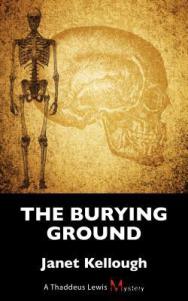
The Burying Ground, by Janet Kellough ****

This book will be released in a couple of weeks, and I can tell you, it’s already gotten some really good reviews. Since I read and reviewed it clear back in January, I’m reblogging it today.

seattlebookmama's avatarSeattle Book Mama

theburyinggroundThis is the fourth book in Kellough’s Thaddeus Lewis series, but it was brand new to me, and I was able to follow the story quite well as a stand-alone. My thanks go to Net Galley and Dundurn Group for the DRC. This book comes out in early August, and I will run my review a second time on my blog then to remind readers that it’s available.

Kellough has merged two enjoyable genres, mystery or detective fiction and historical fiction, and added a splash of social justice–the sort that slides into the story neatly and without preaching. Lots of different story threads eventually braid together elegantly into an ending that satisfies deeply.

The settings are Montreal close to the time of the Industrial Revolution, and outside of Montreal in a village called Yorke. Our protagonists are Thaddeus Lewis, a Methodist Episcopal preacher who travels the circuit, and his son…

View original post 219 more words

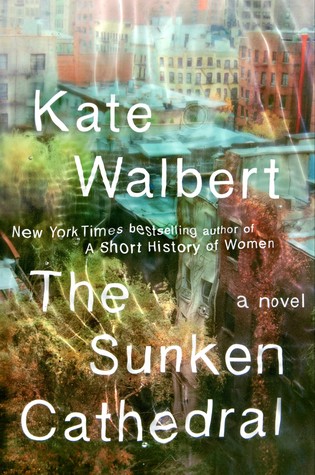
The Sunken Cathedral, by Kate Walbert ***

thesunkencathedralMy three stars here are a compromise. Try as I did, I could not enjoy this novel, but it is marketed more toward New Yorkers than others, and although I like a good urban setting and have enjoyed New York, have friends and family from there, I don’t live there and never have. Also, the plot is oriented toward the art world—Marie and Simone are senior citizens studying art, and there are a lot of references to art that went right past me. So if you are a New Yorker interested in both the history of Manhattan and art history, then this might be your book. And thank you once more to Net Galley and Scribner for permitting me to access a galley in advance for the purposes of review.

Some writers have a taut, urgent writing style that leaves their readers perched, sometimes literally, on the edges of their seats. Some have a sumptuous, painterly style that takes its time, and one should sink back into a soft place by the fire or in summer, perhaps on the beach, and prepare to drink it all in. Walbert uses the latter style, and I wanted to sink back, wanted to drink it all in, but for me, the description was the whole thing. I found myself bogged down with description that did not appear to serve much plot, and it never felt as if it was moving forward. There was a lot of inner dialogue, remembrance, but so very little actually seemed to happen. I have never found myself dissatisfied for this particular reason, and so I thought surely it must be me. I went back and started it over three times, and in the end, I came away frustrated. The over-long footnotes (in fiction?) were a distraction, and the style, in the end, felt pretentious.

But then again, remember that I know almost nothing about art. I know of a couple dozen famous paintings, and I thought I would like this story because I loved The Goldfinch, whose most critical scene is set in an art museum. And maybe that was my own problem as well: trying to follow a Pulitzer winner like The Goldfinch is indeed a heavy burden. I came away from reading that book and Toni Morrison, so perhaps my expectations were a trifle high. But I can’t honestly say I liked this book.

If you are a New Yorker, especially an older one, and if you lean toward the art world, you may enjoy this novel, by an award-winning writer. It has just been released, so if you would like to order it, you can do that now.

Wings in the Dark, by Michael Murphy ***-****

wingsinthedarkMichael Murphy’s Jake and Laura series is both engaging and interesting, the best blend of historical fiction and detective fiction I’ve seen in a long time. Until I got halfway through, it was headed for the land of five stars, and I am not sure how objectively I’ve been able to review it since that point. But I went with my gut, and ultimately, when it comes to fiction, that’s what every reader uses to judge a book. Thank you to Random House, Net Galley, and the author for permitting me a sneak peek; this title will be available to the public August 31.

Jake Donovan, our intrepid detective-turned-novelist, is working on his latest Blackie Doyle novel, but he takes a break from work to honeymoon with his bride, the famous actress Laura Wilson. He has sworn off detective work at her insistence, and has decided he likes being a novelist better, anyway. Fate intervenes, however, when Laura’s good friend, Amelia Earhart, finds a man dead near her plane.

It’s shaping up to be a really great story. At this point, I am noticing the level of historical detail, and thinking of this as potentially great classroom material. A number of public schools teach language arts and history in a block simply titled “Literacy”, and since so many young folks have reading skills that aren’t up to snuff, sometimes the best way to teach history is by partnering it with historical fiction. The book is clean enough that no one is going to race to the nearest school board meeting to complain; no explicit sex. The possibility is exciting, for teenagers and perhaps also for the author and publisher. There are some wonderful, positive depictions of women, who were active in non-traditional roles during this time period. What a great book for teens as well as adults!

It was then that I ran into the “J” word. Here, once I got past the slapped-out-of-nowhere feeling that racist terms generally evoke, I asked myself whether the historical circumstances of the novel merited the inclusion of this term in place of the correct term, “Japanese”. I also reminded myself that the rest of the book might be free of the term, and I could just push past it, as sometimes one must, and return to an appreciation of the story’s period flavor and nicely woven plot.

The problem here is that the word kept popping up in nonessential places, as if it were a bit of window dressing, and it was accompanied by some rather nasty language about that group. And again, it was a word used commonly during the time period by Caucasians and some others. For that matter, so was a lot of racially and ethnically derogatory language; even in the early 1960’s, I can recall hearing casual conversations peppered with anti-Black, anti-Jew, anti-Italian terms when nobody was angry; it was just the way some white folks talked without even thinking. But most writers today would not choose to evoke that part of history in their writing. The harm outweighs the usefulness. In Wings in the Dark, the only place that it might have been contextually useful is when General Patton enters and leaves again, spewing his trademark xenophobic profanity behind him. But neither Patton nor his profanity is really key to the story line, either.

I think about what I like to read; here on the west coast of the USA, most cities have a fairly hefty number of Asians and Pacific Islanders, and this was true of the district in which I taught history and literature until my recent retirement. I could never put this in their hands. What a terrible thing to do to them. And it’s a shame, because they would have enjoyed reading about Amelia Earhart. In fact, there is a magnet school dedicated to aviation and partnered with Boeing. Less the anti-Japanese slurs, they might have made great use of this book; with it, I could see students looking down and away; I could see parents coming to school or to board meetings looking for an explanation.

Apart from the term—which hit me harder than it will most Caucasian readers—this is a strong piece of fiction. The pacing, dialogue, and character development are all strong. There are red herrings that I nibbled on and was fooled by, and the ending is about right; at least I think it is. Again, I struggled with objectivity. But I think without the four places that hit my ouch-button, I would have enjoyed the second half of this novel as thoroughly as I enjoyed the first half.

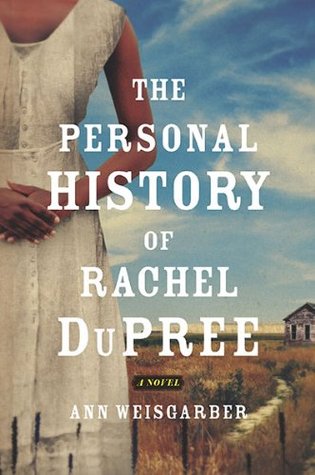
The Personal History of Rachel Dupree, by Ann Weisberger *****

thepersonalhistoryofracheldupreeRachel has married up. She used to be a hired girl working in the kitchen at Mrs. Dupree’s boarding house. Mrs. Dupree was forced into taking in boarders when  she was widowed, but she has done quite nicely for herself. She is among the cream of Chicago’s Negro community, and the women she entertains are light-skinned and at least four generations removed from slavery. Imagine her tremendous dismay when her only son, Isaac, comes home from fighting the Indian wars and announces that he is moving out to the Western territories to stake a claim and become a common farmer. “Rancher,” he reminds her. And if he marries a single woman who has also staked a claim, he will have twice as much land once they marry.

And so he stakes a claim on Rachel’s behalf, and she gets her heart’s desire: she gets to marry that handsome young officer. She becomes Rachel Dupree.

Roll the film forward about 14 years. Rachel is pregnant with her eighth child. The Badlands, “a country so backward and harsh that even Indians didn’t want it”, has had no rain for a long, long time. To get a little water, they have to tie one of their children to a plank and lower her on a rope to the bottom of the well. Liz doesn’t want to do it anymore. She has nightmares. There’s a snake down there, she says.

But their tongues are thick from lack of water. There is grit between their teeth. And they will lose the horses and their only milk cow if they don’t water them.

So at bedtime, Rachel tells her five surviving children to take just one sip of the water Liz brings up.

Are you spellbound, or are you horrified? I confess I was both. I live in the land of water. In Seattle there is moss growing on everyone’s front steps or porch, and if we aren’t careful, it will grow on our fences and our homes! Most of us don’t bother with umbrellas. We’re used to the fine mist that generally falls during the day. Most of the good hard rain falls at night, and it lulls us to sleep better than a lullaby. And yet, we send the kids to school carrying a water bottle anyway, because hydration is so important.

“Only a sip.”

I’m not the only one that doesn’t care for that. Rachel has about had enough of it, too. For one thing, there are no Negro families anywhere nearby. Isaac had told her that plenty of the men with whom he’d been enlisted had filed for homestead claims, but any that may have been nearby have gone on home. They can’t take it here. And actually? The white folk can’t stand it either. Every time someone goes home, Isaac buys their land. Every time there is a spare dollar, it does not go for a coat for the child who’s outgrowing hers; not even for fabric for Rachel to sew some new clothes. Rachel herself has a patched dress and a pair of work boots. What a contrast she makes from the finery she wore on her wedding day! And she is worried about their eldest daughter, Mary, who will be the right age to start dating soon.

The final straw is broken when Isaac buys out yet another departing neighbor–Rachel’s closest friend, too, as luck would have it–and there is no money at all. There is no money for winter provisions, even, and the kitchen garden died when the rain didn’t come. There is nothing, nothing, nothing. And his game plan is to work the gold mine in Lead, South Dakota, which is far enough away that he will be gone all winter, and she and the children will be left with a brand new baby and thousands of miles to ranch unassisted. And no food.

But hey, he believes in her. He’ll go hunting, maybe bag a bear together with his son, and between that and Rachel’s amazing know-how and steely determination, everything will turn out fine!

Not so much.

A strong subplot involves the local American Indian population. Homesteaders who are hungry, thirsty, and have almost nothing but the land on which they live and try to ranch are sometimes resentful of the “reservation Indians”, who have been stripped of their dignity and culture in exchange for free food, rent, and clothing (“free” being a relative term, of course). Isaac was one of the soldiers that subjugated those same Indians; when Rachel is alone on the ranch for days on end and Mrs. Fills the Pipe and her children pass by, Rachel craves company so desperately that she invites them to rest on her porch. She makes the very dead last of her chokeberry tea and serves it to Mrs. Fills the Pipe and her daughter.

“Our water?” said Liz. “You’re giving them our water?”

Liz had a point there; she was the one went down the well to get it. And yet, the good turn, though it upsets Isaac when he hears of it later, is not misplaced, and does not go unrewarded. And eventually Rachel thinks back to the things her hero, Ida B. Wells-Barnett, said in the Negro press (I use the term as the writer does, for historical purposes), she does not regret the gesture, except for the fact that she served them on the front porch when she should have invited them into her precious parlor.

I didn’t read this book as a galley, I got it at the local library. A galley led me to Weisberger, though. I read The Promise a year or two ago and decided that this writer was going on my to-read list. This makes two winners out of the two I have read. And on top of it all, Weisberger is a Caucasian writer (or appears to be; at any rate, she isn’t Black.) This is only the second writer I have encountered that could write a first-person fictional narrative in which she provides the voice of a Black woman, and does it creditably and with great dignity. I bow in awe.

And although I was already sold on the book and its author, the mention of Lead, South Dakota, nearly made me jump out of my skin. That is the tiny town where my late father was born, and its mine (gold but also iron ore) is where my late grandfather contracted the black lung disease that would eventually kill him. For those interested, it is pronounced “leed”. Maybe it’s too embarrassing to admit your home town is named after the mineral it produces, or maybe it’s a positive connotation, like leadership. My only visit there took place when I was a pre-schooler, and I have very few memories of it, all of them related to family rather than place.

Forgive the digression. All told, this is really strong historical fiction. If you want to read something a little different from most of the stuff that’s for sale; if you like stories of the homesteading movement; or if you want a story that features African-Americans in a positive light, this is your book. If you just want a great book to curl up with at night while the spring rains pass, this is your book too.

In short, highly recommended.

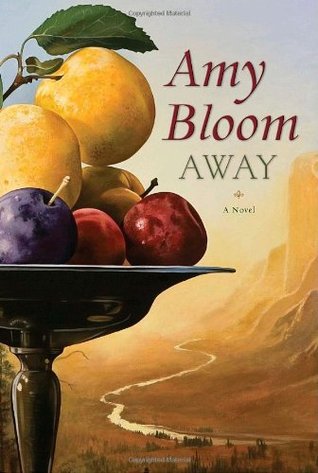
Away, by Amy Bloom *****

away Lillian escapes a pogrom after seeing her husband and parents viciously murdered and her little girl has disappeared. She was told by a neighbor that her daughter had drowned in the river, and so she allowed herself to be herded onto a ship bound for New York.

“In the fifty-seven blocks of the Lower East Side, just that day in July 1924, there are a hundred and twelve candy shops, ninety-three butchers, seventy saloons, forty-three bakeries, and five hundred thousand Jews.”

Away, strong historical fiction by Amy Bloom, is in turns poignant, fascinating, wry, and wrenching. It’s a great book, but it won’t lift your flagging spirits. However, a couple of amusing moments had a Keillor-like tug to them, and they kept the tone light enough to engage me.

Things aren’t going all that well for Lillian, and maybe that is why, when a cousin arrives from the old country and tells her that her little girl is alive, Lillian makes plans to go get her. Nobody will give her boat fare, but a dear friend hatches an alternate plan: she can head west across North America, go north into Canada, and then island hop her way across the Bering Strait. It’s a terrible idea, but if it will bring Sophie back into Lillian’s waiting arms, she’ll do it. And so she’s off.

Bloom is strongest when she is building characters and describing setting. By the time the book is over and done, Lillian is so real that even though I have half a dozen books I am also reading, I think of her fondly from time to time as one might when a good friend or much-loved relative that has been to visit and then gone home again.

That said, I didn’t like it as well as her most recent work, Lucky Us, reviewed earlier and available in my archives. But that is faint condemnation, because the latter was one of the best works of fiction I have ever read.

If you like well written three-hanky stories and excellent historical fiction, you can’t go wrong with Bloom. If your pockets aren’t deep enough for impulsive book buying, check your public library; it’s where I found my copy.