
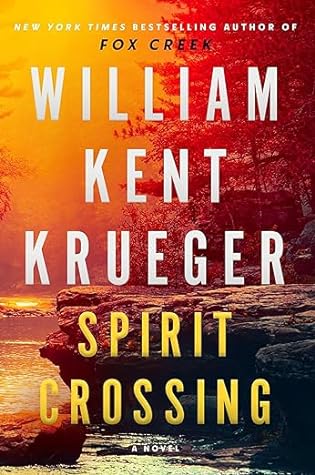
Spirit Crossing is the spellbinding new novel in the Cork O’Connor series by William Kent Krueger. The book starts with two missing women, and an accidental discovery of a fresh grave. Readers faithful to the series will recognize the characters; there are enough of them, mostly related to one another, to provide depth and interest, without confusing the reader or making the plot too complex.
Lucky me, I read it free and early. My thanks go to NetGalley and Atria books for the invitation to read and review. This book is for sale now.
The story begins innocently enough, with the series protagonist, Cork, out berry picking with his son, son-in-law, and grandson, who is known by the Ojibwe nickname Waaboo. While searching for blueberries, they come across a fresh grave. Waaboo sees the victim standing before him, as if she is still alive, and he’s distraught because she is so unhappy. Waaboo is not the first one in his family to have this ability; nobody doubts that he sees what he says he sees. And so the men immediately wonder whether this is the grave of Olivia Hamilton, daughter of a wealthy Anglo, who’s been reported missing with massive headlines everywhere; or that of Crystal Two Knives, a missing Native girl whose name barely elicits more than a yawn from law enforcement.
And so right away, we are looking at not only the characters, but the longtime issue of missing Native girls and women, and the way that law enforcement neglects their cases for those whose families have money and connections.
One of the things I admire most about Krueger’s writing is the way that he incorporates urgent issues that especially impact the place where he lives—northern Minnesota—into the plot, blending them in so seamlessly that the reader isn’t distracted, because the issues are part and parcel of the mystery to be solved. He does the same thing with pipeline protests similar to the Dakota pipeline that lit up the headlines in recent years. Other aspects of the story include Ojibwe (Chippewa) culture and history, which is part of every book in the series, since most of the family is Ojibwe, and in this case, a character with a brain tumor. When significant events occur and the woman with cancer is the only one to witness them, did they really happen, or is it the brain tumor talking? This adds a layer of psychological tension not present in most of Krueger’s book; I’m not a fan of that subgenre, and am pleased to see that this doesn’t take over the plotline. It’s dealt with tastefully and without sensationalism.
Those that read my reviews know that I have an interest in seeing how authors develop child characters, particularly in a story such as this one, in which the child plays a major role. It makes me crazy when an otherwise competent author searches for shortcuts, such as a child that’s precocious or gifted, to explain away their own failure to craft the child’s character in a way that is honest developmentally. This is one more reason I enjoy this series. Yes, Waaboo has unusual powers, but he is still a small boy. The notion of going home without blueberries is a major blow. Tears threaten. I love the way Krueger develops this kid, and I can’t wait to see more of him in the future.
My one criticism involves a specific passage between the 88th and 90th percentiles, just as we rise toward the climax. Without going into spoilerish details, I will say that one character does something that everyone in the family agrees they must not do, and without any explanation, everyone in the family is fine with them doing it this time. This, of course, puts the character in danger, which anyone that’s paying attention can predict the very moment the action commences. It’s clumsy in a way that is atypical of this author, and I have no idea why he makes the choice he does, but it affects my enjoyment of the book, because suddenly I am not thinking as much about the characters as I am about the author. Having this occur a split second before the climax is especially grating.
On the other hand, I am picky. Very picky. I suspect that this passage will annoy only a small percentage of readers.
I do recommend this book, and this series, to those that love a good mystery. Although it can be read as a stand-alone, those with the time and inclination might enjoy going back a few titles, or even to the beginning of the series.
 Seattle Book Mama