
The 25th book in the #1 Ladies Detective Agency series is not to be missed. My thanks go to NetGalley and Knopf/Doubleday for the review copy; this book is available to the public now.
When life becomes stressful, what do you do? Some swear by yoga, herbal tea, walking or running, therapy, mindfulness, journaling, or a number of other remedies. Some of us dive into the chocolate; the short-term benefit is mitigated by the long term weight gain, but when we’re upset enough, we don’t care. And for some of us, this series is just what the doctor ordered.
Precious Ramotswe is our detective protagonist, assisted, and occasionally encumbered, by her headstrong but goodhearted colleague, Grace Makutsi, part time apprentice detective, Charlie, and occasionally, by her bestie, Mma Potokwane, who runs the local orphan home.
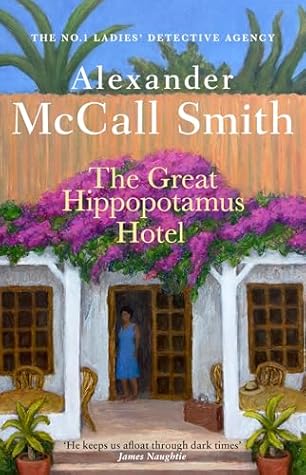
Our mystery revolves, as the title suggests, around a case of possible sabotage at The Great Hippopotamus Hotel. There’s another thread, too—as there usually is—involving Precious’s husband, Mr. J.L.B Matekoni, owner of the garage and technically, Precious’s landlord.
Those looking for an action packed thriller will always be disappointed here, because that’s not what this series is. Instead, it’s closer to being a Miss Marple-ish cozy mystery. The problem is nearly always solved, not by DNA or murder weapons or questioning baddies until they break, but by an examination of the circumstances and characters of those involved. It is here that Precious is at her finest. In addition, she must tread carefully around the feelings of her staff, primarily that of Grace Makutsi, whose insecurities tend to make her prickly. Grace is a bit threatened by Mma Potokwane, and when Precious explains gently that they will be accompanied by the orphan farm matron on an investigation, Grace says, in a serious case of look-who’s-talking:
“Mma Potokwane—yes, she is observant, but…But Mma, if Mma Potokwane has any faults—and we all have faults Mma, myself included—if she has any faults, one of them is taking over. I am not saying that she is bossy—that is not a word that I would use for Mma Potokwane—I would not say that, Mma, and I am not saying it now. No. But there are some people, I think, who might say that.”
And so, in addition to her detective work, Mma Ramotswe must navigate the small minefields that exist between these two women, both of whom are dear to her.
In some ways, the mystery aspect of these stories is almost superfluous. Every story has to have a problem and a resolution, and so it’s convenient, perhaps, to use a mystery as scaffolding for whatever problem Precious must confront. It’s certainly served Smith well. But the real benefit I see in these series is that the solutions to these problems are always dealt with as gently and as kindly as is possible. Nobody is getting thrown face down on the ground and handcuffed in these stories; every effort is made to turn the problem around while allowing the perpetrator to retain as much dignity as possible. The lyrical prose is so soothing that I love reading these stories at bedtime.
And one more word, for regular readers: the recurring character of Violet, who is the closest we have to a villain, pops up here right away, and I rolled my eyes and said, “Not this again. Smith needs new material.” But the way the character is used this time is different, and if I had a hat, I would tip it in appreciation of the author’s cleverness. He always seems to know when it’s time to break a pattern.
Highly recommended.

 Seattle Book Mama