
Martyr! by Kaveh Akbar

“’Do you worry about becoming a cliché? ‘

“’How do you mean?’

“’Another death-obsessed Iranian man?’”

My thanks go to Doubleday and NetGalley for the invitation to read and review this singular debut novel. This book is for sale now.

Our protagonist is Cyrus, an Iranian immigrant who comes to live in the U.S. as an infant. He is raised by his father, Ali; his mother’s plane was shot down shortly after Cyrus was born, an accident on the part of the U.S. military. His father dies suddenly while he is away at college, leaving him rootless. He spends a lot of time anguishing over death, wondering what is worth dying for. He doesn’t want to waste his “one good death.” Later, he points out that “If I died trying to kill a genocidal dictator tomorrow, the news wouldn’t say a leftist American made a measured and principled sacrifice for the good of his species. The news would say an Iranian terrorist attempted a state assassination. “

And you know that he’s right.

The thing that attracted me to this story is its difference from everything else that I have read. Persians almost never show up in American novels, and when they do, the Persian is the other, the bad or weird person, pretty much like the quote above suggests. So I was all in.

However, I have to say that the amount of angsty inner dialogue makes this a slooow read in places. There is also dialogue between Cyrus and friends, but most of it basically the same thing with a different format. I was primed for humor, since that’s how the book is being promoted, but didn’t find much of it.

The story wakes up a bit when Cyrus leaves Indiana for New York, but the writing remains inconsistent, and the transitions are sometimes a bit ragged.

The revelation about his mother, which occurs toward the end of the story, is startling, and I didn’t see it coming, but it also presents a credibility issue; I won’t go into details here, because it would be a spoiler. Still, apart from this one reservation, the ending is nicely rendered.

Akbar is an interesting writer, and I look forward to seeing what he writes next.
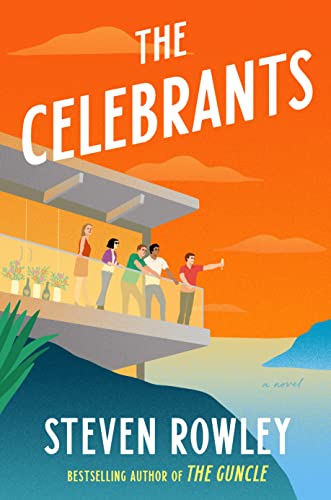
The Celebrants, by Stephen Rowley***

I enjoyed Rowley’s novel, The Guncle, which came out in 2019. When I was invited to read and review The Celebrants, I jumped at the chance. Unfortunately, it didn’t do a thing for me. Nonetheless, my thanks go to Net Galley and Putnam Books for the review copy. This book is for sale now.

As a child, we once had a bird bludgeon itself to death on our sliding glass door, unable to accept that the invisible barrier was really there. Reading this book made me feel just a bit like that bird. I’d liked Rowley’s last book. Other Rowley fans liked this book. So why…(BAM!)…why…(BAM!)…why could I not get into it?

I think it all boils down to privilege.

Had I read the premise more carefully, I might have avoided this trap. A group of seven college friends, grief-stricken after losing the eighth friend, agree to meet every few years and give each other mock funerals to celebrate the lives that still exist among them.

What rarefied conditions must exist to make such a thing possible? Imagine having the resources to be able to drop everything and fly off to wherever the meeting is held. Air fare. Childcare. Housing. But as I read the abundant dialogue in this thing, such trivialities are seldom mentioned. These are people that for the most part came from money, and they have money now, and they assume they will have as much, if not more, in the future.

Of course, the story is not about money and privilege. It’s about taking stock of their current lives and comparing them to their youthful expectations. There are secrets. There is baggage. And now, in their middle aged years, they are older, wiser, and in many ways, sadder.

Oh honey. They think they’re old now? My ass!  My children are middle aged. Get a fucking grip.

So okay, I am probably not the ideal audience; and yet, I will remind you that I didn’t volunteer for this. I was selected. Someone clearly believed that I am within the target audience.

I initially felt some of this when I began reading The Guncle. The protagonist there was a successful actor with a pile of money; and yet, the challenges he faced, first with the death of his partner, and then with the homophobic relative that tried to keep him from taking the children that had been entrusted to him, won out. The presence of well-written children helped a good deal, and the humor was completely on point. I cannot fail to appreciate an author that can make me laugh out loud.

I didn’t laugh out loud this time.  It’s grim, but it’s wealthy-people grim, not working class grim. If you don’t know the difference, then we all know which one you are.  I rolled my eyes a great deal, but it’s even harder to read when you do that, so I borrowed the audio from Seattle Bibliocommons. It didn’t help a bit, apart from making it possible to take in the book and roll my eyes at the same time.

I see that this title has been nominated for the Goodreads Choice awards, so clearly, a lot of people have loved this book. But I am not one of them.

Recommended to rich people that believe their lives to be harder than they actually are.

A Line Made By Walking, by Sara Baume***

I was gob-smacked by this author’s last book, Spill Simmer Falter Wither, and when I saw she had another book out—one set in Ireland, one of my favorite settings—I immediately requested a DRC. Thank you to Net Galley and Houghton Mifflin Harcourt for letting me read it free in exchange for this honest review. The book is for sale now.

ALineMadeByWalkingHad I no obligation to the publisher, I might be tempted to write a rare one-word review: bleak. Our protagonist is grieving the death of her beloved grandmother, and the dog died too. She’s stuck in a place she can’t get out of mentally, but since she is an artist, she takes her ennui and lets it guide her through art, and the narrative follows a pattern in which each grim thought leads her to a different art theme mentally. The story is told in the first person, and so we follow her miserable wandering thoughts from one grim topic to another, and then at some point each train of thought ends with “Works about [ fill in noun here: beds, rabbits…whatever].”

“The world is wrong, and I am too small to fix it, too self-absorbed.”

Yup.

I continued reading because it seemed to me that her earlier book started out depressing and it took some time to warm up, but then once it took off I was in love with it. I waited for this to happen here. And waited. At the 16% mark, she notes that getting drunk provides her with a “heightened sense of despair” the next day, and my notes my notes say “Fuck me.”

The protagonist tells us of an instance when she follows her very elderly landlady down a set of steps and pretends this is her usual pace also, and my notes say, “What the hell else you gonna do? Tell her to move her butt? Give her a shove to help her along?”

Each time I have one of these magic moments, I know it’s time to read something else for a while and come back to this story with fresh eyes. This is why it took me so long to read and review. Had I not bailed at 68% and peeked at the end for some sign of redemption, it would have gone even more slowly. Our protagonist has family members that want to help, but she is not interested. Instead, we notice dead animals; we notice garbage. We notice mold and other ugly things, but we can’t get up and deal with them because we are depressed and going to continue sitting here, lying here, not seeking change and wallowing.

In fairness, the word smithery here is strong in places, and I like the figurative language. However, for me the double-whammy of perpetually depressed prose followed, every now and then, by reflections about art and art history, a subject that makes my eyes glaze over, is a powerful repellent, and I am never able to engage; perhaps by now, you suspected as much.

So the third star is here because I know there are readers that have a great love of art, and if you are one of them, your experience with this novel may be completely different from mine. I wanted to tell the protagonist to take her meds and shut up, but there may be some truly redemptive aspect of the art discussion that makes the rest of it flow beautifully for art lovers.

For most readers, I can’t recommend this novel, and if you take it up anyway, put the sharps in another room and lock up your pills and firearms. Seriously. But for those with an affinity for art and art history, this book should be considered.