
Lucky Red, by Claudia Cravens*****

Larry McMurtry, eat your heart out. There’s a fine new word-slinger come to town, and her name is Claudia Cravens.
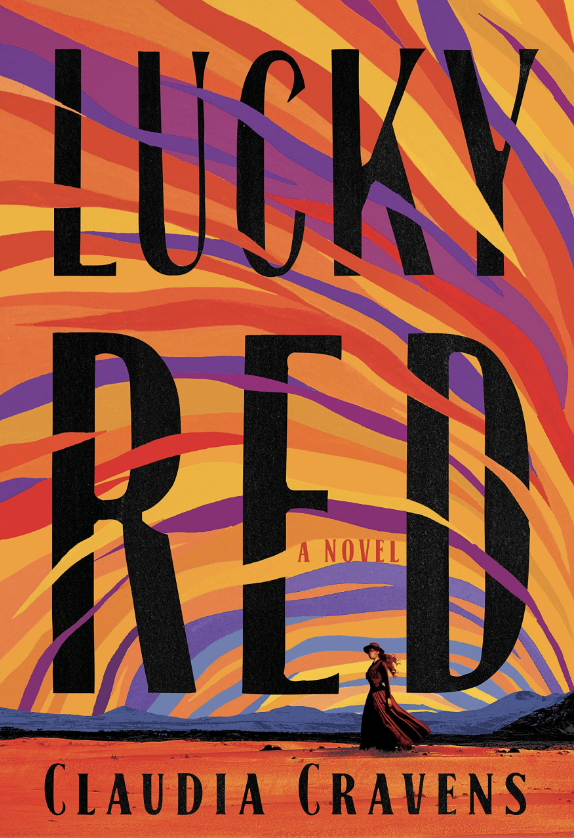
My thanks go to Random House and Net Galley for the invitation to read and review Lucky Red. This book is for sale now, and you should get it and read it.

Bridget lives a life of hardscrabble deprivation; her mother died in childbirth, and all she has is her pa. He loves her, but he’s worthless; when he finally gets a bit of money, he invariably drinks and gambles till it’s nearly gone. During one such episode, he gambles away their little house, and then buys a homestead, sight unseen and many miles away. What they find instead is a tar paper shack; there are no crops or tilled acreage, no tools or even a decent place to live. They crawl into the miserable hovel to get out of the elements, at least, and get some sleep; a rattler has the same notion, but when pa thrashes in his sleep, the rattler bites him in the neck, and then there is only teenage Bridget.

Bridget makes her way to Dodge City, and in no time, she is stone cold broke. She’s recruited to work in a brothel, the only one in town owned and run by women. She doesn’t mind the work and makes friends among the other “sporting women,” and is curiously removed from the process for which she is paid; slide prong A into slot V; moan a little, gush, and collect your pay. But later, she finds herself obsessed with a new sex worker; a lovely blonde woman named Sallie. Everyone around her understands the significance of this fascination, but Bridget herself doesn’t get it. She’s young, and she’s naïve. But when Spartan Lee, a female bounty hunter, comes to town and asks to hire Bridget, the sun shines and the angels sing.

This story is epic, and in many ways reminds me of Little Big Man, but with a female protagonist. And in many ways, what makes it so successful is its restraint. At the book’s outset, there’s a slimy man that wants to buy Bridget’s hand in marriage, which would give her father a nice chunk of change, but she hates the man, and her father doesn’t push it. A less capable writer would have done it the other way, but here, and in every instance where I predict what will happen because it’s so obvious, Cravens does something else. And the lesbian sex is brief and almost free of physical details—a sad thing for anyone looking for soft porn, but it serves to keep the story moving forward—with the emotion behind it carrying the internal narrative.

Although Bridget has no complaint about the work she does, and the management is more benign than in houses owned and run by men, Cravens keeps it real. One night, Sallie is attacked by a client, and Bridget bursts in to rescue her. It doesn’t go well. Sallie berates her for her naivete:

“You don’t see the first thing about this, though, do you. They all have a knife, Bridget. They all have a gun, and they were all born with two fists on the ends of their arms. You think you’ve got this all figured out, but any single one of ‘em could take a swipe at you some night and you’d be dead before you hit the ground.”

To tell you more would be to spoil it for you, so I’ll leave you with this: Lucky Red is the best debut novel of 2023, and one of the best books I’ve seen this year, period. Don’t miss it.

The Four Winds, by Kristin Hannah****-*****

“‘My grandfather was a Texas Ranger. He used to tell me that courage was a lie. It was just fear that you ignored.’ She looked at him. ‘Well, I’m scared.’

‘We’re all scared,’ he said.”

Kristin Hannah’s electrifying new novel, The Four Winds, is set during the Great Depression in the American Dust Bowl and California. It’s a story about courage, and about the ways that love can transform us. My thanks go to Net Galley and St. Martin’s Press for the invitation to review. It’s for sale now.

Elsa is born into a wealthy family, but this doesn’t do her much good. She is tall, ungainly, and considered homely by her parents, a contrast to her two younger, more adorable sisters. She was very ill when younger, and the family liked having her tucked away in her room so much that they would like her to remain there. When company comes over, it is suggested that she go “rest.” Affection and kindness are denied her entirely.

One day, in a fit of unheard-of rebellion, she buys herself a silk dress and sneaks out to a speakeasy. There she meets Rafe, and before long she is rolling in the hay. When the morning sickness comes upon her, her furious father drives her to the Martinelli farm, (“Italians, no less!”) and she is unceremoniously dumped there. The baby is a Martinelli, he tells them, and it—and its mother—are your problem now.

Rose and Tony Martinelli are not affluent like Elsa’s parents; she learns to haul water and do farm chores, and she learns how to make delicious, cheap food the Italian way. But her father’s abandonment is a blessing in disguise, because the Martinellis are good people. She is happy there with them. She marries Rafe, and she bears two children. But the land has been over-farmed, and soon the dust storms come and destroy nearly everything they have built:

Past the outhouse, a murky, urine-yellow haze burnished the sky. Wind picked up, barreled across the farm from the south. A board flew off the chicken coop and cracked into the side of the house. Rafe and Tony came running out of the barn. The cows mooed angrily and pushed into each other, pointing their bony butts into the dust storm.

The door opened. Rose yanked her to her feet, pulled her into the rattling, howling house.

Elsa and Rose ran from window to window, securing the newspaper and rag coverings over the glass and sills. Dust rained down from the ceilings, wafted from infinitesimal cracks in the window frames and walls. The candles on the makeshift altar blew out. Centipedes crawled out from the walls, hundreds of them, slithered across the floor, looking for somewhere to hide.

A blast of wind hit the house, so hard it seemed the roof would be torn off. And the noise. It was like a locomotive bearing down on them, engines grinding. The house shuddered as if breathing too hard; a banshee wind howled, mad as hell.

Friends, this isn’t even the climax. This is sixteen percent of the way into the story. And misery and tribulation continue to rain down on this poor little family and thousands more like them. The crops die, and the livestock that doesn’t starve is killed by breathing dust. Children, including Elsa’s little boy, fall ill with dust pneumonia; no matter how hard they try to prevent it, so much dust is in the atmosphere that it makes its way into the lungs, and so the youngest and oldest are soon in trouble.

The first half of this novel is a rough read. There’s sorrow, and suffering, and loss, and grief, and I find myself eyeing the page numbers and thinking to myself that if this were written by anybody else, and if I didn’t owe a review, I probably wouldn’t finish it, because who wants an entire story of this? But at about the halfway mark, things begin to change.

By now, Rafe has hit the bricks. Never a man of character or great resolve, he sneaks off into the night, leaving the three remaining adults to care for the children and the farm. And it is now that change takes place. Without Rafe to anchor the family as is traditional during this period, Elsa is left to make the decisions about her children’s futures, and in doing so, she changes.

Hannah portrays the Depression era American West vividly and accurately, and this is when the story grows legs. The plight of agricultural workers is likewise dealt with in clear, immediate detail. My one quibble, and it is the source of the missing half star in my rating, is her inexpert portrayal of Communism, which plays more than a passing role in the last thirty percent of the story. The first time I saw farmworkers’ struggles as “shutting down the means of production,” I cleared my throat, but I told myself it was possibly a typo that might be edited out in the finished version. The next two times I saw it, I started making notes. This is not a technical error; this is a dumb-butt error (trying to elude the censors here) that should have been caught on the first pass, and because it appears when the climax ramps up, it is a distraction that interferes with the flow of the narrative.

Nevertheless, this is a well-written novel, set during an interesting time period. Particularly arresting is the development of the relationship between Elsa and her adolescent daughter, Lareda, whose point of view is shared alternately with Elsa’s.  Setting, character, and plot work together seamlessly to enforce one another and move the story forward, yet if I had to hang my hat on one laudable aspect of this book, it would be character development.

I strongly recommend this novel to you.