Good Dirt, by Charmaine Wilkerson*****

Charmaine Wilkerson is the author of the massively successful Black Cake. Her sophomore effort, Good Dirt, carries some of the same components—an impending marriage, a family heirloom, secrets and betrayals—but is nevertheless a very different story, and it’s an even better one. My thanks go to Random House Ballantine and NetGalley for the invitation to read and review. This book will be available to the public on January 28, 2025.

Our protagonist is Ebby Freeman, which is short for Ebony. She lives with her parents in an affluent neighborhood in New England, but there was a fourth family member, her brother Baz, who was murdered during a home invasion; Ebby witnessed all of it, and has long carried the guilt of survivors. Could her ten year old self have done something to save Baz?

Now Ebby is grown, and plans to be married, but things don’t go as anticipated.

As in her previous novel, Wilkerson packs so many points of view into the story that I eventually stop counting, and although I am skeptical about this choice through much of the book, by the end I have to admit that she has carried it off nicely. Some points of view are urgently necessary to carry the plot forward; others, like that of the intended groom, Henry, are straight-up hilarious in places. Once again, we move not only between points of view, but time periods as well, reaching back into an earlier century, when some of her ancestors were enslaved. These passages aren’t entertaining, but they are necessary to provide clarity and urgency.

Ordinarily, I don’t read stories with wealthy protagonists, and make no mistake, Ebby’s family has a great deal of money; but having the family be African-American, and self-made rather than heirs to massive, often ill gained fortunes helped a great deal. Ultimately it was easy to bond with Ebby. When she experienced pain and rejection, I felt it, too. I carried her around in my head in a way that I usually don’t; over 1,000 reviews are in my rearview mirror, and only the truly special ones take hold of me as this one has.

Highly recommended.

Margo’s Got Money Troubles, by Rufi Thorpe****

Margo’s Got Money Troubles, by Rufi Thorpe, is a bold, inventive, and very funny novel about a young woman cut adrift in a difficult, expensive world. My thanks go to NetGalley and William Morrow for the invitation to read and review. This book is for sale now.

Margo is the daughter of a Hooters waitress and a former pro wrestler, an absentee father with a family of his own; her mother had been his woman on the side. Consequently, Margo has always understood that she would have to hit the ground running when she grew up, and so she’s enrolled in a junior college. When the brief affair with her English professor leaves her pregnant, she has nobody reliable to advise her. The women she confides in urge her to terminate the pregnancy, and of course, the professor does, too; yet Margo likes the idea of becoming a mother, and it’s her fetus. Nobody can make her do anything. She decides to keep it.

Her mother is about to marry a man with money and conservative values, and she sees Margo as a loose cannon that just might upset the whole ship, so she tells her to terminate or be cut off.

Wow, Mom. Really?

Margo’s roommates hadn’t agreed to share an apartment with a baby. They need to sleep! They have to get up early!

Early on, I’m rolling my eyes. Part of me is thinking that Margo is about as dumb as they come; part of me is wondering why no author in this entire world is writing—or, more likely, why no major publishing house is publishing—novels in which a young woman chooses to have an abortion and take back her body and her life. But I’m overthinking, because soon, Margo—who after all, is just young, naïve, and rudderless—admits her error. She loves her little boy, but she had no idea he would be so expensive, or that motherhood would be so difficult. She tells her father, who re-enters her life as her mother steps away,

 “’I shouldn’t have had him,’ as though some rip cord had been pulled inside her. ‘I know that, okay? Everyone told me it would ruin my life and it did. They were right, and I was stupid, and I didn’t get it. Okay? But now I’m here.’ And her father, who strangely enough becomes the most reliable adult in her life, says, ‘Yes. Now we’re here.’”

Later, Margo will comment that nothing can make a person pro-choice like having a baby.

Margo has been waiting tables, but she can’t find child care, and when she brings the baby to work, she’s fired. And the truth is, she doesn’t like leaving her baby. Then one day, while looking at her naked self in a full length mirror, she observes that she has huge boobs for the first time in her life. Men would pay to see this. She opens an account on OnlyFans.

And so this controversial choice becomes the crux of the story. Some friends reject her, and her mother has really had it with her now. But there are a lot of meaty conversations that are thought provoking, and so, even though this old lady schoolteacher reviewer is mighty uncomfortable reading about an online sex worker’s film process, there are related questions that cannot be ignored. For example, Jinx—her father—advises her against it, saying that she shouldn’t get mixed up with these kinds of girls, and she asks him, “What are ‘those kinds of girls’?” And it’s true. A man can send his dick pix out into the world any number of times and places, and whereas many will consider these gross, or obscene, which they are, how many people will condemn the guy’s entire character, his moral fiber, for having done it? So the double standard is screaming to be recognized.

Margo goes through a lot of grief, defending custody of her son when the skeevy professor resurfaces, as well as having to deal with housing crises and other problems. But the central issue lurking in the shadows is that of a young mother choosing sex work as a career.

I have to tell you quite frankly that I was way out of my comfort zone through much of this book. I am probably not part of its target audience, despite the fact that I was approached to cover it. Partway in, I considered not finishing it, but the quality of the writing is so strong that I kept going, and I’m glad I did.

The story is told from a third person omnipotent perspective, but it shifts in a surprising and funny way, and that’s all I will say about that, lest I ruin it. I wonder from time to time if we have an unreliable narrator, but this is more than that. This unusual point of view a brave choice, and I think she carries it off well.

There are a lot of worthwhile discussions that can spring from this novel; it’s fertile territory, if you’ll pardon the expression, for book clubs. It’s also being adapted for Apple TV. I recommend this book for any feminist that likes to laugh, and isn’t afraid to think outside the box.

Takes One to Know One, by Susan Isaacs****

I have loved Susan Isaacs’s work for decades, and so when I saw her newest novel up for grabs on Edelweiss, I jumped at the chance to read it. This book is for sale now.

Corie Geller is a former FBI agent. Now she is the stay-home mom of a fourteen year old stepdaughter, and the wife of a prominent judge.  She works as a scout for quality Arabic fiction. And she’s bored out of her mind.

But old habits die hard, and she can’t help noticing that a member of her regular lunch group, Pete Delaney, has habits that raise red flags. He’s too normal, almost as if he’s working at it. His appearance is forgettable, his occupation is dull…but he always sits facing the door when he goes out to lunch. He sets Corie’s professional sense a-jangling. Is Pete really this bland, or is it a front for something more sinister?

The few people that Corie confides in are sure she is jumping at shadows. She needs a job, or a hobby. Briefly I wondered whether Pete and Corie were going to fall madly in love, but then I remembered who my author is. Isaacs would never.

The one person that takes Corie’s questions seriously is her father, a retired cop who’s bored also. As she and her papa peel away Pete’s façade, they grow closer to uncovering his secrets. And Josh—Corie’s husband, whose work requires a whole lot of travel—knows nothing of any of it.

The thing that elevates Isaacs above other novelists is her feminist snark. It’s put to excellent use here. Aspects that don’t work as well for me are the detailed descriptions of upscale furnishings and other expensive possessions, and the whole Arabic literature thing, which adds nothing at all to the story and is a trifle distracting; I kept wondering when it would become relevant to the story, but then it didn’t.  But both of these are minor factors.

The reader should also know that this is not a thriller. There seems to be a trend among publicists to promote all mysteries as thrillers, and perhaps this helps sales in the short run, who knows; but it doesn’t serve the author well in the long run. Isaacs doesn’t write thrillers, she writes solid, feminist mysteries that pull the reader in with the story arc characteristic of strong fiction. When I hit the 62% mark at bedtime one evening, I understood that the next time I read it, I would have to finish it, and indeed, it was too exciting to read flopped in bed as I usually do. I had to sit up straight, and I kept finding myself leaning forward as I read, as if I might need to jump up at any minute.

I would love to see Isaacs use this protagonist in a series. I’ve missed this writer and look forward to her next book, whether it’s another Corie Geller story or something else. I recommend this book to feminist mystery readers that are ready for a chuckle or two. 

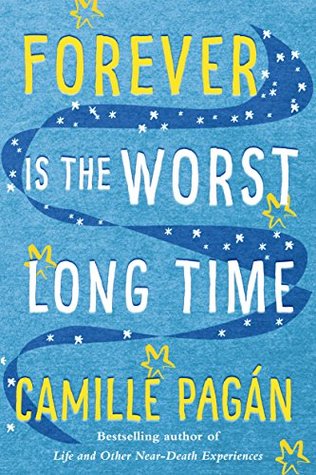
Forever is the Worst Long Time, by Camille Pagan****

 “Each story is different. Every story ends with loss.”

foreveristheworstCamille Pagan is the author Life and Other Near Death Experiences. Thank you Net Galley and Lake Union Publishing for the DRC, which I received in exchange for an honest review. This title is for sale February 7, 2017.

The story starts in the second person, with the narrator speaking to us intimately; he is James Hernandez, and soon we realize that he is speaking to a child about her mother and his memories of her. The narrative is therefore intimate in tone, but also carefully measured and paced, beginning in 1998 when James meets Lou and unspooling toward the present.  I have read oh so many novels in which alternating viewpoints are used to keep the reader’s attention from wandering, and this fresh approach had me at hello.

James is Rob’s best friend; James’s own childhood home was dysfunctional and bleak, and so Rob’s family included him on family vacations and other family-only events. They weren’t just close friends growing up; they were almost brothers. And so when James falls head over heels in love and decides to marry, the first thing he does is send for his BFF. They are introduced and James is asked to be best man at the wedding.  But in one of those blind random moments of fate, James himself falls madly in love with Lou the minute he sees her.

What would you do in a similar circumstance? Get over it and do it fast, of course. It’s just not possible. But years later, when the marriage founders and Lou walks, James can’t help himself.

There is foreshadowing in plenitude here, and the voice at the outset and at the end are what keeps those pages turning. Of course, there’s also mystery, because the speaker is telling us some things, but clearly withholding others.

If you have to like a protagonist in order to enjoy a novel, then this may not be your book. James isn’t merely flawed; in the book’s middle, he’s whiny.  I check my notes and find that in one place I wonder if Woody Allen will option the rights, and in another, I curse and request a violin. Seriously, I want to smack James upside the head and say sure, you shouldn’t have, but you did and it’s done, so man up and get over it already. But around the three-quarters mark, the whole thing takes another turn, one entirely consistent with what has gone before, and once again, it is a book I don’t want to put down till the last page is turned.

Those that enjoy fresh new fiction should consider this book even if romance is not generally a favorite genre. Pagan is an interesting writer, and now that I’ve read this, I want to go back and read the other things she’s written.  She’s already gained a lot of buzz—and a movie deal—with her first title, and I suspect she will be someone to watch in the future.

Don’t get left out.

City on Fire, by Garth Risk Hallberg*****

cityonfireLuminous, epic, and brilliantly scribed, City on Fire is the buzz book of the year. I would be hard pressed to find a story of greater genius published this century. Those that love literature have to read this book. It will be available to the public for purchase October 13.

I received my copy early from Knopf Doubleday Publishers and Net Galley in exchange for an honest review. In doing so, I feel as if I struck oil.

The story, some 992 pages of it, is a complex story, and like an onion, the reader can decide how many layers of interpretation they wish to uncover. What the reader cannot do, however, is skim, or make the story make sense without reading it in its entirety. It is the thing that makes this story great that makes it complicated, and so those that lack the stamina for a book this length will probably not find it fulfilling. A college-ready literacy level is required in order to understand it.

First, the reader will want to know who committed the act of violence that sets so many things into motion, and how the planned escalation by her friends will unfold. But ultimately, the story is a much broader one, and its genius is in the way each character, even its most peripheral ones, is developed, usually within the same space that the setting is described, and how both of these things drive the plot forward rather than slowing it down. This reviewer came away with hundreds of flagged pages, eloquent quotes, and fifty notes to myself, most of which say exactly that; in fact, eventually I was too engrossed in the story to write a full note anymore, and began using “ch dev, setting” as a shorthand that meant, look! He’s done it again! And by the 80 percent mark, the author had so consistently developed so many characters that I began to ask myself who had not yet been included. Those I watched for were also developed by the conclusion.

In looking for a writer’s purpose, it’s easy to choose one part or another of a storyline and home in on that, and it’s particularly dangerous when the writer touches upon one’s own particular fond subject, or one’s own pet peeve.

In her memoir, Amy Tan remarks upon having stumbled upon a set of Cliff Notes for her own first novel, and discovering that she had intended as metaphor or message passages that actually, she had included for the sake of telling a good story. It’s a cautionary reminder here. If we want to know the author’s purpose and we aren’t sure, we should probably just ask him.

Yet the emphasis on the city, and the development of the characters, seems to point to one thing above all else: “I see you”. For though the author includes the diverse races, genders, ethnicities, and classes that make up a great cosmopolitan city, the story isn’t really about race, and it isn’t really about being gay or straight, and it isn’t really about the entitlement that comes of great wealth and capitalism unfettered, or anarchy and cataclysmic change, or cops, or the disabled, or addiction, or any of the story’s other facets. Rather, each is a foil to show the common humanity of all.

And at a time such as this one, with our social fabric strained and our political ideas polarized, it isn’t such a bad thing, I think, to have an author come forward and say, in a way far more compelling than anyone else has managed to do for decades, that we are all of us just people, after all. All of us will grow old or sick or both, and eventually die. All of us will grieve. Most of us will be injured, and we will forgive it to the extent that we are able. And if any of that sounds trite, it is only my own failing in this review rather than the author’s work, which is breathtaking in its scope and mesmerizing in its capacity to weave so many threads and perspectives into one intricate, flawless story.
If you read one great book this year, let this be it.