
New Iberia Blues is the twenty-second addition to the Dave Robicheaux series, which I will love till the day I die. The Denver Post has called Burke “America’s best novelist,” and the Mystery Writers of America made him a Grand Master. Big thanks go to Net Galley and Simon and Schuster for the review copy. This book will be for sale January 8, 2019.
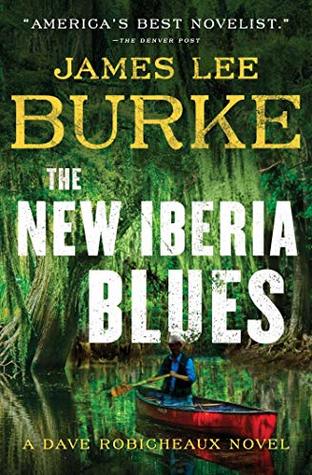
The qualities that have made Burke’s writing famous include his lyrical prose, particularly with regard to setting, and a host of memorable characters, often with quirky names. His bad guys are wealthy and often come from Hollywood to the Gulf Coast of Louisiana, where the series is set, but he often also features a character or two that works for the wrong side, but is complicated and has redeeming qualities. All of these things hold true for this novel, which is one of Burke’s best.
Dave Robicheaux is a cop in New Iberia, Louisiana, a senior citizen, thrice widowed and lonesome when our novel begins. Then an old acquaintance comes home after making it big:
Desmond Courmier’s success story was an improbable one, even among the many self-congratulatory rags-to-riches tales we tell ourselves in the ongoing saga of our green republic, one that is forever changing yet forever the same, a saga that also includes the grades of Shiloh and cinders from aboriginal villages. That is not meant to be a cynical statement. Desmond’s story was a piece of Americana, assuring us that wealth and a magical kingdom are available to the least of us, provided we do not awaken our own penchant for breaking our heroes on a medieval wheel and revising them later, safely downwind from history.
Desmond was not only born to privation, in the sleeper of a semi in which his mother tied off the umbilical cord and said goodbye forever; he was nurtured by his impoverished grandparents on the Chitimacha Indian Reservation in the back room of a general store that was hardly more than an airless shack. It stood on a dirt road amid treeless farmland where shade and a cold soda pop on the store gallery were considered luxuries, before the casino operators from Jersey arrived and, with the help of the state of Louisiana, convinced large numbers of people that vice is a virtue.
Desmond returns to the bayou in glory after hitting it big in the motion picture industry; he brings with him an unsavory character named Antoine Butterworth. While Dave is welcoming Desmond home, a terrible surprise looms into view: a boat on which a dead woman hangs on a wooden cross. It is plainly visible from Courmier’s deck, and yet he and Butterworth both deny seeing it. And with that, the story commences.
A complicating factor is that screenwriter Alafair, Dave’s daughter, has begun dating Lou Wexler, a man involved in the film Desmond is making. She is an adult woman, and her father has absolutely no authority in any of her affairs, and yet he feels as if he should. He doesn’t like Wexler, and this creates friction between himself and his daughter.
But at the same time, Dave has plenty of issues of his own. The bottle still calls to him, and sometimes he experiences a ‘dry drunk,’ in which he consumes no alcohol but exhibits many of the same poor impulses as if he had done so. Alafair tells him in exasperation, “Dave, you use a nail gun on the people who love you most.”
One aspect of this book bothers me, and I briefly considered removing a star from the rating but I couldn’t bring myself to do it. Nevertheless, the female characters in this novel, and in this entire series, need to be discussed. The very moment a young, nubile newcomer joins the force and is made Dave’s cop partner, I made a note. “Oh Christ, here we go. There’s no way she can exist and not be a romantic partner. Will she walk on the tops of his feet like his first three wives did? [yes.] Will his ears pop when they have sex? [yes.] And will he marry her and make her wife #4?” (Not telling.)
Burke has difficulty creating a female character who is not Dave’s relative and whose sexuality is not prominent or at least discussed. (His boss, Helen, is allowed to be an exception, but in every book we are told that she is a lesbian, as if business couldn’t proceed without this news.) Can we have an important female character whose sex life isn’t an issue, and can we see her developed in other respects? Of course, Burke is hardly alone in this regard, but the rest of what he writes is so outstanding that this one obvious flaw stands out like a ketchup stain on the Mona Lisa.
Having said that, I can get back to the novel’s more congenial aspects, one of which is Dave’s closest friend, Clete Purcel. Clete can’t be a cop anymore because he doesn’t honor boundaries; however, this quality, combined with his loyalty to Dave, is what makes him so engaging and entertaining. Moreover, it is he who is most effective at pulling Dave away from the bars and the bottle. I cannot think of any literary sidekick that has been better developed across any series ever than Clete. I have a mental movie that runs when I read this series, and in my mind, Dave looks like a younger version of the author, and Clete—I only just realized the other day—shows up in my head as a sunburned Rodney Dangerfield.
One other regard in which Burke consistently shines is his ability to create tragicomic side characters, and Smiley Wimple is unforgettable. Smiley is not all there, until he is. In fact, he may surface from beneath your bed. Smiley works as an assassin, but he also has standards. He needs to believe he is taking out a bad guy, or he won’t take the job. Smiley is fond of children, and he likes ice cream. Who knows? He might want to be your friend. And while I am on the subject—there’s some graphic material here, as is true for all of the books in this series; don’t count on this as meal time or bedtime reading. In fact, you may want a few extra lights turned on when you pick this one up.
Lastly, this book can be read as a stand-alone. I entered the series halfway in when I was given a free paperback copy of The Tin Roof Blowdown; you can enter the series anywhere you prefer. However, if you love a complex, literary mystery and can tolerate a fair amount of violence, you will probably like it well enough to go find the rest and read them too.
Masterfully written, and highly recommended.

 If there is a prize for courageous literature, Picoult deserves to win it. I have grown frustrated over the years as I have watched countless novelists dodge and weave to avoid the mere mention of abortion as a means to deal with an unplanned, unwanted pregnancy, and I wanted to do cartwheels when I read the teaser for this book. I thank Net Galley and Random House Ballantine for the review copy, and the author and publisher for having the integrity to go there. This book is for sale now.
 Darl Moody and Calvin Hooper have been best friends forever, and so when Darl has the worst kind of accident, he knows who to turn to. You know what they say real friends will help you bury. The body in question is Carol Brewer; Darl was hunting out of season, and when he glimpsed something moving through the woods he thought it was a wild pig. Turned out he was wrong; turned out to be Carol, poaching ginseng on Coon Coward’s land. But you can’t bring the dead back to life, and you sure can’t call the cops for something like this. Carol is Dwayne’s brother, after all. Dwayne is a huge man, half- crazy and rattlesnake mean. There are no bygones in Dwayne Brewer’s world. There is only revenge.
 Seattle Book Mama