
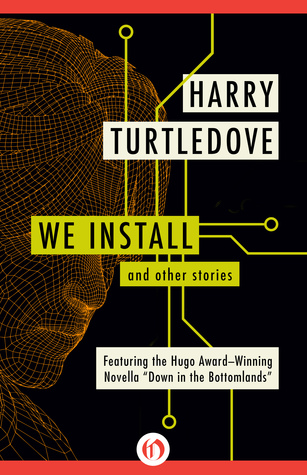
We Install and Other Stories, by Harry Turtledove ****

weinstallScience fiction is a big house with a lot of rooms. Turtledove has managed to leave his calling card in almost all of them, and includes a couple of thought-provoking essays as well. Once again, I send hearty and heart-felt thanks to Net Galley and Open Road Integrated Media for permitting me to glimpse this collection in advance, and free of charge. It goes on sale in August of this year.

I used to read more science fiction than I do now; one reason is that a big branch of it has veered into tech-speak that requires more knowledge than I possess in that field. But another reason also occurred to me as I read these stories, sometimes voraciously and at other times more tentatively, and that is that sci fi requires a flexible mind, and as we get older, our brains don’t bend as readily. Now that I know it, I will require myself to read it more frequently, because they say to use it or lose it, and I’m not ready to surrender yet. I did find that there were too many characters and relationships introduced in too little time for me to keep up with “Down in the Bottomlands”. This one won the Hugo Award, so I am fairly sure the flaw is mine rather than his. Maybe those of you that are younger and more oriented toward this genre will find it more to your taste.

However, I loved “Hoxbomb”, a thought-provoking twist on the notion of computers having intelligence of their own. And I actually laughed out loud during parts of the first selection, “Father of the Groom”, and also “Birdwitching”. The temerity of “Under St. Peters” left me nearly breathless with admiration; the guy will end up on the Banned Books list for sure if this collection sells well.

Maybe most intriguing of all is the subgenre of alternate history. Turtledove’s essay made me want to roll up my sleeves and write again. How much fun could it be?

All told, this is a meaty collection that the sci fi lover should read when it’s possible to do so. I promise you’ll have a great time, and stretch your mental muscles in the process.

California, by Edan Lepucki *****

californiaLepucki has written a powerhouse of a novel, one that resonates with the tense times in which we live. Her premise is an imagined future USA which has gone to ruin, aside from a few small enclaves for the very wealthy, where life is lovely. Resources are scarce, and attrition has claimed most of the population. Cities have caved in, with toppled power poles and roofs stoved in…she uses the word “deflated” for homes, great figurative language. In fact, her descriptive language, both for setting and character, are so palpable that this ruin-of-the-future she has built seems quite believable.

Her main character, Frida, is not entirely lovable. Most of the time, we identify with her as we should, but many times we are her unseen sister, brother, invisible friend, wanting to yell at her to do things differently, or develop a spine, or take action, or NOT take action. She isn’t the sharpest knife in the drawer, but she is entirely credible nevertheless, or maybe even because of it.

Frida and Cal have been living in a shed in the wilderness, nearly starving, nearly freezing. They are barely scraping by, just the two of them, stumbling along in the dark, when they learn of a whole community of people not too far away. But this community doesn’t want outsiders. Will they be allowed in; chased away; killed for approaching? There are spikes surrounding the area, strongly suggesting that intruders are really not welcome. But they have to try.

The story that unfurls is fascinating. I am a six-book-at-a-time reader, but once I got halfway through this one, it took up a disproportionate amount of my reading time.

The book is also available as an audiobook. By lucky circumstance I was able to get both print and audio. The reader who performs the audio version is easy to bond with and listen to, but a third of the way in I chucked the audio version because I knew I could read it a lot faster. A great big thank you goes to Net Galley for hooking me up.

Lepucki introduces half a dozen hot-button topics. When does life begin after a woman becomes pregnant? Is it responsible to give birth when there are so few resources that others must sacrifice besides the woman and her partner? When is it acceptable to deceive others? When is it acceptable to look the other way for the purpose of self-interest when one is aware of wrong-doing, perhaps of the variety that might be unstoppable anyway? What about internet privacy, personal space, and again, the individual versus society? Is human nature invariably selfish?

At times the tone is Orwellian, but the novel never turns into a soapbox to drive a particular point home. Rather, it raises questions that may leave the reader scratching his or her head long after the story ends.

And any story that makes us think more and deeper is good for all of us…individually, and as a group.