Nirvana, by J.R. Stewart****

NirvanaNew rating and review based on updated DRC:

Larissa Kenders is a musician living in a post-apocalyptic world; her lover Andrew is missing. This newly revised young adult novel is a winner, and it will be published  November 10. Thank you to Blue Moon Press, Net Galley, and Adam Mawer at DigiWriting Book Marketing Agency for including me on the second spin. It was time well spent.

The problem on Earth began when the bees began to die. How can anyone grow food, flowers, or anything else if pollen can’t be transferred? And indeed, how does pollen get from one plant to another without the bees? Corporate giant Hexagon has created an alternate world, and humans are dependent upon the company for their sustenance. Nirvana is a virtual world that workers can visit, for a hefty price, on their days off. The question Larissa has, then, is whether the Andrew she sees in Nirvana is the virtual Andrew of her memories, or whether he may in fact still be living, hiding out from those that may wish him gone.

Various topics are explored, from alienation and the question of whom to trust—one that will resonate with teenage readers—as well as environmental issues such as GMOs, and more futuristic philosophical questions. Edward Snowden comes up, and why should he not, in a story in which many researchers have uploaded their brains to the Cloud so that their work will remain once they are gone?

I was one of a handful of reviewers that read the first draft of this book. I reported that it was dreadful because it lacked character development. This new and vastly improved version creates a Larissa Kenders that is believable, a character to whom we can bond. The remaining stereotypes, such as the jealous female that is our main villain, along with the preponderance of males rather than the usual fifty percent of the population, are problems that are so rife within the genres of science fiction and fantasy that it’s hard to hang the whole problem on this one writer, who has created a truly original and interesting plot .

Teachers considering its classroom use should be forewarned that there are a couple of sexual situations; the porn industry, a pet project of one of the villains, also gets multiple mentions. I should emphasize that this reviewer sees no problem with today’s teenagers reading the book, since most of them have seen far more explicit material on their own. But those that teach in school districts so conservative that the villagers bring everything but flaming torches to the school board meeting may want the information ahead of time prior to going out of pocket for a classroom set.

In revising his story, Stewart has plucked victory from the ashes; a job well done.
 

The Peace Process, by Bruce Jay Friedman ****

thepeaceprocessThe Peace Process is actually a collection of short stories plus one novella at the end. The writing is edgy all the way through and in a number of places it’s very, very funny. Thank you to Net Galley and Open Road Integrated Media for providing me with a DRC to read in advance. This collection will be available to the public October 13.

If any work of fiction you have read in the past five years or so has offended you in any way, the first selection in this collection is guaranteed to do so. It did me. Frankly, I am such a consistently fast, thorough reviewer that I could blow one off right now if I was disturbed enough by it, and I came pretty close. I don’t like to spoil things, but at the same time you ought to be warned. Is incest—even imagined incest, and with details—offensive to you? Is there a way to make a boy’s graphically imagined incest with an older sister acceptable, even funny? If so, then this is your collection. As for me, I almost wrote to the publishers to tell them that I wasn’t reading or reviewing one more story in this nasty little book; fortunately for me, I looked at the table of contents, figured out how much more of the book there was left to read, and decided to stick with it for one more story. And the next story, “The Storyteller”, was funny enough that I forgot—well, almost forgot–how mad I’d been a few minutes before.

But I seriously question the editor’s choice to put that one dreadful story right up front. It’s almost like begging the reader to throw the book out the window.

Moving on, the writing in all the other stories, from the second on through the last, is really strong. My imaginary red teacher’s pen sometimes comes out when I’m reading a galley, and I’ll think how much better the work would be if we could just nip this part here and take a meat-axe to another section. Not so for Friedman. Every word is well chosen, and the pacing is taut and brisk. Besides “The Storyteller”, my other favorites were “The Choice” and “The Strainer”. The endings always surprised me, and a couple of times, had I not had someone sleeping beside me as I read, I would have moaned aloud when I reached the denouement.

If I were to advise someone with tastes like my own as to whether to read the collection or leave it go, I would say get the book; skip the first story; read the rest of it. But then, you have to decide these things for yourself. I’ve done what I can, and the rest is up to you.

For fans of edgy, dark fiction, recommended with the caveat mentioned.

World War Moo, by Michael Logan****

“Where there’s war, there’s udder destruction.” Michael Logan’s new release, World War Moo, is the sequel to Apocalypse Cow. Mix the zombie apocalypse with mad cow disease, toss in some technology, then ask the spirits of Terry Pratchett and Monty Python to hop into the cauldron. What follows is a deeply mooooving story that is bound to amuse. Many thanks go to Net Galley and St. Martin’s Press for allowing me a glimpse in advance.

worldwarmooHow does one contain the deadly infection that has taken over the British Isles, and why are some people inexplicably immune to it? The world appears to have gone stark raving mad, or at least, part of it has. Trade among nations has been obliterated, and famine is rampant. Inflation is out of control, and when you find yourself spending a thousand pounds for a rat kebab, it’s pretty clear that simply surviving ought to be the order of the day.

Not so for young Geldof. His Grandfather Carstairs, the evil genius who twiddles his moustache to prove his inner nature, has appeared and told him that his mother is alive and in danger. Fanny must be rescued from Britain before the bombs fall; there’s even talk of dropping neutron bombs. Grandfather Carstairs has come to help Geldof, not because of any depth of affection, but because he needs an heir to take over his evil empire. He has to find out whether Geldof is “man enough” to do the job.

In addition to being entertained, I greatly appreciated Logan’s metaphorical explanation of the difference between male and female brains. In fact, much of the book is composed of hilarious metaphors and similes. English teachers’ paradise meets the zombie cow apocalypse: the stuff of which dreams are made.

This absurd story, second in its series, was released yesterday. Better get going before they’re all gone!

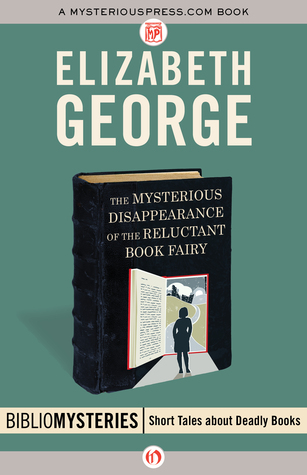
The Mysterious Disappearance of the Reluctant Book Fairy, by Elizabeth George ***

the mysteriousbookfairyJanet Shore is the book fairy, a librarian gifted with the supernatural ability to send another person into literature in a literal fashion. She sends them in to enjoy a specific episode, guesses at the time it will take for the event to unfold, and then brings them back. This 75 page long story is interesting, but was mislabeled as a mystery, which is the author’s principal genre; it’s really more a fantasy story. I was waiting for the mystery until toward the end, when I realized there really wasn’t one, apart perhaps from final moment, and even then, it isn’t a mystery to us. And where are my manners? Thank you to Net Galley and Open Road Integrated Media for allowing me a glimpse in advance. This story goes up for sale digitally June 16.
All is going well as long as Janet’s supernatural power is kept under wraps. Just she and a friend know. Then another person finds out and persuades Janet to come out of her book-fairy closet and advertise her services. She could “make a mint”. Janet is aghast at the vulgar implication, but the acquaintance persists. She needn’t keep the funds for her own use, she tells Janet; think of the causes she could help! So many deserving charities could benefit, all while making so many people’s—let’s face it, women’s—fantasies into the vacation of a lifetime.
But it’s too much. Tiny Whidbey Island (located off the shore of Washington State) can’t sustain this level of traffic. The locals are at first pleased at the amount of custom, then dismayed at the disruption. No one can buy anything without standing in a very long line. Their favorite quiet spots are now very noisy, busy spots.
On top of all of that, Janet is about to give out. She is exhausted, and still they clamor for more.
The voice with which this story is told is so different from the Thomas Lynley series (which I adore) that at first, I thought I had inadvertently picked up something by one of the other authors of the same name. But then, it’s set on Whidbey, where the Thomas-Lynley-George lives, and she even slips in a sly reference to Havers when discussing excellent literature. So yes, it is she.
Other reviewers thus far have been more enthusiastic about this piece if they are unfamiliar with, or don’t like, the Lynley series. For me, it took a long time to really engage. There are no chapters at all; it is just one long story, a little long for a short story, but maybe too short for a novella. I would have liked it organized, and I might also have enjoyed it more had it been told in something other than the third person. There’s too much narrative, too little dialogue.
In the end, though, I found it charming. It just took me awhile to climb on board. I was looking for a mysterious disappearance, and in this case, the surprise element, which I eventually saw coming, was a little disappointing. There’s no mystery to unravel, no detective in the mix.
In short, for those who enjoy fantasy stories, this is a winner, and it should be billed as fantasy, not mystery.